
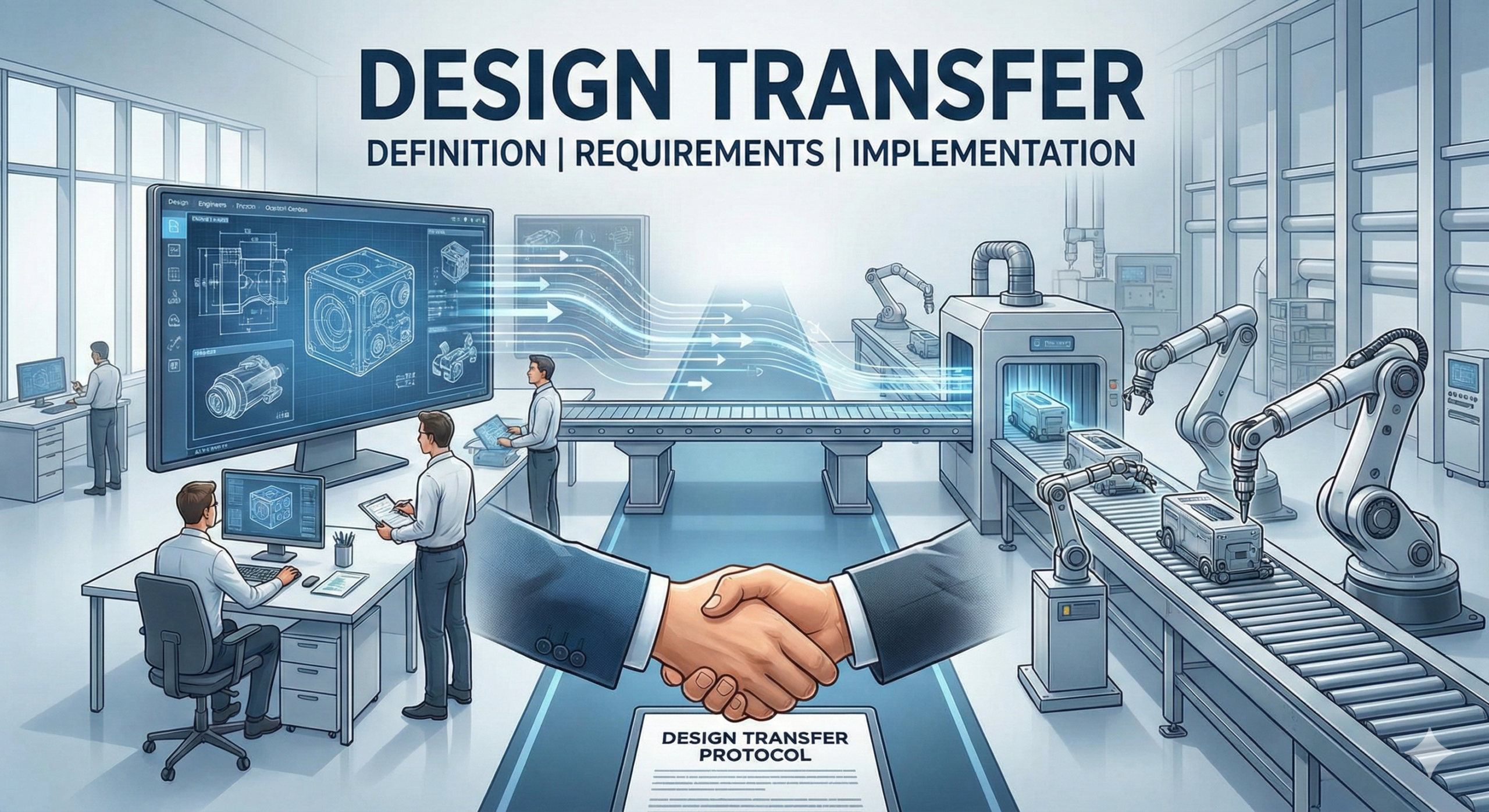
Design Transfer: Definition, Requirements, and Implementation
Regulatory Background
ISO 13485:2016 explicitly incorporates “Design and Development Transfer” as a mandatory requirement. Meanwhile, the U.S. Food and Drug Administration (FDA) has required design transfer since the inception of the Quality System Regulation (QSR) in 1996, establishing this as a global regulatory standard.
ISO 13485:2016 explicitly incorporates “Design and Development Transfer” as a mandatory requirement. Meanwhile, the U.S. Food and Drug Administration …
The Dual Purpose of Medical Device Design
Medical device design processes serve two critical purposes. First, design enables the submission of a medical device to regulatory authorities for approval or clearance. Second, and equally important, design establishes the foundation for manufacturing the device. This article focuses on the second objective and provides a comprehensive explanation of design transfer.
Distinguishing Production Scale-Up from Design Transfer
All manufacturing industries, not limited to medical devices, initiate the transition to mass production at certain stages of the design process. For components and semi-finished products with long lead times, early transition to the manufacturing facility is essential to meet production schedules. Additionally, process design must be established to ensure consistent quality and efficient manufacturing at scale. For medical devices, process design includes equipment qualification (such as Installation Qualification [IQ] and Operational Qualification [OQ]) and process validation for special processes, as mandated by regulatory requirements.
However, a critical distinction must be emphasized: production scale-up and design transfer are not synonymous. Production scale-up is a component of design transfer, but design transfer encompasses a broader scope. Design transfer includes the entire spectrum of technical transition from the design department to the manufacturing operations, extending beyond the simple transfer of information to the production line.
FDA Requirements for Design Transfer
The FDA Quality System Regulation defines design transfer as follows: “Each manufacturer shall ensure that the device design is accurately translated into production specifications” (21 CFR § 820.30(j)).
In practical terms, outputs from the design process—including drawings, manufacturing specifications, inspection specifications, and risk analysis records—that are necessary for manufacturing must be accurately transcribed into the Device Master Record (DMR). The DMR is analogous to Japan’s “Product Standard Specification.” This transcription must be confirmed and verified with documented evidence.
The most critical aspect of design transfer is establishing documented evidence that accurate transcription has been performed. This is not merely a matter of information handoff; rather, it underscores the fundamental importance of traceability and documentation in regulated medical device manufacturing.
Challenges in Incremental Technology Transfer
When technology transfer from design to manufacturing occurs incrementally (sometimes referred to as “incremental or staggered” transfer), there is a risk that updates to manufacturing specifications may be overlooked when design specifications change during the transition process.
What the FDA requires in design transfer is that, upon final completion of the transfer (specifically after design verification is concluded), the entire set of design outputs be compared systematically with the DMR to ensure complete consistency and absence of discrepancies. This comparative review must be documented. Furthermore, the DMR that has been verified for accuracy must be registered in the Design History File (DHF). When feasible, conducting a Design Review, particularly a Design Transfer Review, following the completion of design transfer is recommended best practice.
Selective Translation of Design Outputs to the DMR
It is important to note that not all design process outputs are transcribed into the DMR. The design process generates various deliverables, some of which are not directly required for manufacturing. Examples include detailed verification reports, software source code, and comprehensive risk analysis records. These items are retained in the DHF for traceability and regulatory compliance but are not incorporated into the DMR itself.
Conversely, the DMR cannot be completed through design transfer alone. The DMR must also include deliverables typically generated by the manufacturing engineering department, such as process validation procedures, equipment qualification procedures, equipment maintenance procedures, and calibration procedures. In essence, the DMR represents an integrated document system that consolidates outputs from both the design department and the manufacturing engineering department, encompassing all information necessary for the manufacture of the medical device.
Ongoing Management of Design Changes and Design Transfer
Design changes may occur following the initial design transfer. Since medical devices are fundamentally designed for manufacturing, design changes and manufacturing changes are inherently interconnected. Viewing them as integral to the same process clarifies the required management approach.
Each design change necessitates corresponding design transfer activities—a partial re-transfer—to maintain current and accurate DMRs. The updated DMR must then be registered in the DHF. This ongoing management is critical not only for regulatory compliance but also from a practical manufacturing and risk management perspective. For instance, if a medical device distributed three years ago generates a market complaint, the original accurate manufacturing specifications from that period must be retrievable and reviewable to identify the root cause. Maintaining traceability of the DMR across time is essential for preserving product safety and effectiveness and enabling appropriate responses to regulatory inquiries.
Additionally, design change management—typically formalized through Engineering Change Notices (ECN) or change control processes—is more than a simple update to design documents. It must include a systematic evaluation of the change’s impact on other design elements, risk management outcomes, process validation status, and regulatory submissions. Only after this impact assessment and formal approval should the corresponding design transfer activity be executed.
International Regulatory Alignment
The European Union’s Medical Device Regulation (MDR) similarly mandates accurate transfer of design outputs to manufacturing documents, with full documentation of this process (MDR Annex I, Section 4.3). Additionally, coordination with ISO 14971 (Risk Management) is essential; during design transfer, consistency between design outputs and the risk management file must be verified.
Design transfer transcends administrative requirement; it represents a fundamental process for ensuring medical device safety and effectiveness while enabling appropriate quality management in manufacturing operations. Understanding and properly implementing design transfer is vital for regulatory compliance, product quality assurance, and ultimate patient safety.
Related Articles
- Understanding Labeling Definitions in the United States: Navigating FDC Act, QSR, and QMSR Requirements
- Process Validation: Requirements and Implementation Conditions
- China IVD Manufacturing Validation Requirements: Comprehensive Guide for 2026 New GMP Implementation
- The Relationship Between URS (User Requirements Specification) and PQ (Performance Qualification)
- Understanding Data Retention Requirements in Pharmaceutical Regulations
- Challenges in Electronic Record Retention Requirements: Maintaining Authenticity During Long-term Preservation and System Migration

Comment