

Following an FDA Inspection
Introduction
The author recently accompanied a medical device manufacturer through an FDA inspection this month. The result was NAI (No Action Indicated), meaning no FDA Form 483 was issued. While the favorable outcome was certainly due to meticulous preparation and careful planning, that was not the only contributing factor. This was the manufacturer’s first FDA inspection. During initial inspections, Level II inspections (comprehensive inspections) are typically conducted, with the primary objective being the creation of the company’s database within the FDA system. Consequently, significant findings are generally not common at this stage.
The author recently accompanied a medical device manufacturer through an FDA inspection this month. The result was NAI (No Action Indicated), meaning …
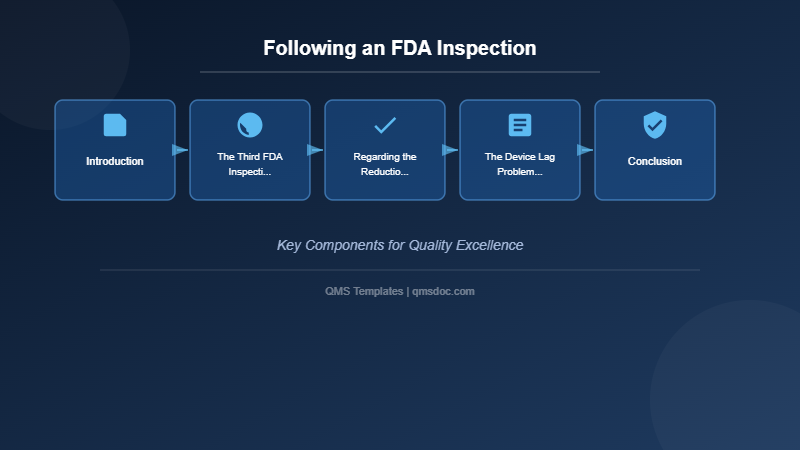
The Third FDA Inspection as the Critical Test
It is often said that the third FDA inspection represents the critical turning point. As mentioned above, the first and second inspections are comprehensive inspections (Level II), with the establishment of manufacturing facility databases as the primary objective. The FDA’s Investigation Operations Manual explicitly states that when two consecutive NAI inspections occur, the assignment of the inspection officer for the third inspection should be reconsidered.
The manual specifically states: “In order to facilitate on-the-job training, multiple points of view, and perspectives of firms being inspected whenever practical, those with assignment authority should consider assigning different Investigator/s or different Lead Investigators at different times. This is recommended particularly when there have been multiple sequential NAI inspections or when the firm’s management has been uncooperative.”
This provision functions as an important mechanism to ensure fairness and transparency in FDA inspections. When inspections are conducted by the same investigator consecutively, there is a risk of becoming unconsciously constrained by certain standards and interpretations. By deploying investigators with different perspectives and experience, the FDA seeks to achieve more multifaceted and rigorous auditing.
Regarding the Reduction in FDA Form 483 Issuances
When the Democratic administration (Obama administration) took office in the United States in 2009, FDA inspections became increasingly stringent both domestically and internationally. The number of warning letters issued also doubled. However, after the transition to the Republican administration (Trump administration), the number of FDA Form 483s and warning letters issued dropped dramatically. In 2017, the total number of warning letters issued both domestically and internationally was merely 42. Since the FDA Commissioner is appointed by the President, FDA policy changes when the administration changes.
However, this is not the only reason. While the FDA has issued numerous FDA Form 483s (findings) in the past, industry dissatisfaction and loss of confidence regarding these findings have been cited as contributing factors. Successive criticism has emerged from industry associations and medical device manufacturers regarding the transparency and consistency of inspection finding criteria. The FDA has consequently recognized the need to build a relationship of trust with industry. Against this backdrop, there exists a viewpoint that excessive findings have impeded the development and market entry of innovative medical devices.
When examining more recent data from 2023 to 2024, the FDA’s inspection policy has become increasingly flexible, with enhanced emphasis on a risk-based approach. In particular, inspections of medical devices utilizing artificial intelligence (AI) and machine learning (ML) have expanded guidance beyond traditional quality management systems (QMS) to include algorithm validation and continuous learning considerations.
The Device Lag Problem in the U.S. Market
Beyond findings in FDA inspections, industry dissatisfaction has accumulated regarding the time required for 510(k) clearance. Originally, in the European Union, medical device market entry was achieved solely through notified body review, representing a significant difference from the U.S. regulatory system.
However, the European Union’s medical device regulatory landscape has changed substantially from 2023 to 2024. The full implementation of the In Vitro Diagnostic Regulation (IVDR) resulted in significantly strengthened regulatory requirements for IVD medical devices. Prior to IVDR implementation, many IVD products achieved market entry through simplified conformity assessments by notified bodies. Currently, more advanced risk classifications require rigorous technical scrutiny by notified bodies. In particular, requirements for Performance Evaluation (PE) and Clinical Evidence (CE) for in vitro diagnostic medical devices have been substantially strengthened, and practical regulatory rigor now equivalent to FDA 510(k) review is demanded.
In other words, the previous simplistic logic that “EU regulation is more lenient” is no longer applicable. Under IVDR, medical devices classified in Annex II and Annex III are now mandatory subjects of rigorous notified body review, with assessment periods often extending from 12 to 18 months.
Simultaneously, the United States has advanced modernization of the 510(k) clearance process. The FDA has pursued the development of more efficient and predictable review systems, expanding acceptance of De Novo applications and implementing a Total Product Life Cycle (TPLC) approach. Furthermore, enriched guidance on AI/ML medical devices has resulted in clarified review standards and shortened review timelines.
As a result, the regulatory timing differential between the United States and Europe (the so-called device lag) has become less pronounced than previously. Rather, the company’s adaptive capacity, the maturity of its regulatory response infrastructure, and its commercialization strategy have emerged as critical determinants of ultimate market entry timing. Companies that simultaneously advance IVDR compliance and FDA 510(k) compliance while proactively monitoring global regulatory trends ultimately achieve optimal market entry timing.
Conclusion
The case presented in this article exemplifies successful achievement of NAI in an initial FDA inspection. This demonstrates both the maturity of the company’s regulatory compliance infrastructure and its ability to communicate effectively with regulatory authorities. The background to the FDA’s reduced frequency of issuing findings is not solely attributable to changes in administration but also reflects trust-building with industry and advances in regulatory science.
Meanwhile, the global regulatory environment has become increasingly complex, with simultaneous compliance with multiple regulatory frameworks—including the EU IVDR, MDSAP, and PMDA review—now essential. Achieving resolution of device lag and timely market entry into global markets requires not merely enhanced inspection preparation but rather strategic regulatory science knowledge, deep understanding of industry standards (ISO 13485, IEC 62304, IEC 62366-1, and others), and continuous attention to regional regulatory guidance.
Related Articles
- Understanding Quality Control (QC) in Pharmaceutical Manufacturing: Beyond Inspection to Process Excellence
- The Commencement of ER/ES Inspections by Regulatory Authorities: Historical Context and Current Practices
- Understanding Part 11 in FDA Inspections: Key Considerations for Pharmaceutical and Medical Device Companies
- Have Part 11 Inspections Disappeared? Understanding Current Regulatory Trends
- FDA Inspection Response and the “15-Minute Rule” (Revised Edition)
- Regulatory Expectations for Self Inspection and Data Integrity

Comment