
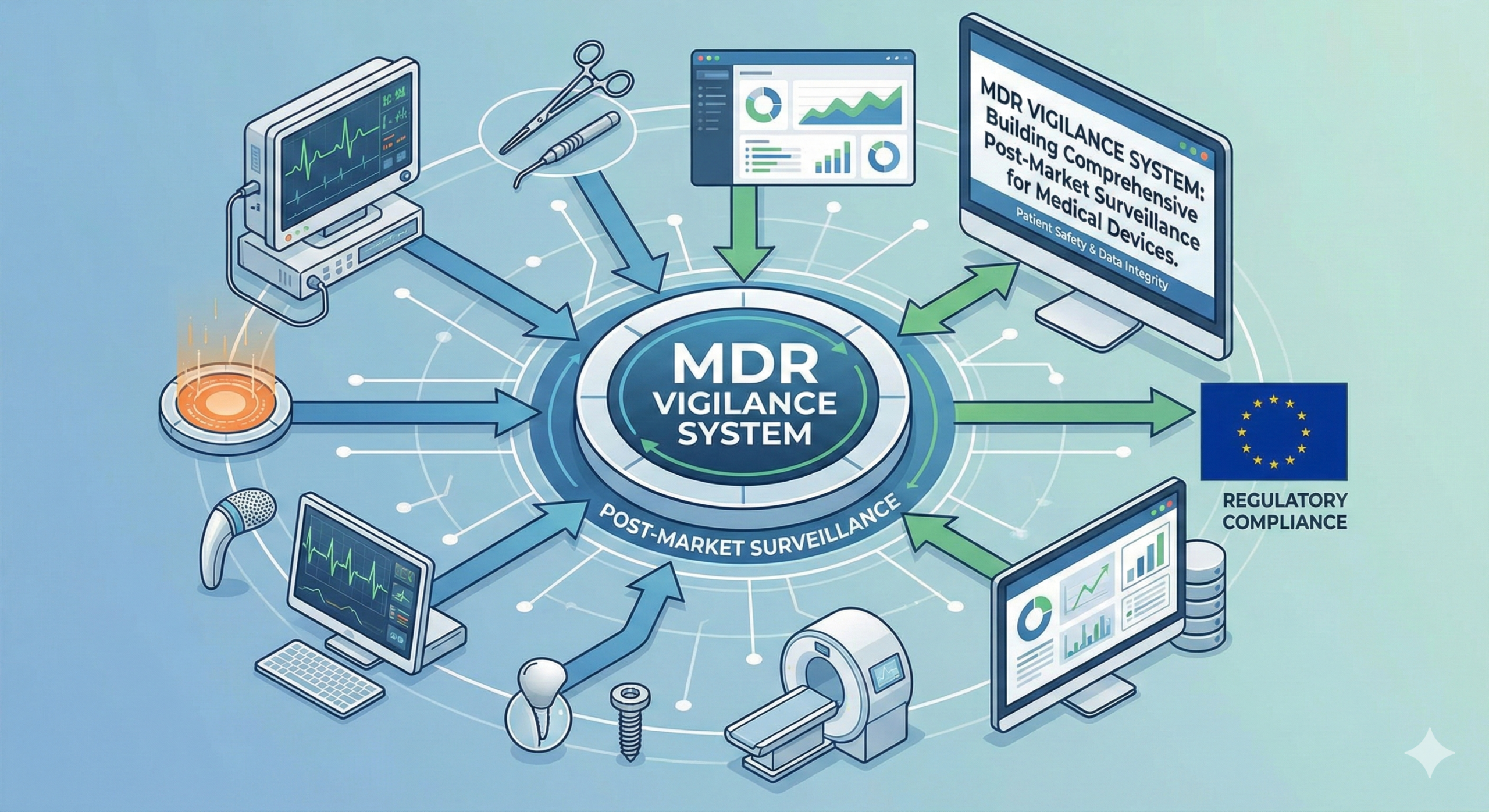
MDR Vigilance System: Building Comprehensive Post-Market Surveillance for Medical Devices
Historical Background: From MDD to MDR
The transition from the Medical Device Directive (MDD) to the Medical Device Regulation (MDR) represents a fundamental shift in European medical device regulatory philosophy. Originally scheduled for full implementation on May 26, 2021, the EU Medical Device Regulation (EU 2017/745) marked the end of nearly two decades of regulation under the MDD, which had been in effect since 1998. This regulatory evolution was driven by a watershed moment in device safety—the PIP breast implant scandal—that exposed critical gaps in traceability and post-market surveillance systems.
The transition from the Medical Device Directive (MDD) to the Medical Device Regulation (MDR) represents a fundamental shift in European medical devic…
The PIP Scandal: A Catalyst for Regulatory Reform
The PIP (Poly Implant Prothèse) breast implant scandal of 2009-2010 serves as a seminal case study in medical device regulation. The French manufacturer PIP produced breast implants with exceptionally high rupture rates—approximately 30 percent compared to industry standards of less than 2 percent. Most troublingly, PIP deliberately substituted industrial-grade silicone, intended for non-biocompatible applications such as mattress fillings, for the medical-grade silicone required for implantable devices. This cost-cutting measure resulted in hundreds of thousands of implanted devices with compromised biocompatibility.
The public health consequences were severe. Women with ruptured PIP implants experienced not only physical complications from the device failures but also potential systemic health effects from chronic exposure to non-biocompatible materials. Deaths were documented, and numerous cases of serious illness were reported. Critically, authorities discovered that approximately 16,000 women with PIP implants could not be reliably traced through existing registry systems. This traceability failure meant that post-market surveillance efforts, device recalls, and patient follow-up were significantly hampered.
The regulatory response was equally significant. Not only was PIP held criminally liable, but the Notified Body that had approved the PIP device was also found culpable and faced substantial penalties. This dual accountability reflected the recognition that oversight gaps extended throughout the regulatory ecosystem, not merely to the manufacturer.
From MDD to MDR: Key Regulatory Enhancements
The PIP scandal catalyzed a comprehensive regulatory overhaul. The MDR, adopted in April 2017 and fully implemented on May 26, 2021, introduced the world’s most stringent medical device regulatory requirements. Several provisions directly address the deficiencies exposed by the PIP incident.
Traceability and Unique Device Identification (UDI)
The MDR mandates comprehensive traceability across all medical device classes through the implementation of Unique Device Identification (UDI). This represents a paradigm shift; under the MDD, traceability requirements were applied inconsistently, with implantable devices receiving greater scrutiny but still falling short of systematic tracking.
Under MDR, manufacturers must implement UDI systems that enable the tracking of devices from manufacturing through distribution to patient implantation. For implantable devices—the category most affected by the PIP scandal—the regulation requires the issuance of an implant card to the patient, documenting the specific device implanted. This serves multiple functions: it enables rapid identification should a safety issue arise; it facilitates patient notification in case of recalls; and it supports long-term epidemiological tracking.
The UDI itself consists of a Unique Device Identifier (the identifier for the specific product) and a Unit Identifier (which may include serial number and/or lot/batch number). These must be displayed in both human-readable and machine-readable (barcode or RFID) formats. For implantable devices, the minimum requirement is the human-readable format on the implant card.
Integration with the European Regulatory Database (EUDAMED)
The MDR introduced the European Regulatory Database for Medical Devices (EUDAMED), a centralized electronic system designed to manage device information, clinical investigations, post-market surveillance, and vigilance data. All UDI data must be registered in EUDAMED, creating a comprehensive, electronic repository accessible to regulatory authorities, healthcare providers, and potentially patients.
This represents a dramatic expansion compared to the largely paper-based or fragmented systems under the MDD. The integration of UDI data with vigilance reporting creates a unified system where safety signals can be cross-referenced against device identification and distribution data, enabling rapid detection of potential safety issues across the entire European market.
The Vigilance System: Post-Market Surveillance and Field Safety Actions
Definition and Scope
The vigilance system represents the cornerstone of MDR post-market surveillance. It is a structured, mandatory procedure through which manufacturers, distributors, importers, and authorized representatives report to competent authorities any incident that has caused or may have caused serious harm to public health. This is substantially more expansive than the adverse event reporting systems familiar to manufacturers regulated under 21 CFR Part 803 (FDA MDR/MedWatch system) in the United States.
In pharmacovigilance (drug safety), European regulatory systems have long been recognized as among the world’s most rigorous. The MDR essentially applies an equivalent pharmacovigilance paradigm to medical devices, recognizing that device safety monitoring must achieve parity with pharmaceutical safety monitoring.
Vigilance Reporting Requirements
Manufacturers must establish systematic procedures for collecting, evaluating, and reporting information about adverse events, including serious adverse events (SAEs) and Field Safety Corrective Actions (FSCA). The reporting obligations are triggered when a manufacturer becomes aware—or reasonably should become aware—of any serious adverse event associated with the device, including:
- Deaths attributable to device failure or malfunction
- Serious deterioration of the condition of a patient
- Temporary or permanent impairment of body function or damage to body structure
- Necessity for medical intervention to prevent permanent damage
- Device failure or malfunction likely to cause one of the above outcomes
Importantly, the MDR introduces the concept of “reasonably should become aware,” establishing that manufacturers have affirmative obligations to actively monitor for safety information, not merely to respond to reports that come directly to them.
Field Safety Corrective Action (FSCA)
When a device poses an actual or potential safety risk, manufacturers must initiate a Field Safety Corrective Action. An FSCA may include device recall, retrofit, repair, replacement, or destruction; temporary or permanent removal from use; or provision of supplementary information. FSCA procedures must be documented and implemented within defined timelines that reflect the severity of the risk.
For implantable devices—which posed such challenges in the PIP scenario—the FSCA process is particularly complex because it may require individual notification to healthcare providers and patients who have already undergone implantation. Manufacturers must establish tracking systems capable of identifying all patients who received a recalled or modified implant, using the UDI and implant card data registered in EUDAMED.
Post-Market Surveillance Planning and Execution
Beyond reactive vigilance reporting, the MDR requires manufacturers to develop comprehensive Post-Market Surveillance Plans (PMSPs) for higher-risk devices. These plans must systematically collect and analyze information about device performance and safety, establish mechanisms for continuous monitoring, and define processes for detecting and evaluating emerging safety trends.
The PMSP transforms post-market surveillance from incident-driven reporting into a proactive, data-driven process. Manufacturers must analyze trends, identify potential safety signals, and communicate findings to regulatory authorities. This approach reflects lessons learned from the PIP scandal, where fragmented reporting and the absence of systematic trend analysis delayed recognition of the problem.
Organizational and Supply Chain Responsibilities
The Competent European Representative
One of the most significant distinctions between the MDR and regulations in other major markets (particularly the United States) is the role of the European Representative. This legal representative bears substantial responsibility for MDR compliance on behalf of the manufacturer.
The European Representative must be established within the EU and must be legally authorized to represent the manufacturer. Critically, the European Representative bears responsibility for ensuring compliance with MDR obligations, including quality management systems, technical documentation, post-market surveillance, and vigilance reporting. Unlike the United States Authorized Representative role (which is often limited to regulatory correspondence and document receipt), the European Representative has substantive operational and legal responsibilities.
For vigilance, the European Representative serves as the primary point of contact with regulatory authorities regarding adverse event reporting. The Representative must receive vigilance reports, evaluate them, and submit them to appropriate authorities. Should non-compliance with MDR requirements be discovered, the European Representative may face regulatory action.
Expanded Supply Chain Accountability
The MDR fundamentally restructures accountability throughout the medical device supply chain. Manufacturers remain primarily responsible for quality and safety, but the regulation explicitly defines and allocates responsibilities among manufacturers, authorized representatives, importers, distributors, and other parties in the supply chain.
Each party in the supply chain must comply with MDR requirements applicable to their role. An importer, for example, must verify that a device is accompanied by the required documentation, maintain records of the supply chain, and cooperate with manufacturers in post-market surveillance activities. Distributors must ensure that devices remain in proper condition and maintain traceability information.
This contrasts with the MDD era, when accountability was sometimes ambiguous, particularly regarding the responsibilities of importers and distributors in non-EU countries. The MDR establishes clear, enforceable expectations for all parties involved in placing devices on the European market.
Regulatory Dynamics and Implementation Realities
The ten-year transition period from MDD to MDR (2013-2021) allowed manufacturers time to restructure quality systems, implement UDI systems, and establish European Representatives. However, implementation has proven complex, and many manufacturers—particularly small and medium-sized enterprises—have required extended implementation timelines and compliance support.
The gradual phase-in of certain requirements and the availability of extension provisions for specific device categories reflect pragmatic recognition of implementation challenges. Nonetheless, by May 26, 2024, full compliance was mandatory for virtually all medical devices. The European Commission and Notified Bodies have emphasized that compliance deadlines are firm, and non-compliant devices may not be legally supplied in the EU.
Strategic Implications for Global Manufacturers
For medical device manufacturers exporting to Europe, the MDR represents a significant investment in quality infrastructure, traceability systems, and post-market surveillance capabilities. These investments, while substantial, should be viewed as investments in business resilience and risk management.
Manufacturers that implement robust vigilance systems and traceability infrastructure not only achieve regulatory compliance but also build foundational capabilities that support global operations. A comprehensive post-market surveillance system—including systematic adverse event collection, trend analysis, FSCA procedures, and supply chain coordination—provides early detection of safety issues before they escalate into public health crises comparable to the PIP scandal.
The most successful approach involves establishing systems at the earliest stages of product development and market launch. Collaboration among manufacturers, authorized representatives, importers, distributors, and regulatory authorities—enabled by the EUDAMED database and strengthened by explicit supply chain accountability—creates an integrated ecosystem designed to ensure device safety throughout the product lifecycle.
Conclusion
The evolution from MDD to MDR, catalyzed by the PIP breast implant scandal, represents a fundamental maturation of European medical device regulation. The introduction of comprehensive UDI-based traceability, the EUDAMED database, expanded vigilance requirements, and clarified supply chain accountability collectively address the critical gaps exposed by the PIP incident.
For manufacturers, establishing robust vigilance systems and coordinating with European Representatives, importers, and distributors is not a compliance checkbox but an investment in patient safety and business sustainability. The regulatory framework is demanding, but it reflects the serious responsibility that medical device manufacturers bear for patient welfare.
Related Articles
- Differences Between Pharmaceuticals and Medical Devices
- Understanding Quality Systems in Pharmaceutical and Medical Device Industries
- The Importance of Design Control in Medical Devices
- The Strategic Benefits of Supplier Audits: Building Auditor Competence Through Comprehensive Experience
- Understanding Risk in Pharmaceuticals and Medical Devices
- FDA Finalizes Comprehensive Guidance on Electronic Systems, Electronic Records, and Electronic Signatures in Clinical Investigations

Comment