
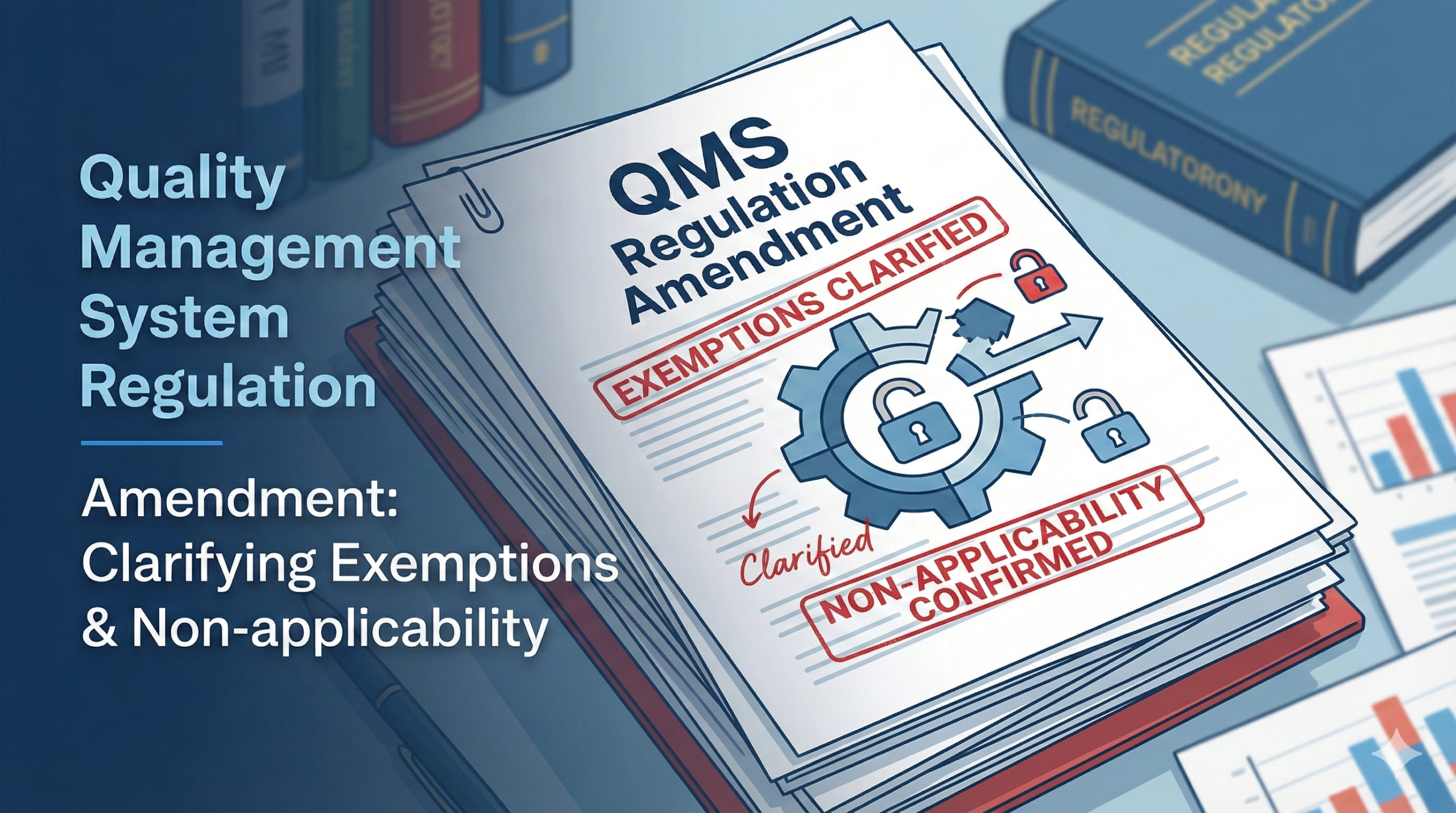
Quality Management System Regulation Amendment: Clarifying Exemptions and Non-Applicability
Overview of the Regulatory Change
Japan’s Quality Management System (QMS) Regulation, which sets requirements for medical device manufacturers and marketers, is undergoing significant amendments. These amendments particularly focus on clarifying the requirements for explaining situations where certain regulatory requirements do not apply to a manufacturer’s quality system. This distinction between what regulations call “exemptions” (適用除外) and “non-applicability” (非適用) has become increasingly important as manufacturers develop their quality manuals and document their quality management systems.
Japan’s Quality Management System (QMS) Regulation, which sets requirements for medical device manufacturers and marketers, is undergoing significant …
The Fourth Article of the Amended QMS Regulation
According to the industry draft of the amended regulation, the Fourth Article of the new QMS Regulation will establish clear requirements for outsourced manufacturing processes. The regulation states that manufacturers and marketers of medical devices must bear responsibility for any processes they outsource to external service providers, and they must clearly define how they will monitor, maintain, and manage these outsourced processes within their quality management supervision system.
This represents a fundamental principle of quality management: outsourcing a manufacturing process does not eliminate the manufacturer’s responsibility for that process. To understand why this matters, consider what would happen without such a requirement. If a manufacturer could escape regulatory responsibility simply by outsourcing work, companies could potentially outsource every manufacturing step and claim they have no obligation to comply with quality management regulations. Clearly, such an outcome would undermine the purpose of medical device regulations, which exist to ensure product safety and effectiveness.
The explanatory document accompanying the Fourth Article further clarifies this principle. It specifically states that manufacturers remain responsible for any processes they carry out through outsourcing, even when those processes are not performed directly within the manufacturer’s own facilities. Additionally, manufacturers must clearly document within their quality management supervision system how they monitor, maintain, and manage these outsourced processes.
From this regulatory text and explanation, one important conclusion follows: the fact that a process is outsourced is itself neither a valid “exemption” nor a valid reason for declaring something “non-applicable.” These terms have specific regulatory meanings that must be understood correctly.
Understanding “Exemptions” and “Non-Applicability”
The second and third paragraphs of the Fourth Article address these two distinct concepts. The second paragraph describes what regulators mean by “exemption” (tekiyō jogai).
An exemption occurs when regulations explicitly exclude certain products or devices from specific requirements. For example, regulations might state that medical devices in a particular classification category are not required to comply with certain sections of the QMS Regulation. When such an exemption exists in law and regulations, a manufacturer may declare that exemption in their quality manual and thereby exclude that requirement from their own quality management system.
A concrete example helps illustrate this concept. Under international medical device regulations including those referenced in Japanese law, Class I medical devices—the lowest risk category—may be exempt from design control requirements, provided they meet certain conditions. A manufacturer producing only Class I devices with the appropriate characteristics could reference this regulatory exemption in their quality manual, explaining why their quality system does not include design control procedures.
The third paragraph of the Fourth Article addresses a different situation: non-applicability (hiteki’yō). Non-applicability refers to circumstances where a specific regulatory requirement literally cannot be applied because of the inherent nature of the product being manufactured. In other words, the regulatory requirement itself is not wrong or inappropriate; rather, the nature of the product makes it impossible to implement that requirement.
Consider a practical example. Suppose a manufacturer produces medical devices that are never subject to sterilization—for instance, certain diagnostic instruments used only in non-sterile environments. Because the manufacturer never performs sterilization processes, sterilization requirements obviously cannot be applied to the manufacturer’s operations. This is a case of non-applicability. Even though sterilization is a critically important requirement for many medical devices, it is meaningless to require sterilization procedures from a manufacturer that never sterilizes anything. This situation must be documented in the quality manual as a non-applicable requirement.
Similarly, a manufacturer that does not produce active implantable medical devices (such as pacemakers or drug-eluting stents) would not apply requirements specific to those device types. The manufacturer would document this in their quality manual as a non-applicable requirement.
Distinction Between Exemption and Non-Applicability
| Aspect | Exemption (Tekiyō Jogai) | Non-Applicability (Hiteki’yō) |
| Source | Law, regulations, or official guidance explicitly exclude the requirement | The product’s inherent characteristics make the requirement impossible to implement |
| Legal Basis | Regulatory authority has determined the requirement does not apply to certain device categories | No explicit regulatory exclusion; rather, the requirement cannot logically apply |
| Example | Class I medical devices may be exempt from design control requirements | A non-sterile diagnostic device manufacturer cannot implement sterilization requirements |
| Documentation | Reference the specific regulatory provision allowing the exemption | Explain why the product characteristics make the requirement non-applicable |
| Responsibility | Manufacturer declares authority’s exemption in quality manual | Manufacturer independently assesses and declares non-applicability |
The Critical Importance of Documentation
The fourth paragraph of the Fourth Article emphasizes what may be the most important practical point for manufacturers. It states that when manufacturers declare either exemptions or non-applicable requirements, they must include in their quality management supervision system documentation—specifically in what the regulation calls the “Quality Management Supervision System Standards Document”—not only the declaration that a requirement is exempt or non-applicable, but also the specific reason why.
This requirement represents a fundamental principle of modern medical device regulations: transparency and justified decision-making. Regulators and inspectors need to understand not merely that a manufacturer has decided certain requirements do not apply, but why the manufacturer reached that conclusion. The documentation must make clear whether the exemption is authorized by law and regulation, or whether it is based on the non-applicability of a requirement to the particular products manufactured.
This documentation requirement serves multiple important functions. First, it demonstrates that the manufacturer has carefully analyzed regulatory requirements against their actual manufacturing operations and products. Second, it provides evidence that the manufacturer’s decisions are rational and based on regulatory analysis rather than convenience or cost reduction. Third, it creates a record that regulators can review during inspections to verify that the manufacturer correctly understood and applied regulatory requirements. Fourth, it helps ensure consistency and continuity if manufacturing personnel change or if the manufacturer’s product portfolio shifts over time.
Conclusion: The Amended Regulation’s Clarification
The amended QMS Regulation responds to real-world situations that regulators have observed in quality management systems. Some manufacturers have incorrectly treated all outsourced processes as exempt from oversight requirements. Others have declared requirements non-applicable without clear justification or understanding. The amendments, particularly the clarification in the Fourth Article and its explanatory materials, establish unambiguous rules: manufacturers must understand the difference between regulatory exemptions and non-applicability, they must document their quality management decisions with clear explanations, and they must maintain responsibility for all manufacturing processes regardless of whether those processes are outsourced.
For manufacturers preparing for the amended regulation, this means careful review of product portfolios and manufacturing processes, thoughtful application of regulatory exemptions where they genuinely exist, honest documentation of non-applicable requirements where products do not require specific processes, and most importantly, clear written explanations for all such determinations in quality management system documentation.
Related Articles
- FDA Issues Quality Management System Regulation (QMSR)
- UDI Regulation in Europe and Integration within Quality Management Systems
- FDA Medical Device Quality System Regulation (QSR) Amendment: Current Status and Industry Impact
- Proper Japanese Translation of “Review” in Medical Device Regulatory Requirements: Clarifying Terminology in Quality Management Systems
- Quality Management Systems in Medical Device Regulation
- 【translation into Japanese】FDA Part 820 QMSR(Quality Management System Regulation)revised plan
