
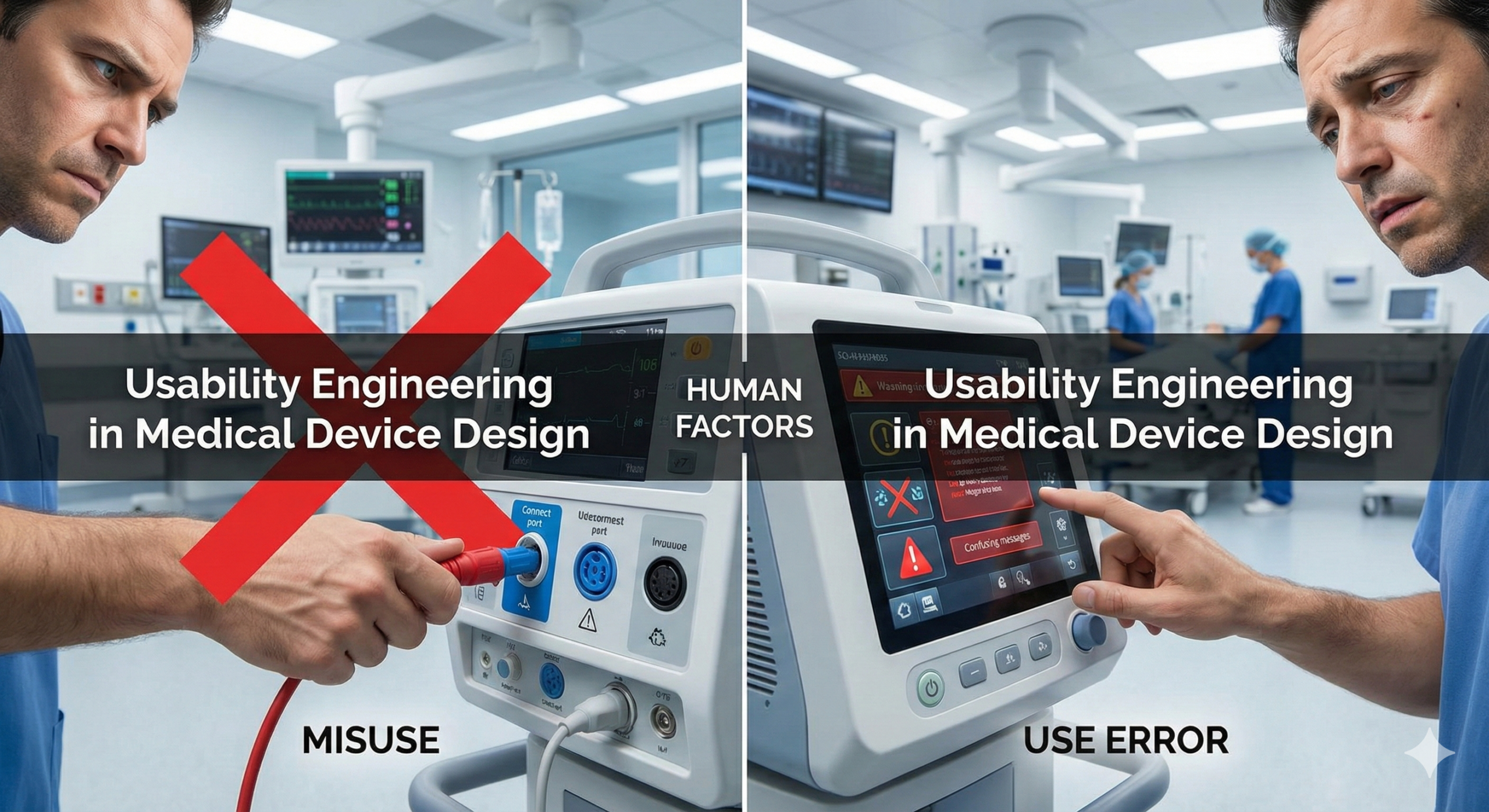
Misuse and Use Error: Usability Engineering in Medical Device Design
Positioning Misuse in Regulatory Requirements
ISO/IEC Guide 51:2014 “Safety aspects — Guidelines for their inclusion in standards” presents an iterative process for evaluating risks not only within the scope of the intended use envisioned by designers, but also within the scope of “reasonably foreseeable misuse,” and for implementing risk reduction until an acceptable level is achieved. The explicit inclusion of “reasonably foreseeable misuse” in the scope of risk assessment represents a critically important policy shift in medical device safety management.
ISO/IEC Guide 51:2014 “Safety aspects — Guidelines for their inclusion in standards” presents an iterative process for evaluating risks not only withi…
In the design and development of medical devices, the application of ISO 14971 “Medical devices — Application of risk management” and IEC 62366-1 “Medical devices — Part 1: Usability engineering” is mandatory. The scope of application for both standards is limited to “reasonably foreseeable use.” Importantly, “reasonably foreseeable use” includes “reasonably foreseeable misuse.”
Classification of “Reasonably Foreseeable Misuse”
“Reasonably foreseeable misuse” is further subdivided into two distinct categories: one is “use error” and the other is “misuse” or “abnormal use.” In other words, use error is a category encompassed within misuse; while all use errors constitute a form of misuse, not all misuse constitutes use error.
ISO 14971 requires that the full spectrum of “reasonably foreseeable misuse,” including “abnormal use,” be evaluated during the risk management process. This requirement ensures that dangerous use methods not intended by designers are also subject to risk assessment and mitigation strategy development at the design stage. By doing so, the standard seeks to prevent or minimize harm that could result from foreseeable but unintended uses of the medical device.
In contrast, usability engineering as specified in IEC 62366-1 is limited to addressing “use error” within the broader category of “reasonably foreseeable misuse.” This distinction arises because “abnormal use” — deliberate use of the device in a manner outside its intended use — cannot be controlled through the design approach employed in usability engineering. While interface design improvements can reduce or prevent use errors, they cannot effectively prevent intentional misuse. Use error, however, is susceptible to mitigation or prevention through appropriate interface design.
Definition and Nature of “Use Error”
A “use error” is defined as an act or omission by the user during the use of a medical device that produces a result different from that intended by the manufacturer or expected by the user. Several critical perspectives inform this definition:
Use errors can occur within the context of normal use. This is not merely a matter of inattention or lack of knowledge, but rather a phenomenon that emerges within normal use scenarios. Additionally, use error encompasses situations where the user is unable to complete the intended task.
Specifically, use errors occur when users attempt to operate a medical device in accordance with instructions, yet fail to complete the operation due to various limiting factors. These include physical capability limitations, such as insufficient strength or dexterity; sensory limitations affecting the ability to perceive or interpret information, such as inability to read text or distinguish colors; and difficulties in identifying interface elements, such as unclear button labeling or confusing operational procedures.
An important distinction must be made: “use error” should not be conflated with “human error.” Use error does not necessarily constitute human error in the conventional sense. For example, depending on user characteristics—individuals with physical disabilities, persons with color vision deficiency, elderly users, children, pregnant women, or non-native speakers—a person may be unable to use a device correctly despite genuine intent to do so, due to insufficient strength, inability to read instructions, or language comprehension difficulties. In such cases, the root cause is not an inadequacy on the user’s part, but rather the medical device’s interface design failing to accommodate the capabilities of particular user populations.
User Populations and Use Error Risk
According to ISO/IEC Guide 51, the evaluation of “reasonably foreseeable misuse” requires the identification of user characteristics and populations. Specific populations requiring consideration include persons with physical disabilities, individuals with color vision deficiency, elderly persons, children, women (particularly pregnant and postpartum women), and persons of different linguistic backgrounds.
For each user population, the critical consideration is whether individual users possessing the characteristics typical of that population are capable of completing the intended task. Designers must ensure that medical devices can be safely used not only by typical users matching designer assumptions, but also by users with diverse physical and cognitive characteristics. This consideration extends beyond mere accessibility concerns and constitutes an essential requirement for ensuring medical device safety.
Interface Design and the Mechanisms of Use Error Generation
Use errors arise from deficiencies in medical device interface design. Interfaces that are unclear, confusing, difficult to identify, or prone to misinterpretation generate use errors.
Usability engineering focuses on use errors that occur within normal use. Consequently, usability engineering implements risk management with an explicit focus on the interface.
The interface encompasses far more than electronic displays such as liquid crystal displays (LCDs). It includes all elements through which users perceive information and interact with the medical device through their visual, auditory, and tactile senses. Specifically, the interface includes text-based information in instruction manuals and labels, physical control elements such as buttons, visual characteristics such as the device’s shape and color, acoustic signals such as alarm sounds and beeping tones, tactile feedback such as vibration, and every other point of contact between the user and the medical device.
Root Causes of Medical Device Incidents and the Importance of User Understanding
Medical device incidents frequently result from gaps between “how users intend to use the device” and “the design intent of the device designer.” When such fundamental misalignment exists, even robustly engineered systems can give rise to unexpected hazardous events.
The extent to which an interface can be made intuitive, clear, and error-proof depends fundamentally upon how thoroughly the device designer understands how medical devices are actually used in practice. When the designer’s assumptions about “proper use” diverge from users’ actual usage patterns in the field, the risk of unforeseen use errors increases substantially.
For this reason, the practice of usability engineering requires more than formal inspections and evaluations. It demands actual observation of users, multi-faceted consideration of use scenarios, and iterative design improvements through formative evaluation. Medical device design must account for diverse factors including the physical environment in which the device will ultimately be used, the backgrounds and characteristics of users, actual patterns of device operation, and behavioral patterns under conditions of fatigue or stress.
Conclusion
Ensuring the safety of medical devices requires more than formal compliance with standards; it demands a deep understanding of user diversity and actual use conditions. Through appropriate application of ISO 14971 and IEC 62366-1, adopting a user-centered design approach from the outset represents the key to realizing safe and effective use of medical devices in clinical practice.
Related Articles
- The Importance of Use Environment and User Characteristics in Medical Device Usability Engineering
- Aircraft Pilot Type Ratings and Medical Device Usability Engineering
- Distinguishing Between Misuse and Use Error: Critical Concepts in Medical Device Safety Evaluation
- Differences Between Pharmaceutical and Medical Device Regulations Regarding Engineering Design
- Distinguishing Between “Misuse” and “Use Error” in Medical Device Regulation
- Reasonably Foreseeable Misuse in Medical Device Design
