
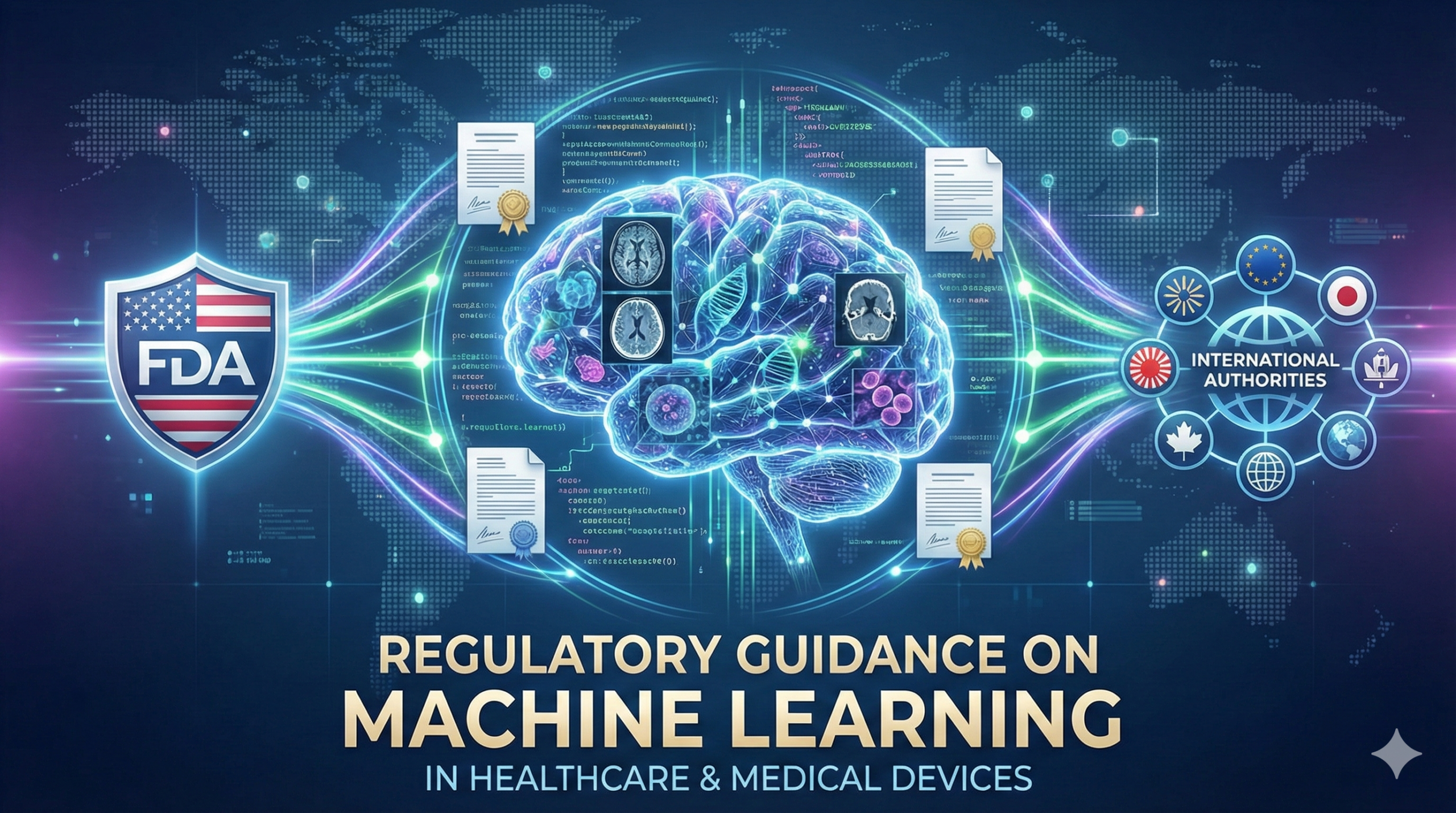
Regulatory Guidance on Machine Learning by FDA and International Authorities
Background and Publication
On October 27, 2021, the U.S. Food and Drug Administration (FDA), Health Canada, and the United Kingdom’s Medicines and Healthcare Products Regulatory Agency (MHRA) jointly identified ten guiding principles to inform the development of Good Machine Learning Practice (GMLP) and published new guidance titled “Good Machine Learning Practice for Medical Device Development: Guiding Principles.” This collaborative effort was designed to promote the safe, effective, and high-quality application of artificial intelligence and machine learning (AI/ML) in the development of medical devices.
On October 27, 2021, the U.S. Food and Drug Administration (FDA), Health Canada, and the United Kingdom’s Medicines and Healthcare Products Regulatory…
AI/ML technologies hold transformative potential for healthcare by extracting novel and critical insights from the vast amounts of data generated daily in clinical settings. In the development and operation of medical devices, these technologies employ software algorithms to continuously learn from actual use environments and, in appropriate circumstances, can leverage this learned information to enhance device performance. However, due to their inherent complexity and the iterative, data-driven nature of their development processes, AI/ML systems present unique considerations distinct from those of traditional software-based medical devices. Consequently, the development, evaluation, and deployment of AI/ML as medical devices require specialized approaches that differ from conventional frameworks.
The Significance of the Guiding Principles
The ten principles presented in this guidance aim to establish a foundational framework for developing sound machine learning practices that address the unique characteristics of these products. Simultaneously, these principles are expected to foster future growth in this rapidly advancing field while maintaining an appropriate balance between technological innovation and regulatory requirements.
These ten principles identify domains of collaboration where the International Medical Device Regulators Forum (IMDRF), international standards organizations such as the International Organization for Standardization (ISO), and other relevant stakeholders can work toward advancing GMLP. Specifically, these collaborative areas include foundational research, creation of educational tools and resources, international regulatory harmonization, and development of consensus standards. These cooperative efforts are expected to eventually contribute to improvements in regulatory policy and guidance.
Implementing the Guiding Principles
These principles are considered applicable for use in medical device development practice for the following purposes: adapting good practices proven in other sectors (such as the financial industry or autonomous driving) to the healthcare field; modifying and adjusting practices established in other industries to make them applicable to medical technology and the healthcare sector; and developing new practices unique to medical technology and the healthcare sector.
As the field of AI/ML medical devices continues to evolve rapidly, best practices and consensus standards for GMLP must similarly evolve to keep pace with emerging technological developments and regulatory requirements. For stakeholders—including medical device manufacturers, regulatory authorities, healthcare professionals, and patient representatives—to drive responsible innovation in this field, strong partnerships with international public health collaborators are indispensable. Therefore, this initial collaborative effort by the FDA, Health Canada, and MHRA is expected to inform broader international regulatory harmonization initiatives, including those led by the IMDRF, thereby accelerating global healthcare system readiness for AI/ML-enabled medical devices.
The Ten Guiding Principles
1. Utilization of Interdisciplinary Expertise Throughout the Product Lifecycle
Integration of knowledge and skills from multiple professional disciplines is essential across all stages of AI/ML medical device development, from conception through commercialization to post-market surveillance. These disciplines include medicine, statistics, machine learning, software engineering, regulatory science, and clinical testing methodology. This interdisciplinary approach ensures that technical validity and clinical utility are achieved concurrently in system design and implementation.
2. Implementation of Sound Software Engineering and Security Practices
AI/ML-enabled medical devices must meet fundamental requirements for medical software—as defined in international standards such as IEC 62304—and additionally address cybersecurity, data integrity (including application of ALCOA+ principles), and continuous update management. Robust development processes and quality management systems, comparable to those required for traditional software-based medical devices, are of equal or greater importance for AI/ML systems.
3. Clinical Trial Participants and Datasets Representative of the Intended Patient Population
The datasets used for training and evaluating AI/ML models, as well as the patient populations participating in clinical trials, must appropriately represent the characteristics of the actual patient population who will use the medical device in clinical practice. These characteristics include age, gender, ethnicity, and disease severity. Such representation increases the likelihood that the safety and efficacy demonstrated during development will be reproducible in the actual post-market clinical environment.
4. Appropriate Management of Training Datasets
Training datasets used to develop AI/ML models must be thoroughly documented and managed with regard to data provenance, quality control, preprocessing methodologies, and potential biases. The integrity and traceability of data form the foundation for ensuring reliability and reproducibility as a medical device.
5. Appropriate Selection and Management of Reference Datasets
Reference (test) datasets used for evaluating and validating model performance must be independent of training datasets and must be representative and of sufficient size. Rigorous data management and version control must be applied to datasets used for evaluation.
6. Adaptation of Model Design to Available Data and Intended Use
The design of AI/ML models—including architecture, hyperparameters, and performance metrics—must be appropriately adapted to the characteristics of available data and simultaneously must clearly reflect the specific intended use as defined for the medical device (e.g., specific diagnoses, patient populations, or clinical scenarios).
7. Focus on Human-AI Team Performance
The clinical utility of AI/ML systems in medical practice should be evaluated not by the performance of the AI algorithm alone, but by the overall performance of the collaborative team comprising clinical users (physicians, nurses, and other healthcare professionals) and the AI system working together. This principle recognizes that human factors—specifically, how users interpret and apply information and recommendations provided by AI in their clinical decision-making—have profound implications for clinical effectiveness and safety.
8. Verification of Device Performance Under Clinically Relevant Conditions
Device testing and evaluation must be conducted under conditions that reflect actual clinical use environments. This includes consideration of diverse patient characteristics, disease variability, different healthcare facility settings, and potentially foreseeable misuse or unintended use scenarios.
9. Provision of Clear and Clinically Relevant Information to Users
Healthcare professionals and patients using AI/ML-enabled medical devices must be provided with clear, understandable, and clinically relevant information regarding the device’s intended use, capabilities and limitations, the reliability of the AI/ML model’s recommendations, and anticipated methods of use. Particular attention must be given to preventing users from developing inappropriate over-reliance on AI recommendations or using the device without understanding its limitations. Appropriate educational materials and explanatory documentation are essential for this purpose.
10. Continuous Monitoring of Post-Market Model Performance and Risk Management
After a medical device is made available for clinical use, the performance of AI/ML models in real-world clinical environments must be continuously monitored. It is essential to monitor post-market performance data and to develop risk management plans in advance for responding to deviations from expected performance (such as model retraining or updates). This consideration reflects the distinctive characteristics of AI/ML systems that learn continuously from new data.
Evolution of the International Regulatory Landscape
The guidance jointly issued by the FDA, Health Canada, and MHRA has become an important foundation for international harmonization of regulatory approaches to AI/ML medical devices. Subsequently, the European Medicines Agency (EMA) has strengthened AI/ML-related specific requirements within the Medical Device Regulation (MDR) and In Vitro Diagnostic Regulation (IVDR). Similarly, Japan’s Pharmaceuticals and Medical Devices Agency (PMDA) is advancing development of comparable guidance frameworks.
Concurrently, the International Organization for Standardization (ISO) and other standards development organizations are advancing the development and revision of international standards that reflect requirements specific to AI/ML medical devices. These include standards for AI management systems (ISO/IEC 42001:2023), adaptation of software lifecycle processes standards to accommodate machine learning (IEC 62304:2015/A1:2020), and AI risk management standards (ISO/IEC 23894:2023).
Medical device development organizations are expected to continuously monitor not only their own national regulatory requirements but also this rapidly evolving international regulatory landscape and standardization trends. This vigilance is necessary to ensure that AI/ML medical devices are developed and operated in a manner that maintains global competitiveness and aligns with the international harmonization of requirements.
Related Articles
- The Commencement of ER/ES Inspections by Regulatory Authorities: Historical Context and Current Practices
- Differences in Approach Between JIS Standards and FDA Guidance: Current State of International Harmonization
- Guidance on Article 15 of the Medical Device Regulation (MDR) and in vitro Diagnostic Device Regulation (IVDR) regarding a 'person responsible for regulatory compliance'(PRRC)
- Understanding CFR: The Foundation of U.S. Regulatory Framework
- Have Part 11 Inspections Disappeared? Understanding Current Regulatory Trends
- Understanding Regulatory Audits: Purpose, Misconceptions, and Modern Approaches

Comment