
The Distinction Between Misuse and Use Error
In the context of medical device safety management, the precise distinction between “misuse” and “use error” is of paramount importance. It is observed that many regulatory practitioners and medical device manufacturers in Japan tend to conflate these two fundamental concepts, a situation that presents significant risks to patient safety. This article provides a comprehensive explanation of this critical distinction.
In the context of medical device safety management, the precise distinction between “misuse” and “use error” is of paramount importance. It is observe…
Historical Context: Translation Confusion and Its Resolution
The Japanese Industrial Standards (JIS) versions of ISO 14971 (Risk management for medical devices) have experienced translation-related inconsistencies across multiple editions. In JIS T 14971:2012, the English term “use error” was mistakenly translated as “誤使用” (misuse), which constitutes a clear mistranslation. The correct translation should be “使用エラー” (use error). Fortunately, this error was corrected in JIS T 14971:2020, the JIS version of ISO 14971:2019. Nevertheless, the influence of earlier editions persists in practical regulatory work, and the conflation of these terms continues in many corners of the industry.
“Use error” and “misuse” represent fundamentally distinct concepts and should never be treated as synonymous. Understanding this difference with precision is essential not only for risk assessment of medical devices and usability engineering practice, but ultimately for patient safety itself.
Defining the Two Concepts
Definition of Misuse
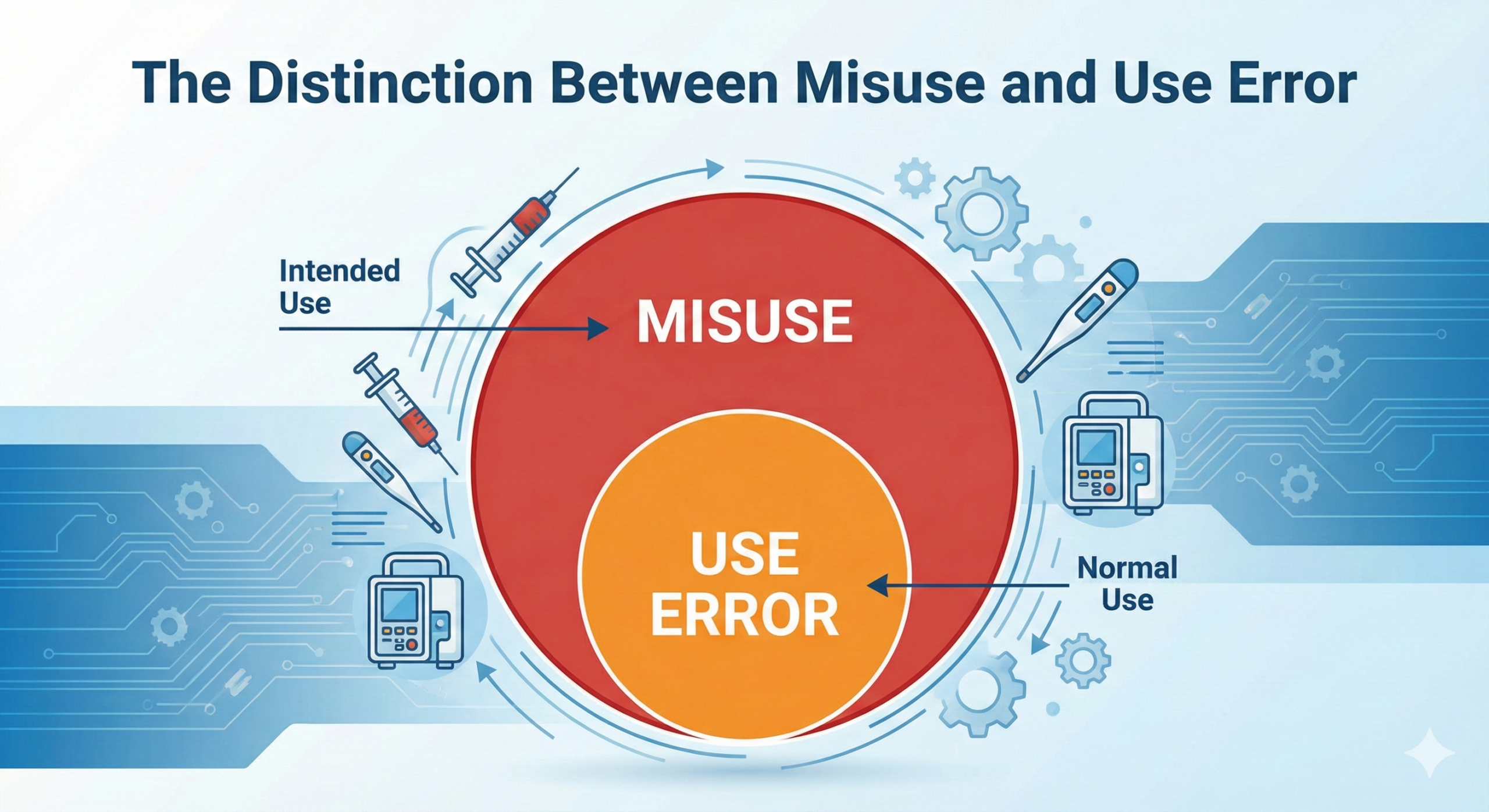
Misuse refers to use of a medical device that deviates from the intended purpose envisioned by the device manufacturer. More specifically, misuse encompasses the failure to adhere to instructions documented in the user manual accompanying the medical device. In other words, misuse occurs when a user, either consciously or unconsciously, does not follow the usage method specified by the manufacturer.
Definition of Use Error
In contrast, use error is defined in ISO 14971:2020 as follows:
“An action or omission of an action by the user that results in a different outcome than that intended by the manufacturer or expected by the user.”
This definition is accompanied by several important notes that provide critical context. First, use error encompasses situations where a user is unable to complete a task. Second, use error may result from incompatibilities between user characteristics, the user interface, task requirements, or the use environment. Third, the user may or may not be aware that a use error has occurred.
Additionally, the definition explicitly clarifies that unexpected physiological responses of the patient are not themselves considered use errors. Similarly, malfunctions of the medical device itself that produce unexpected outcomes are distinguished from use errors.
Fundamental Distinctions Between the Two Concepts
From these definitions emerges a clear understanding of the essential differences between misuse and use error.
Use error occurs when a user follows the user manual and attempts to use the device in the manner intended by the manufacturer, yet the intended function or performance fails to materialize and the user cannot complete the task as expected. In other words, the user is following the “correct usage,” yet for some reason, the expected outcome is not achieved.
Concrete Examples of Use Error
The following situations exemplify use error in clinical and practical contexts:
Elderly individuals, patients with medical conditions, pregnant women, or pediatric users lack the physical strength or motor skills necessary to operate a medical device. Despite following the user manual correctly, they are unable to complete the required task such as manipulating an injection device or applying medical equipment.
Users with color vision deficiency, color blindness, or visual impairment are unable to perceive critical information in the medical device interface when that interface relies on color discrimination. Although they follow the user manual, they cannot recognize essential information such as warning symbols or status indicators distinguished by color.
Foreign language speakers encounter a medical device user manual or label written solely in Japanese. Unable to comprehend the instructions, they cannot operate the device in the manner the manufacturer intended.
Hearing-impaired users cannot perceive alarm sounds or voice guidance that communicate critical safety information, despite the manufacturer intending for this auditory information to be essential to safe operation.
Positioning of Misuse and Use Error in Risk Assessment
To understand the framework for medical device risk assessment, reference to ISO/IEC Guide 51, “Safety aspects—Guidelines for their inclusion in standards,” is instructive. The third edition of ISO/IEC Guide 51 was published in 2014 and has since become foundational to medical device regulatory approaches.
ISO/IEC Guide 51 clearly establishes that the scope of medical device risk assessment must encompass not only the intended use envisioned by the manufacturer, but also “reasonably foreseeable misuse.” The designer must identify the characteristics of anticipated users and predict usage methods that users might reasonably be expected to attempt incorrectly. The risks arising from such reasonably foreseeable misuse must be included within the scope of risk assessment.
A critically important aspect of this approach is that the distinction between “reasonably foreseeable misuse” and “inconceivable misuse” is not fixed but instead evolves dynamically over time.
The Dynamic Nature of Acceptable Risk
The level of acceptable risk is subject to change over time due to various factors including evolving social conditions and technological progress. That is, a usage method assessed as “reasonably foreseeable misuse” at the design stage may, following subsequent changes in the social environment, eventually come to be recognized as falling within the scope of foreseeable misuse. Conversely, usage methods once considered unconscionable may, with the passage of time, come to be viewed as falling within reasonable bounds.
Three principal factors drive this dynamic evolution in the boundaries of acceptable risk.
First, social values and norms are continuously subject to change. The social needs and values within medical device use environments constantly shift, and user behavior patterns evolve accordingly. For example, whereas elderly individuals were not previously considered a major user population for many medical devices, the progression toward an aging society has made older adults a critically important user group for contemporary medical devices.
Second, product history plays a significant role. As medical devices remain in clinical use over time and usage experience accumulates, usage patterns and user characteristics unanticipated during initial design phases become apparent. Moreover, the market introduction of competing products can elevate user expectations regarding device functionality and performance.
Third, increasing diversity in user populations represents a major driving force. Medical device user populations are becoming increasingly heterogeneous. For example, a device that was previously used exclusively by healthcare professionals may now encounter use by patients themselves. As the user population expands, the scope of “reasonably foreseeable misuse” necessarily expands as well.
The Inevitability of Human Error and Its Design Implications
Prevention of accidents caused by misuse or use error represents a paramount concern in contemporary medical device regulation. However, complete prevention of such accidents is unrealistic. The fundamental reason is that human error—inevitable and unavoidable—underlies both misuse and use error.
Human error is a phenomenon that occurs with a certain probability regardless of what preventive measures are implemented. This fundamental recognition must always remain at the forefront of medical device design. That is, the medical device designer must operate from the premise that “users will inevitably make errors” and must incorporate design features that minimize harm to patients even when such errors do occur.
The Importance of Usability Engineering
Ensuring medical device safety requires design that enables and supports users in executing tasks appropriately. To achieve this objective, proper application of the principles and methodology of IEC 62366, “Medical devices—Usability engineering,” is critical.
IEC 62366 establishes a comprehensive engineering process by which a medical device user interface is optimized to minimize use error among actual users and ensure that intended use is conducted safely and effectively. In particular, IEC 62366-1 (Process) emphasizes an iterative approach encompassing prediction of use errors, evaluation of use error hazards, and refinement of the user interface.
Furthermore, the most recent edition, IEC 62366-2 (Guidance), provides detailed implementation guidance, with particularly thorough methodology applicable to medical devices with highly diverse user populations. Examples include self-administered drug delivery devices and remote medical devices where the diversity of user characteristics is pronounced.
Conclusion
Understanding the distinction between misuse and use error is not merely a matter of terminological precision; rather, it touches upon the fundamental architecture of medical device safety management. If designers mistakenly regard use error as a species of misuse, there is serious risk that essential safety measures will be overlooked.
Ensuring medical device safety requires recognition of the inevitability of human error, appropriate definition of the scope of reasonably foreseeable misuse, and implementation of design features to minimize use error within that scope. Through application of usability engineering principles exemplified by IEC 62366, construction of a support system enabling users to employ medical devices correctly has become fundamental to contemporary medical device design practice as demanded by modern regulatory frameworks.
Related Articles
- Distinguishing Between Misuse and Use Error: Critical Concepts in Medical Device Safety Evaluation
- Distinguishing Between “Misuse” and “Use Error” in Medical Device Regulation
- Understanding the Difference Between Use Error and Misuse
- Difference between misuse and use error
- The Distinction Between Fraud and Unintentional Changes in Data Integrity
- Misuse and Use Error: Usability Engineering in Medical Device Design
