
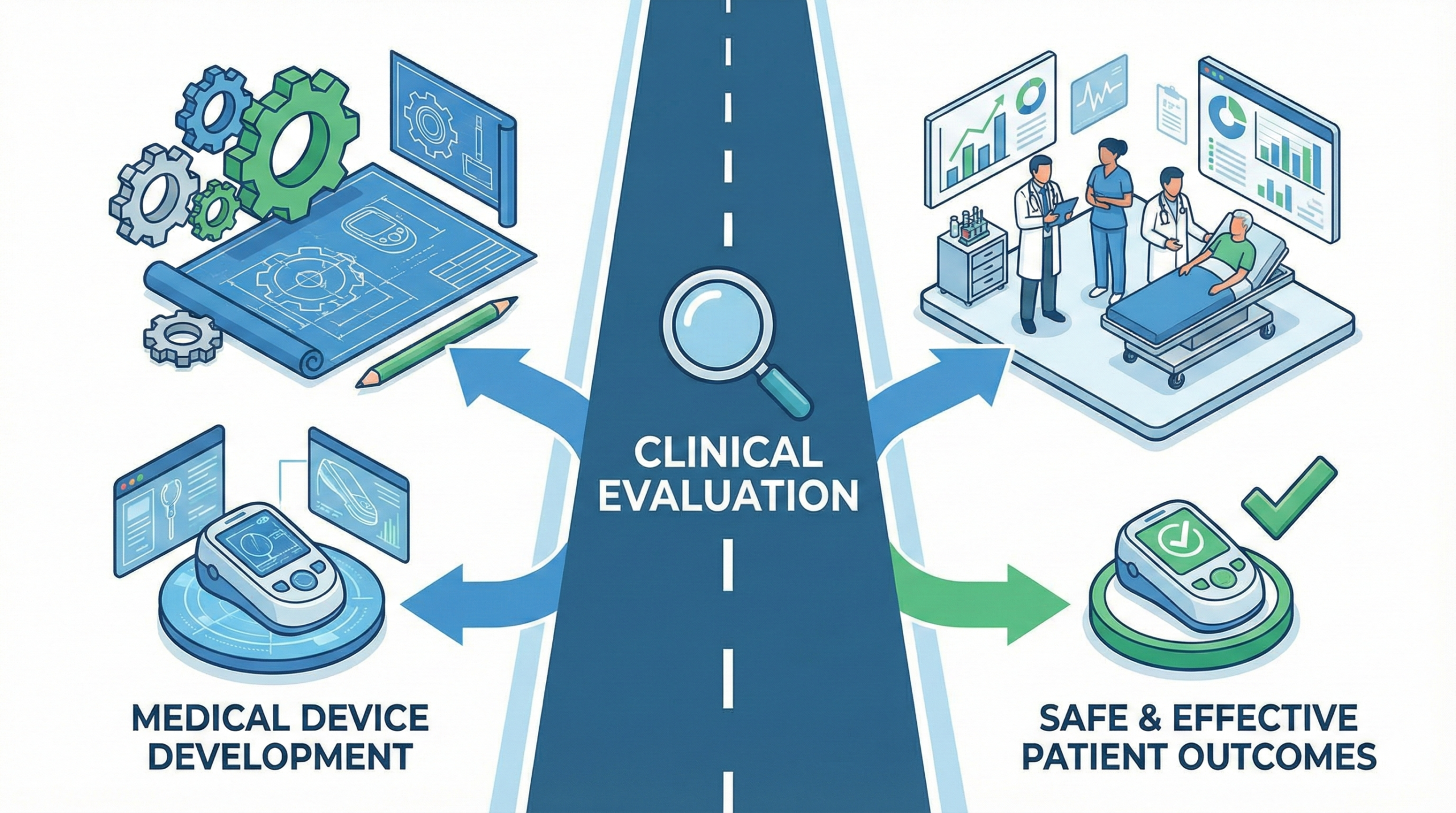
The Importance of Clinical Evaluation in Medical Device Development
Regulatory Requirements
ISO 13485:2016, clause 7.3.7 (Design and Development Validation), establishes a fundamental requirement for medical device manufacturers:
ISO 13485:2016, clause 7.3.7 (Design and Development Validation), establishes a fundamental requirement for medical device manufacturers:…
As part of design and development validation, organizations shall perform clinical evaluation or performance evaluation of the medical device in accordance with applicable regulatory requirements.
This requirement reflects a critical distinction in medical device regulation: medical devices require clinical evaluation to demonstrate safety and efficacy based on clinical evidence, while in vitro diagnostic devices (IVDs) require performance evaluation. Both pathways share the same fundamental principle: rigorous, evidence-based assessment of the device’s ability to function safely and effectively in its intended use.
Why Clinical Evaluation Matters
The rationale for clinical evaluation is straightforward: medical devices are used in human patients. Clinical evaluation ensures that safety and efficacy are not merely theoretical concepts, but are validated through rigorous clinical evidence. This is a foundational principle of medical device regulation globally.
Clinical evaluation serves a critical protective function. It ensures that the safety and performance characteristics of a medical device are established with adequate clinical evidence and are continuously reassessed throughout the device’s lifecycle in the marketplace. This ongoing assessment protects patients by providing a mechanism to identify emerging risks, validate continued efficacy, and ensure that the risk-benefit profile remains favorable as the clinical environment evolves.
The Necessity of Continuous Clinical Evaluation
Post-market clinical follow-up (PMCF) requirements have intensified under the European Union’s Medical Device Regulation (MDR) (EU) 2017/745. The MDR established PMCF as a mandatory component of the manufacturer’s post-market surveillance obligations, with PMCF plans now required as part of the technical documentation. These requirements reflect a regulatory shift toward greater accountability for device safety and efficacy monitoring after market authorization.
Despite these regulatory requirements, many medical device manufacturers have elected not to implement PMCF, often citing cost constraints or assumptions that pre-market testing is sufficient. This approach carries significant risk. During device design and development, manufacturers often make design decisions where residual risks are deemed acceptable based on risk-benefit calculations. However, the validity of these decisions depends critically on one assumption: that the risk-benefit profile remains stable over time. In practice, this assumption frequently proves incorrect.
The reality is that risk-benefit ratios are dynamic. Consider what occurs post-market:
| Benefits (Efficacy) | Risks |
| Only decline with time. Improved therapeutic or diagnostic alternatives may emerge through advances in medical practice, competing devices, or pharmaceutical interventions. | Only increase with time. Manufacturing issues may emerge. New hazards not identified during pre-market testing may be discovered through extended clinical use. |
This asymmetry creates a critical problem. As time passes post-market, the clinical context evolves. Superior diagnostic or therapeutic alternatives may be developed and adopted in clinical practice, reducing the relative benefit of the original device. Simultaneously, risks may increase as unexpected adverse events, manufacturing issues, or long-term safety signals emerge from real-world use in diverse patient populations. This trajectory means that a risk-benefit assessment that appeared favorable at market launch may become unfavorable as market circumstances change.
Understanding the current risk-benefit profile requires continuous accumulation of clinical knowledge. Additionally, the state of the art (the current standard of technical achievement) is not static. As clinical science advances, manufacturing capabilities improve, regulatory expectations evolve, and new international standards emerge, devices must be evaluated against this changing landscape. Manufacturers must incorporate the latest safety information from comparable devices, updated regulatory requirements across all jurisdictions in which they operate, relevant international standards (such as ISO 14971 for risk management or IEC 62304 for software lifecycle), and evolving industry best practices.
Continuous clinical evaluation provides the mechanism by which manufacturers can fulfill this obligation. Through ongoing PMCF processes, device manufacturers can systematically evaluate the risk-benefit profile throughout the device’s market lifecycle. This evaluation informs whether modifications to the device, updated labeling, changes in intended use, or market withdrawal are necessary to maintain patient safety. This is not merely a regulatory checkbox; it is a fundamental responsibility to the patients who use the device.
Looking forward, regulatory expectations for PMCF are unlikely to diminish. Unless risk management during design and development is truly comprehensive and residual risks are genuinely minimal, PMCF will become a de facto requirement for most medical devices placed on the market. Manufacturers who treat PMCF as a regulatory obligation to minimize rather than as a core component of their patient safety strategy may find themselves unable to defend their devices if adverse events emerge unexpectedly in the market.
Conclusion
Clinical evaluation is not an afterthought in medical device development. It is a foundational requirement that extends beyond pre-market testing to encompass the entire device lifecycle. As regulatory requirements continue to strengthen, particularly in major markets such as the European Union, manufacturers must embrace continuous clinical evaluation as a core business practice. This approach protects patients, ensures regulatory compliance, and ultimately strengthens the safety and efficacy profile of medical devices in clinical practice.
Related Articles
- Clinical Evaluation and Performance Evaluation in Medical Device Regulation
- The Importance of Design Control in Medical Devices
- The Importance of Data Analysis: The Foundation of Quality Assurance in Medical Device and Pharmaceutical Companies
- Regulatory Requirements for Medical Device Software Development
- The Purpose and Strategic Importance of Pest Control in Pharmaceutical and Medical Device Manufacturing
- The Importance of Use Environment and User Characteristics in Medical Device Usability Engineering

Comment