
Why Software Category Classification is Necessary
A comprehensive guide to GAMP 5 software categorization, risk-based validation, and the paradigm shift from CSV to Computer Software Assurance (CSA).
This classification method is recommended by GAMP 5 (Good Automated Manufacturing Practice) and is a practical approach adopted by companies worldwide. GAMP 5 Second Edition, published in July 2022, reflects significant technological advancements, emphasizing critical thinking by knowledgeable subject matter experts (SMEs), increased reliance on service providers including cloud computing, and integration with modern software development methodologies such as Agile.
Furthermore, in September 2022, the U.S. FDA released draft guidance on Computer Software Assurance (CSA) for Production and Quality System Software, which was finalized in 2024. This guidance represents a paradigm shift from traditional Computer System Validation (CSV) to a more risk-based, efficient approach that aligns with GAMP 5 principles — focusing validation efforts on areas with the highest risk to patient safety, product quality, and data integrity.
Software Categories: Four Classifications
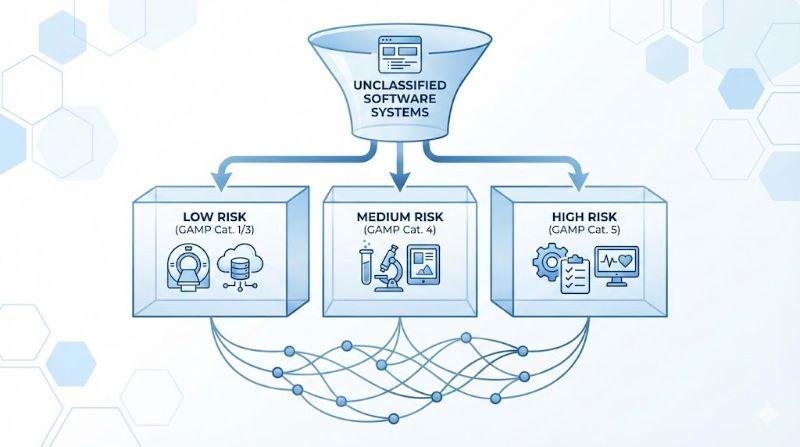
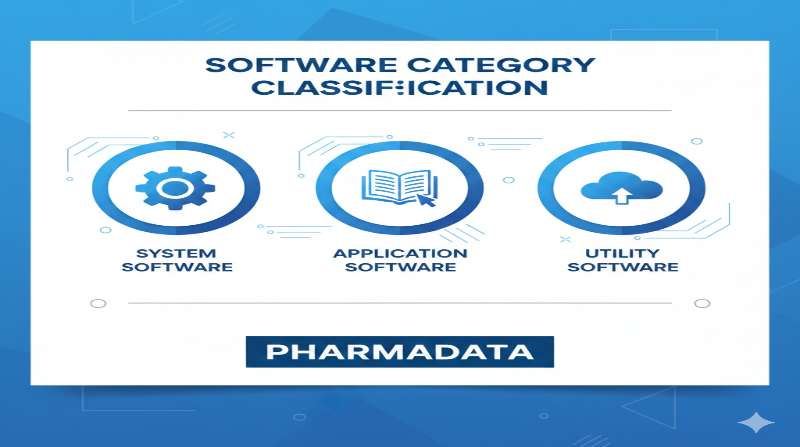
Software is primarily classified into the following four categories based on its characteristics and usage. GAMP 5 Second Edition emphasizes viewing these categories as a continuum rather than rigid boundaries, as computerized systems are generally composed of a combination of components from different categories.
Software, systems, and tools that support computerized system lifecycle activities, IT processes, and infrastructure processes — as opposed to directly supporting business, pharmaceutical, or medical device lifecycle processes. Infrastructure components typically have minimal or no direct impact on GxP-critical processes. The focus should be on installation verification and assessing tool adequacy for use.
Software that is ready to use immediately after installation without requiring configuration changes or adjustments by users. Commercial package software that cannot be modified falls into this category. The focus is on confirming that the software installs correctly, operates as expected for its intended use, and is fit for purpose.
Software that requires various parameter settings and initial configuration before use. Users need to configure the operating environment, enable or disable functions, and set parameters. Since software behavior changes depending on configuration settings, more careful verification is required. Configuration settings must be documented with their rationale.
The most complex category, requiring significant modifications or new development tailored to users’ specific needs. This category carries the highest risk and requires detailed management throughout the entire development process — including requirements definition, design reviews, comprehensive testing at multiple levels, performance testing, and security testing.
Comparison Table of Software Categories
| Category | Type | Config | Dev Required | Typical Validation Effort | Risk |
|---|---|---|---|---|---|
| Cat 1 | Infrastructure | Minimal | None | Installation verification, adequacy assessment | Lowest |
| Cat 3 | Non-configurable | None | None | IQ, OQ focused on intended use | Low |
| Cat 4 | Configurable | Extensive | None | IQ, OQ with focus on configured features, configuration documentation | Medium |
| Cat 5 | Custom | Required | Extensive | Full lifecycle validation: requirements, design, code review, comprehensive testing | Highest |
The Necessity of Category Classification
Why is such classification necessary? Managing all software according to the same standard leads to inefficiency and excessive costs, while also failing to adequately address risks where they are most significant.
1. Differences in Depth of Validation (CSA)
Modern approaches emphasize Computer Software Assurance (CSA) rather than traditional CSV. CSA is a risk-based approach that focuses on establishing confidence that software performs as intended, rather than generating extensive documentation for compliance purposes alone.
🏗️ Category 1 Assurance
- Installation verification (confirming proper startup and operation)
- Assessment of tool adequacy for intended use
- Documented records of infrastructure qualification
- Virus scanning implementation
- Focus on “one qualification, many implementations” model
⚙️ Category 4 Assurance
- Validation of configuration settings (why those values were set)
- Post-configuration operational verification
- Verification of impact on other systems
- Procedure verification for configuration changes
- Documentation of configuration rationale and traceability
- Risk assessment of configured features and functions
- Testing focused on critical, configured capabilities
🔧 Category 5 Assurance
- Validation of requirements definition
- Design reviews implementation
- Source code review (where appropriate based on risk)
- Unit testing, integration testing, system testing
- User acceptance testing
- Performance testing, security testing
- Comprehensive documentation throughout SDLC
- Risk-based approach to determine appropriate level of testing
CSA Approach Emphasis
Validation effort should be scaled based on the intended use of the software and the process risk it poses. High process risk features require scripted testing with documented test cases, while features that are not high process risk may be addressed through unscripted testing methods such as scenario testing, exploratory testing, or error-guessing.
2. Differences in Required Documentation
Documentation requirements differ significantly by category. The CSA approach encourages focused, value-added documentation rather than excessive screenshots and redundant paperwork. Digital records, audit trails, system logs, and automated testing results should be leveraged to reduce manual documentation burden.
3. Cost and Resource Optimization
Appropriate category classification enables critical optimizations:
Prevention of Over-Management
Eliminating wasteful costs from applying Category 5-level management to Category 3 software.
Risk-Based Management
Concentrating resources on high-risk areas while applying proportionate controls to lower-risk areas.
Efficient Quality Assurance
Achieving both quality and speed through necessary and sufficient verification.
Supplier Leverage
Maximizing supplier involvement to leverage their knowledge and reduce duplication of effort.
Critical Thinking
Utilizing experienced SMEs to determine appropriate validation strategies rather than rigid checklists.
Agile Compatibility
Supporting modern development methodologies while maintaining compliance.
Addressing Complexity in IT Applications
The Reality of Mixed Categories
Modern IT applications often do not fit into a single category. For example, an ERP system typically contains components spanning all four categories:
📦 ERP System Configuration Example
- Category 3 — Basic Modules: Standard accounting, inventory management, and report functions (when used as-is)
- Category 4 — Configured Functions: Organizational structure, approval workflows, chart of accounts, user access, alarm thresholds
- Category 5 — Customized Functions: Unique reports, automated integrations, industry-specific logic, custom workflows, AI/ML algorithms
- Category 1 — Infrastructure: Underlying database, operating system, network infrastructure, backup systems, development tools
Importance of Function-by-Function Classification
For complex systems, it is crucial to classify by functional unit rather than classifying the entire system into one category. This “component-based approach” provides key benefits:
Appropriate Management Levels
Standard functions get simplified verification; customized parts receive sufficient effort; configuration parts focus on settings rationale.
Clarified Scope of Impact
Clear understanding of which functions belong to which categories, enabling focused change control on affected components.
Efficient Resource Allocation
Assignment of specialists to high-risk functions, standard procedures for low-risk functions, and optimal effort balance.
Relationship with Risk-Based Approach
Software category classification is positioned as part of a “risk-based approach” philosophy. Both GAMP 5 Second Edition and FDA’s CSA guidance strongly emphasize this principle.
Risk Assessment Perspectives
🎯 Impact on Business & Patients
- Does it directly affect sales or revenue?
- Does it handle customer or patient data?
- Is it related to legal and regulatory compliance?
- What is the potential impact on product quality?
- What is the potential impact on patient safety?
- What is the risk to data integrity?
🔬 Technical Complexity
- Extent of integration with other systems
- Complexity of data processing
- Degree of customization
- Novelty of technology being implemented
- Use of emerging technologies (AI/ML, blockchain, cloud)
📋 Process Risk Assessment (CSA Approach)
- Assess risk of the business process that the software supports, not just the software category
- Focus on consequences if the software does not perform as intended
- Consider the intended use of each feature, function, or operation separately
Practical Classification Points
1. Importance of Initial Assessment
In the initial stage of software implementation, it is critical to clearly identify which category each function belongs to and to assess the overall risk profile of the system.
- Which parts are provided as standard functions?
- Which parts require configuration?
- Which parts require customization?
- What is the degree of business importance of each part?
- What is the intended use of each feature, function, or operation?
- What process risks are associated with each component?
- What is the appropriate balance between scripted and unscripted testing?
- How can we leverage supplier documentation and testing?
- What level of critical thinking and SME involvement is needed?
2. Coordination with Change Management
Even after operation begins, categories may change with system modifications. CSA emphasizes that software assurance is an ongoing process, not a one-time activity.
🔄 Examples of Category Changes
- Adding macros to standard functions (Cat 3) → That part becomes Cat 5
- Customizing configuration-only functions (Cat 4) → Becomes Cat 5
- Standardization of custom functions (Cat 5) → May become Cat 3 if adopted as vendor standard
- Infrastructure upgrades (Cat 1) → Require re-assessment of adequacy
Integration with Modern Regulatory Landscape
GAMP 5 Second Edition Updates
The Second Edition of GAMP 5 (July 2022) introduces several key updates reflecting the modern technology landscape:
Critical Thinking
Experienced SMEs apply critical thinking to determine strategies based on documented risk assessments.
Agile Support
Recognition of non-linear development with explicit support for Agile, iterative, and DevOps methodologies.
Service Providers
Increased emphasis on leveraging supplier knowledge, particularly for cloud and SaaS solutions.
Emerging Tech
New appendices addressing AI/ML, blockchain, cloud computing, and open-source software.
Categories as Continuum
Systems typically composed of components from multiple categories, viewed as a continuum.
Reduced Documentation
Emphasis on avoiding over-documentation, focusing on value-added records and digital evidence.
FDA Computer Software Assurance (CSA)
The FDA’s CSA guidance (draft 2022, finalized 2024) represents a significant shift in regulatory thinking:
Identify Intended Use
Identify the intended use of the software in the context of production or quality system processes.
Determine Risk-Based Approach
Determine a risk-based approach depending on possible outcomes if software does not perform as intended.
Determine Assurance Activities
Select appropriate assurance activities based on the risk level — scripted testing for high process risk, unscripted for others.
Establish an Appropriate Record
Create sufficient evidence to demonstrate software assessment and performance, leveraging digital records and audit trails.
Alignment: GAMP 5 + FDA CSA
Both GAMP 5 Second Edition and FDA CSA share common principles: risk-based approach, critical thinking by SMEs, supplier leverage, efficiency focus, modern technology support, and process-centric risk assessment. Together, they emphasize assessing risk based on business process and intended use rather than software classification alone.
Summary
Software category classification is not merely a formal exercise. This method, recommended by international guidelines such as GAMP 5, provides substantial practical value:
Quality Assurance Efficiency
Necessary and sufficient validation based on risk
Cost Reduction
Elimination of excessive management and over-documentation
Risk Optimization
Appropriate response focusing effort where it matters most
Regulatory Compliance
Fulfillment of accountability during audits and inspections
Modern Alignment
Support for Agile, cloud, and emerging technologies
Patient Safety Focus
Primary emphasis on safety and product quality
Key Takeaways for Implementation
By adopting these principles, organizations can avoid cost increases from excessive management while ensuring necessary quality and compliance. Category classification, integrated with risk-based Computer Software Assurance principles, is an essential concept in modern software quality management — enabling organizations to confidently adopt modern technologies while maintaining the highest standards of patient safety, product quality, and data integrity.
Related Articles
- Understanding CFR: The Foundation of U.S. Regulatory Framework
- The Birth of 21 CFR Part 11: A Historical Perspective
- The Four Unsolvable Challenges of Part 11
- Understanding the “Typewriter Excuse” in FDA 21 CFR Part 11 Compliance
- Why Printouts Cannot Be Trusted: Understanding the Vulnerability of Paper-Based Document Management
Related FDA QMSR Templates
Streamline your FDA QMSR compliance with our professionally crafted templates:

Comment