
Boeing and Airbus Design Philosophy: Understanding the Fundamental Approaches to Aircraft Development
Have you ever consciously thought about the manufacturer of the aircraft when boarding a flight? In fact, the two largest aircraft manufacturers in the world, Boeing and Airbus, while sharing the common goal of safe and reliable air transport, employ fundamentally different design philosophies in building their aircraft. Understanding this essential difference is crucial to comprehending how aviation safety is constructed and maintained.
Have you ever consciously thought about the manufacturer of the aircraft when boarding a flight? In fact, the two largest aircraft manufacturers in th…
The Fundamental Differences in Design Philosophy
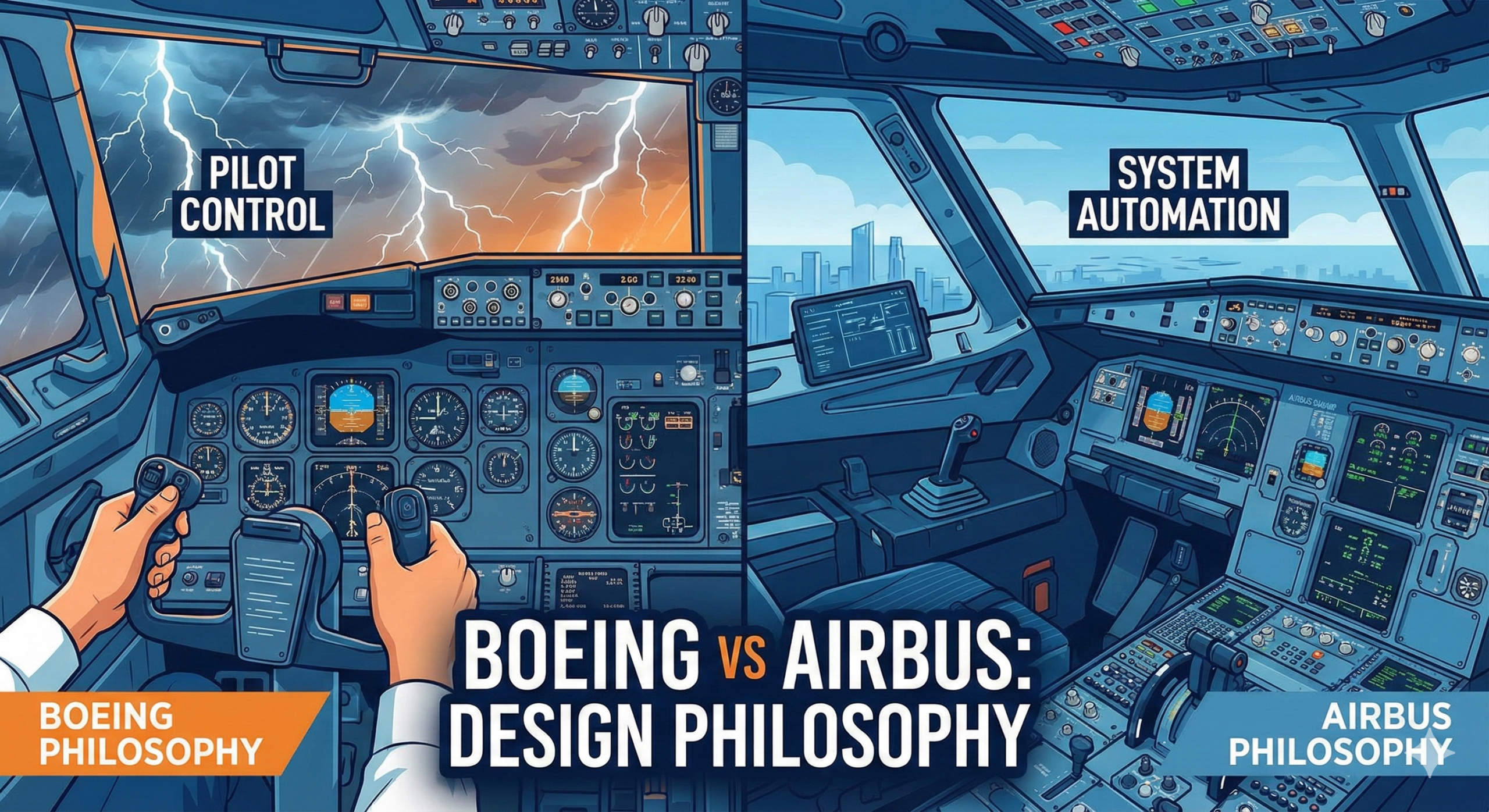
The most significant difference between Boeing and Airbus lies in the philosophical question of which entity—the pilot or the computer—should hold the ultimate authority over aircraft operations. This design philosophy emerged from each company’s technical heritage during its founding and differing values regarding safety.
Boeing: Pilot Authority Priority
Boeing has long adopted a “pilot authority priority” philosophy. This approach grants pilots the fundamental freedom to decide how much force to apply to the control column and the extent of control inputs when operating the aircraft. In other words, the pilot remains in command of the airplane, while computers serve primarily as information providers and support tools.
To illustrate this philosophy, consider operating a standard automobile. When you turn the steering wheel sharply to the right, the car responds immediately with a corresponding turn. Similarly, in Boeing aircraft, the pilot’s intentions are directly reflected in the aircraft’s movements, maximizing the value of the pilot’s experience and judgment. Boeing’s underlying conviction is that experienced pilots understand the aircraft’s limitations and that restricting their decisions does not necessarily enhance safety.
Airbus: Computer Protection First
Conversely, Airbus emphasizes a “computer protection first” design philosophy. This means that computers onboard the aircraft receive pilot inputs and automatically adjust the aircraft’s behavior to maintain operation within a defined safe operating envelope. This safe operating envelope encompasses the aircraft’s operational limits defined by multiple parameters: airspeed range, altitude, G-loading (gravitational acceleration), and other critical factors.
Airbus’s approach is grounded in the recognition that humans are inherently prone to error. Through automatic adjustments within computer-defined safety boundaries, this design aims to prevent accidents resulting from pilot mishandling. Airbus terms this function Flight Envelope Protection and positions it as a critical technical guarantee of aviation safety.
Design Philosophy and Aviation Accidents: The Lessons of Air Inter Flight 148
However, in the early stages of technological implementation, pilot unfamiliarity and interface design problems occasionally resulted in accidents. The crash of Air Inter Flight 148 on January 20, 1992, exemplifies how initial-phase challenges and the critical importance of interface design can intersect with tragic consequences.
The Accident Sequence
On January 20, 1992, an Airbus A320-111 crashed during approach to Strasbourg Airport in France, resulting in 87 fatalities among the 96 people aboard. At that time, the Airbus A320 was a state-of-the-art aircraft equipped with a computerized control system fundamentally different from conventional aircraft. Following a detailed investigation, the accident investigation commission concluded that a pilot input error was the root cause. Simultaneously, however, the investigation also identified system design flaws that contributed to the error.
The Cause of the Accident: Input Error and Its Background
The pilot, intending to set the descent angle (Flight Path Angle, FPA) to “-3.3 degrees” on the Flight Control Unit (FCU), inadvertently entered a vertical speed (Vertical Speed, V/S) of “-33” (3,300 feet per minute descent rate). This erroneous input resulted in a descent rate approximately four times steeper than normal for landing approaches, causing the aircraft to strike a mountainous terrain before reaching the preset hard altitude limit.
Several factors contributed to this input error. First, the FCU design utilized the same switch for both “path and flight path angle mode” and “heading and vertical speed mode,” requiring pilots to select the appropriate mode via separate up-and-down controls. This design was not intuitive and readily invited mode-selection confusion. Second, the pilot failed to verify the mode setting after input before proceeding to the next operational step. Third, both pilots were insufficiently familiar with the newly introduced Airbus A320 aircraft. The confluence of these factors resulted in a preventable operational error.
Post-Accident Improvements and Lessons
In response to this tragic accident, Airbus immediately undertook corrective measures. The company redesigned the FCU control panel to be less prone to misoperation, developing a more intuitive and error-resistant interface. New aircraft incorporated the improved design, and existing aircraft underwent modification. Additionally, French aviation authorities mandated the installation of Ground Proximity Warning Systems (GPWS) to prevent such accidents. Subsequently, more advanced Terrain Awareness and Warning Systems (TAWS) became widely adopted throughout the industry.
This accident definitively demonstrated the critical importance of aircraft design philosophy and, equally, how human-machine interface (UI) design profoundly impacts safety. From this point forward, Airbus intensified its focus on pilot training and equipment usability.
Both Companies’ Design Philosophies and Modern Aviation Safety
Following the lessons of such accidents, both companies have made continuous efforts to enhance safety. However, as of 2025, the fundamental design philosophies distinguishing Boeing and Airbus remain distinct. Interestingly, however, both companies’ approaches have shown a tendency toward convergence over time.
Boeing maintains its foundational pilot authority priority philosophy while enhancing safety features in its latest aircraft. For instance, the 737 MAX is designed with multiple layers of safety systems, ensuring pilots maintain continuous situational awareness and can intervene as necessary. The 787 Dreamliner provides advanced information supporting pilot decision-making through sophisticated sensors and an integrated flight management system.
Similarly, Airbus does not completely eliminate pilot authority; rather, in its latest aircraft, pilots possess the capability to override protection functions and manually operate the aircraft when deemed necessary. For example, the latest A320 family variants allow pilots to disable certain computer protection features when taking explicitly corrective or emergency action. This reflects the recognition that in exceptional and unpredictable circumstances, pilot judgment remains paramount.
| Aspect | Boeing (Pilot Authority Priority) | Airbus (Computer Protection First) |
| Core Philosophy | Trust in experienced pilots’ judgment and maximize its application | Assume human error as inherent; ensure safety through computer-controlled operational envelope |
| Control Interface | Traditional control yoke. Pilot inputs are directly reflected in aircraft response | Side stick. Pilot inputs are restricted and adjusted by the computer |
| Pilot Authority | Pilots retain ultimate operational authority | Pilots operate within protection boundaries; override capability exists in emergencies |
| Safety Strategy | Enhance pilot training and experience; provide advanced information support systems | Define technical operational envelope parameters; prevent mishandling through automatic adjustment |
| Principal Aircraft | 737 MAX, 787 Dreamliner | A320 family, A350, A380 |
Competition Between the Two Companies and Market Positioning
As of 2025, Airbus leads the market with the A320 family, while Boeing competes with the 737 MAX and 787 Dreamliner. Both companies remain in fierce competition and continue aircraft development based on their respective philosophies. While market discussions occasionally focus on which design philosophy is superior, both companies’ contrasting approaches actually contribute to continuous improvements in aviation safety, each leveraging its respective strengths.
Airbus’s approach finds support among airlines emphasizing high-capacity transport and operational simplicity. Particularly in international long-haul operations with multinational pilot crews, computer-enforced unified safety standards are highly valued. Conversely, Boeing’s approach appeals to airlines prioritizing pilot autonomy and judgment authority, as well as operators emphasizing the capability to respond effectively to complex meteorological conditions and emergency situations.
Design Philosophy Convergence and Continuing Distinctions in the Modern Era
Notably, since the 2020s, both companies’ design philosophies have shown a tendency toward partial convergence. The aviation industry faces transformative changes, including those precipitated by the COVID-19 pandemic, the development of electric and autonomous aircraft, and the application of artificial intelligence and machine learning to flight operations. In such an environment, the appropriate balance between pilot authority and computer assistance becomes increasingly important.
Simultaneously, however, the fundamental philosophical distinctions between the two companies will likely persist. This difference transcends technical choice; it reflects foundational convictions about aviation safety and the human role in complex systems. These philosophies will continue to exert significant influence on the aviation industry’s development.
Conclusion
Understanding the design philosophy differences between Boeing and Airbus is valuable not merely for accident prevention but for comprehending how aircraft achieve safety and how superior technology emerges. The choice between pilot authority priority and computer protection priority is not a purely technical matter but rather addresses a profound question: the relationship between humans and technology and how to realize safety as humanity’s highest value.
The fact that both companies’ differing approaches contribute to advancing aviation safety, each capitalizing on its respective strengths, demonstrates that diversity and competition foster technological progress and enhanced safety. The next time you board a flight, perhaps take a moment to reflect on the design philosophy underlying your aircraft and the effort each manufacturer invests in safety.
Related Articles
- Safe Design of Medical Devices: Understanding Risk Management Fundamentals
- Understanding Legibility: A Fundamental Requirement for Electronic Records
- Understanding Regulatory Audits: Purpose, Misconceptions, and Modern Approaches
- Understanding Self-Inspection in Pharmaceutical Quality Management: A Comparative Analysis of Global Regulatory Approaches
- Understanding Installation Qualification (IQ): Purpose, Requirements, and Modern Approaches
- Understanding “Fast Time to Market” in Pharmaceutical Development
