
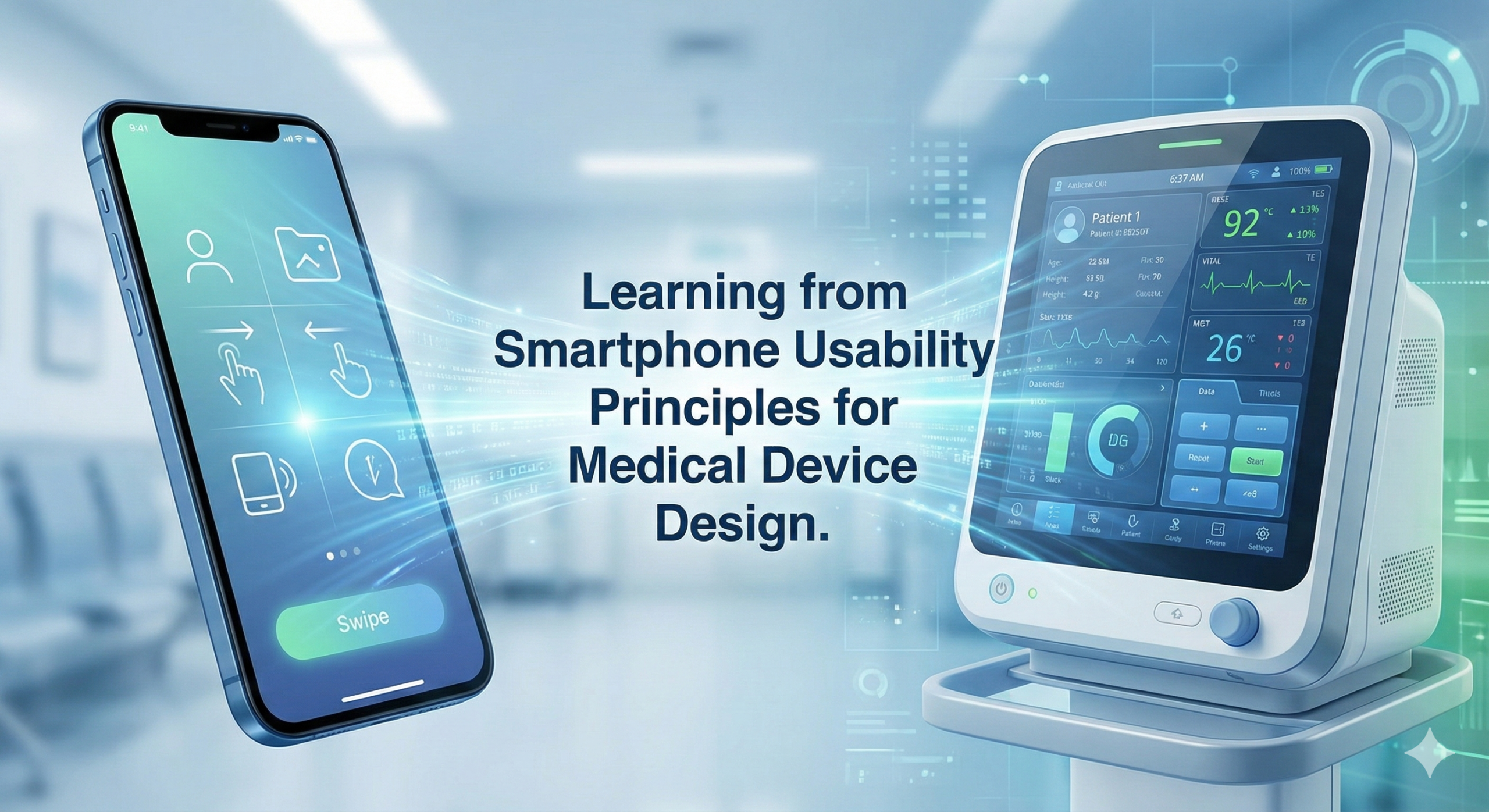
Learning from Smartphone Usability: Principles for Medical Device Design
Chapter 1: Learning Usability from Everyday Products
Smartphones, which we use daily, serve as excellent teaching materials for usability design in medical devices. In particular, Apple’s “iPhone” and Google’s “Android,” despite their different design philosophies, have been adopted by billions of users worldwide. The differences in their approaches provide important insights for medical device designers.
Smartphones, which we use daily, serve as excellent teaching materials for usability design in medical devices. In particular, Apple’s “iPhone” and Go…
In the medical device industry, usability is no longer an accessory element but has become the foundation that ensures safety and efficacy. As indicated by IEC 62366-1 (Usability Engineering for Medical Devices) and FDA‘s “Applying Human Factors and Usability Engineering to Medical Devices” (initial publication in 2016, comprehensively updated in 2024), appropriate usability design is the frontline for preventing use errors and protecting patient safety.
Chapter 2: What Usability Means in Medical Devices
IEC 62366-1 defines usability as “the degree to which users can achieve specified goals with effectiveness, efficiency, and satisfaction in a specified context of use.” In the context of medical devices, this is augmented by the crucial element of “safety.”
Usability in medical devices encompasses several key elements. Effectiveness refers to whether users can achieve their intended clinical objectives. For example, in an infusion pump, this means accurately delivering the prescribed flow rate of medication. Efficiency involves the time and effort required to achieve goals, which is particularly important in healthcare settings. In time-constrained environments such as ICUs, simplified operational procedures can directly impact patient outcomes. Learnability refers to the ease with which new users can master device operation, affecting whether new nurses and junior doctors can quickly transition to practical duties. Memorability concerns whether operators can recall procedures after periods of non-use, becoming critical during staff reassignments or returns from leave. Error Prevention involves designing to prevent use errors, a paramount concern in medical devices. Satisfaction reflects the user’s subjective experience with the device, influencing long-term success in healthcare facility adoption.
These elements are interrelated and sometimes exhibit trade-off relationships. Medical device designers must find optimal balance by considering the device’s risk classification, intended users, and usage environment. For instance, high-risk devices may prioritize safety by strengthening error prevention, while low-risk devices might emphasize learnability and satisfaction.
Chapter 3: Learning from Two Design Philosophies
The iPhone Approach: Ensuring Safety Through Consistency
iPhone design philosophy centers on “safety through constraints” and “reduced learning costs through consistency.” Basic operational methods are consistent across iPhone models, allowing users to switch devices without requiring new learning. This consistency offers several advantages.
Standardized user interfaces enable intuitive operation and minimize training time. All users become familiar with identical button layouts and menu structures, improving usage efficiency. Predictable behavior means user expectations align with actual device responses, reducing error risk. In medical devices, predictable operation decreases cognitive load and prevents errors among fatigued healthcare professionals. Ease of quality management allows integrated hardware-software management, ensuring high stability. This reduces the burden of system testing and regression testing. Extended security support provides seven or more years of OS updates and security patches for current iPhone models, ensuring ongoing response to security threats.
This approach is suitable for high-risk medical devices in Risk Classes II and III. For example, devices like ventilators and infusion pumps, where use errors directly threaten patient life, require consistent operation and high standardization. When identical equipment is used across multiple healthcare facilities, standardized procedures reduce staff burden and minimize transfer-related risks.
Important Considerations in Medical Devices: Medical devices require continuous security attention exceeding smartphone support periods. Particularly for implantable devices and large diagnostic systems, ongoing cybersecurity management throughout the product lifecycle is mandatory. FDA’s Premarket Cybersecurity Guidance and Postmarket Cybersecurity Guidance require submission of security update plans covering the device’s expected service life. Under EU MDR Article 34, manufacturers must immediately address and report to marketing authorization authorities any serious software-related security vulnerabilities discovered (strengthened as of 2024). Furthermore, IEC 62304:2023 explicitly specifies software security requirement management, requiring integrated security measures from the design phase.
The Android Approach: Addressing Diverse Needs Through Flexibility
Conversely, Android design emphasizes “flexibility” and “customizability.” With diverse manufacturers participating, users can select devices optimized for their individual needs.
High-level customizability allows free configuration of home screens, widgets, and default applications, enabling users to optimize for their specific workflows. Diverse hardware options provide choices in screen size, processing power, and price point suited to different use cases. Open ecosystem facilitates third-party app development and system integration, fostering innovation. Graduated feature additions enable feature expansion according to user proficiency levels.
This approach suits relatively low-risk devices in Risk Classes I and IIa, or advanced diagnostic devices for specialists. For example, home medical devices like blood pressure monitors and glucose meters serve users of diverse ages and technical proficiency, where customizable interfaces prove valuable. Young, digitally native patients and elderly patients require distinctly different interface designs. Similarly, imaging workstations used daily by radiologists benefit greatly from customization matching individual physician workflows. However, this flexibility should be constrained within appropriate guardrails, with patient safety-related functions remaining non-modifiable.
Chapter 4: Practical Application to Medical Device Development
Analysis of Use Environment and User Characteristics
The most critical step in medical device usability design is detailed analysis of the use environment and user characteristics. The following elements require consideration.
Understanding user diversity is the starting point. In healthcare settings, interactions with medical devices vary significantly among specialists, nurses, clinical engineers, patients, and caregivers by role. Technical proficiency spans a broad spectrum, from digital natives to elderly users, requiring accommodating designs. Physical capability variations, including vision impairment, hearing loss, and reduced manual dexterity, demand attention to diverse needs.
Use environment characteristics are equally important. High-stress emergency rooms demand quick, intuitive operation, whereas low-stress routine health examinations benefit from detailed features and educational information. Lighting conditions differ dramatically between surgical room bright direct lighting and varied home medical lighting, requiring substantially different screen designs. Ambient noise levels and time constraints are significant factors.
Integration requirements represent an often-overlooked design element. Integration with electronic health record systems significantly reduces healthcare provider burden. Interoperability with other medical devices is essential for safe, efficient care delivery. Without alignment with existing clinical workflows, device adoption will stall regardless of technical merit.
Specific Design Strategies
Strategy 1: Progressive Disclosure
Provide basic functions through a unified, intuitive interface, with advanced functions revealed gradually. This technique achieves both iPhone-style consistency and Android-style extensibility.
Consider the infusion pump example: the basic mode presents only standard infusion rate settings with large buttons and clear displays, enabling rapid operation in emergencies. The detailed mode provides pharmacy libraries, infusion protocols, and alarm settings, sufficient for typical daily operations. The expert mode enables programmable complex infusion patterns and research applications. Advancing between modes requires authentication or explicit selection, preventing accidental access to complex settings.
Strategy 2: Context-Dependent Display
Optimize interfaces according to use circumstances.
For cardiac monitors: the emergency mode achieves rapid measurement initiation with minimal operations and large alarm displays enabling immediate recognition of critical abnormalities. The routine mode provides detailed waveform analysis and historical comparison, tracking patient condition changes. The review mode enables recorded data search and standardized report generation, supporting conferences and records management.
Strategy 3: Multimodal Feedback
Combine visual, auditory, and tactile feedback to strengthen error prevention and confirmation.
For defibrillators: visual feedback includes color-coded charging status displays (progressing from red through yellow to green) and explicit next-step indication, allowing users to continuously recognize their current stage. Auditory feedback provides charging completion sounds and clear voice guidance like “Clear all personnel,” ensuring critical instructions reach users in chaotic emergency scenes. Tactile feedback uses distinctive button shapes and positions to physically prevent incorrect operation.
Design Weighting Based on Risk Levels
Following IEC 62366-1’s risk management process, design emphasis should vary according to use-related risk severity.
| Risk Level | Function Examples | Recommended Approach | Design Characteristics |
| High risk (possibility of serious injury or death) | Ventilator mode changes, infusion pump drug selection | iPhone approach priority | Standardization, physical constraints, confirmation steps, consistent operation regardless of device type or user |
| Medium risk (possibility of temporary injury) | Ultrasound presets, patient data input | Balanced approach | Standardized foundation with some customization, progressive disclosure utilization |
| Low risk (low injury possibility) | Report format selection, screen layout adjustment, language selection | Android approach acceptable | Emphasis on flexibility and customizability, responsiveness to individual user needs |
This table demonstrates the importance of applying different design philosophies according to functional risk characteristics. Even within a single medical device, employing different approaches for different functions achieves both safety and usability.
Chapter 5: Usability Verification and Postmarket Management
Usability Verification During Development
No matter how excellent usability goals established during design, completion requires actual user verification. Formative Evaluation and Summative Evaluation, as required by IEC 62366-1, represent continuous improvement processes implemented by both iPhone and Android products. These evaluations constitute both regulatory requirements and product quality assurance mechanisms.
Formative Evaluation involves iterative testing at the prototype stage, observing actual intended user use under conditions approximating real environments to identify use errors and gather design feedback. This stage prioritizes learning and improvement speed over completeness, implementing multiple design iteration cycles. IEC 62366-1:2015 requires Formative Evaluation execution at each stage of the design process.
Summative Evaluation provides comprehensive human factors verification of final products, implementing testing with statistically sufficient sample sizes to demonstrate that critical use errors have been reduced to acceptable levels. Typically, medical device summative evaluations involve 20 to 40 actual users testing standardized use scenarios with performance measurement. Regulatory authorities including FDA, EMA, and PMDA highly value this evaluation report as evidence of device safety and efficacy.
Critical Differences in Postmarket Improvement Processes
Fundamental differences exist between smartphone and medical device postmarket improvement processes. Understanding these distinctions is essential for medical device developers.
The smartphone approach implements frequent software updates (weekly to monthly) enabling rapid feature improvements based on user feedback. A/B testing with graduated feature rollout validates new functions while minimizing risk. Importantly, this process requires no regulatory authority preapproval, with updates delivered directly to users with their consent.
Medical device regulatory requirements differ substantially. Change management rigor makes regulatory change procedures following FDA (21 CFR Part 820.70) and EU MDR Annex IX mandatory when software changes impact device safety or efficacy. These procedures require documentation of change details, impact scope analysis, risk assessment, and verification planning.
Preapproval necessity determination follows FDA’s “Deciding When to Submit a 510(k) for a Software Change to an Existing Device” guidance (updated 2024 version). Major changes require preapproval through 510(k) or PMA supplement. Major change examples include algorithm modifications, new diagnostic feature additions, and safety-related parameter changes. Conversely, minor changes (such as user interface visual improvements, language additions, performance enhancements) may not require preapproval. However, this determination process itself must be rigorously executed and documented.
Continuing postmarket surveillance also represents device-specific requirements. Complaint handling following ISO 13485 Section 7.2.3 and 21 CFR Part 820.198 is mandatory, requiring documentation and analysis of all customer complaints regarding medical devices, however minor. Furthermore, MDR and incident reporting obligations require reporting and analysis of all events involving patient harm. EU MDR mandates registration in serious adverse event reporting systems (Medical Device Vigilance System: MDVS).
Verification and validation repetition, following IEC 62304, requires regression testing and revalidation according to software change impact scope. For example, even background color changes require verification that color selection does not impact visual accessibility. Algorithm changes demand performance comparison testing pre- and post-change, proving efficacy preservation. IEC 62304:2023 specifically addresses software security update verification, requiring confirmation that security patches do not adversely affect other functions.
Practical Implications
Medical device developers should adopt modular design considering postmarket change management from the design phase. Specifically, critical versus non-critical function separation clearly distinguishes safety-critical functions (such as alarm thresholds, dose calculation logic) from user experience improvement functions (such as screen layout, color schemes, language settings). This reduces revalidation burden for non-critical function changes.
Next, change impact prediction must occur during design stages. Software Hazard Analysis enables anticipation of potential change scenarios, predicting whether future modifications require regulatory submission, facilitating long-term product support strategy development. For instance, anticipating future security updates by modularizing security-related code eases later modifications.
Graduated release strategy planning includes controlled release trials with limited user groups, enabling premarket discovery of unanticipated issues. For example, initial three-month trials of new versions at limited healthcare facilities (such as five university hospitals) enable real-use condition problem identification before broader release.
Thorough documentation maintaining change history, risk assessments, and verification records in ISO 13485 and FDA QSR compliance is essential. These records are indispensable for future audits and traceability assurance. Particularly for security-related modifications, detailed records support regulatory authority postmarket safety surveillance and should be preserved with precision.
Realizing smartphones’ “rapid iterative improvement” advantage in medical devices requires deliberate design considerations and regulatory strategy. To implement postmarket improvements rapidly, medical device manufacturers should consciously employ regulatory risk-minimizing designs and streamline change management processes. Some manufacturers employ strategy of preparing multiple 510(k) submissions in advance, enabling rapid response when postmarket issues emerge.
Conclusion: Achieving Optimal Balance in Medical Device Design
iPhone and Android usability approaches provide important lessons for medical device design. “Ensuring safety through consistency” and “enabling adaptability through flexibility” are not opposing elements but should be appropriately balanced according to specific device characteristics.
Medical device developers should follow these principles.
Comprehensive user-centered design establishes the foundation, approaching design from actual user perspectives rather than engineer perspectives. User feedback collected during Formative Evaluation should consistently take priority in design decisions.
Risk-based approach determines standardization versus flexibility balance based on risk assessment for individual functions. Prioritizing standardization for high-risk functions and flexibility for low-risk functions achieves both safety and usability.
Iterative improvement establishes continuous feedback cycles respecting regulatory requirements. Continuously incorporating postmarket data analysis, user suggestions, and emerging clinical literature insights maximizes device value.
Global perspective requires adaptation to different healthcare systems, regulatory requirements, and cultural contexts. For instance, US markets require FDA compliance, EU markets require MDR compliance, and Japanese markets require Pharmaceutical Affairs Law and PMDA notification compliance. Usability verification should also consider region-specific real-use scenarios.
Long-term perspective requires establishing support systems throughout ten or more years of product lifecycle. Security updates, new clinical guideline adaptation, and aging hardware accommodation demand long-term commitment. Particularly for implantable devices, lifelong patient support represents an ethical obligation.
Superior usability functions simultaneously as medical device differentiation and patient safety foundation. Learning from familiar smartphone products and combining with device-specific requirements enables development of truly user-centered medical devices. As regulatory environments continuously evolve, maintaining user perspectives as design center remains key to sustainable, trusted medical device development.
Related FDA QMSR Templates
Streamline your FDA QMSR compliance with our professionally crafted templates:
Related Articles
- Misuse and Use Error: Usability Engineering in Medical Device Design
- Why Should We Focus on Differences from Predicated Devices in Medical Device Design?
- The Importance of Design Control in Medical Devices
- FDA Design Control Guide: Foundation of Medical Device Quality Management
- Essential Requirements and Essential Principles for Medical Devices
- The Importance of Use Environment and User Characteristics in Medical Device Usability Engineering
