
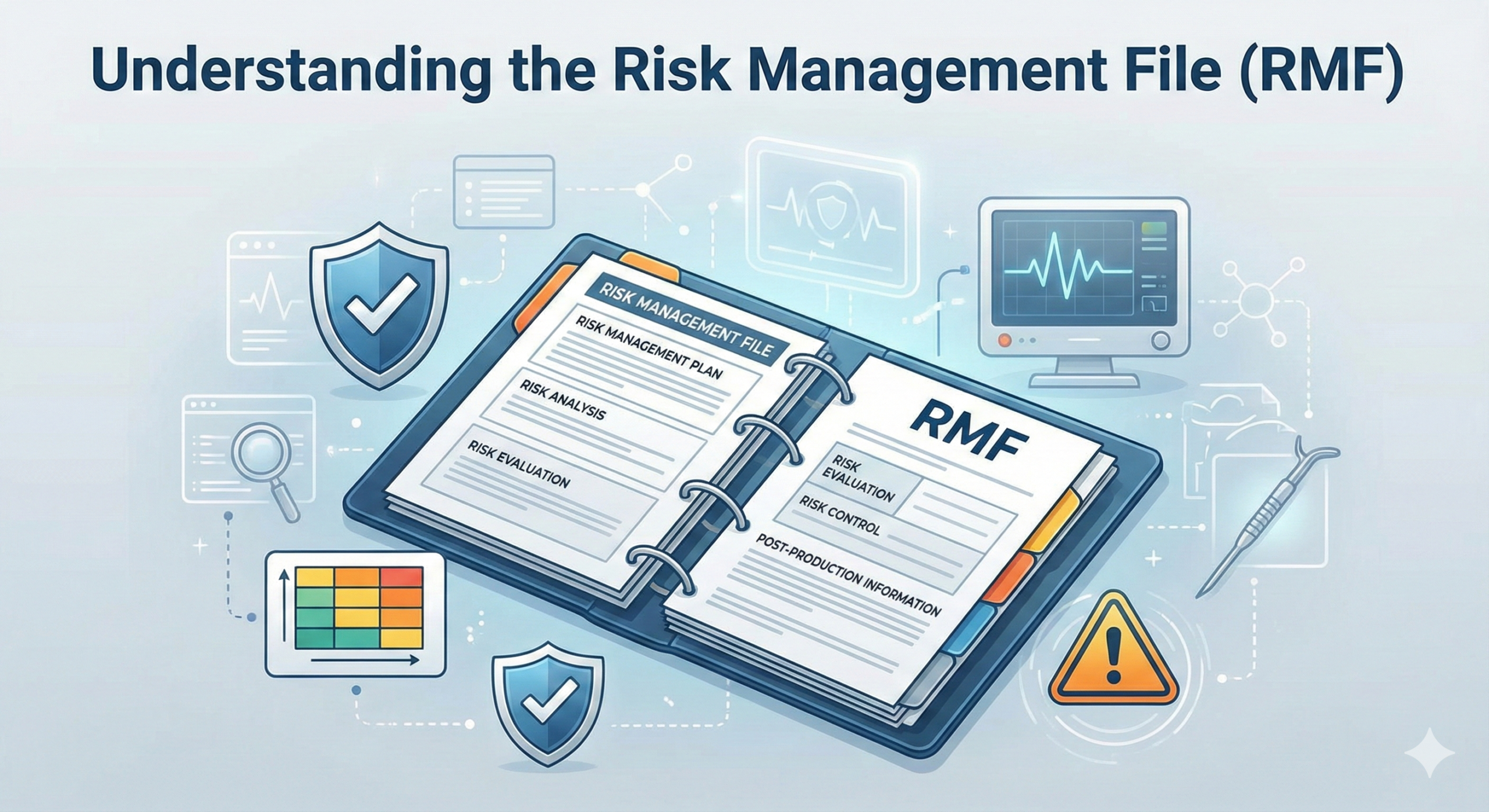
Understanding the Risk Management File (RMF)
For a sample Risk Management File, please see here.
For a sample Risk Management File, please see here….
In the development of medical devices, ensuring safety is the highest priority. However, efficiently extracting and evaluating safety-related information from the vast amount of documentation generated during the development process is not straightforward. The Risk Management File (RMF) was created to address this challenge.
Definition and Purpose of the RMF
The Risk Management File is an index document that systematically organizes all information related to the safety of a medical device. It is not merely a collection of documents but serves as a “map” that clearly indicates where risk-related information can be found within each document.
The main purposes of the RMF are as follows:
Centralized management of safety information – This enables rapid identification of necessary information from multiple documents where risk-related information is scattered, facilitating efficient access to critical safety data.
Enhanced efficiency in regulatory reviews – It allows regulatory authorities and notified bodies to conduct cross-sectional document reviews from a safety perspective, enabling reviewers to quickly locate relevant risk management activities without having to search through extensive documentation.
Ensuring traceability – It makes the entire process traceable, from risk identification through implementation of control measures to verification, creating a complete audit trail that demonstrates how each identified hazard has been systematically addressed throughout the device lifecycle.
Components of the RMF
A typical RMF includes the following elements:
1. Risk Analysis-Related Documents
- Hazard analysis documents
- Risk assessment reports
- FMEA (Failure Mode and Effects Analysis) documents
- Preliminary Hazard Analysis (PHA)
2. Risk Control-Related Documents
- Design specifications (sections describing risk reduction measures)
- Verification and validation reports
- Documentation supporting warnings and precautions
- Test protocols and results demonstrating effectiveness of control measures
3. Post-Production Information
- Post-market surveillance plans
- Adverse event reports
- Corrective and preventive action records (CAPA)
- Field safety corrective actions (FSCA)
- Periodic Safety Update Reports (PSUR) for higher-risk devices
- Post-market Clinical Follow-up (PMCF) data
4. Comprehensive Evaluation Documents
- Risk/benefit analysis
- Residual risk evaluation documents
- Risk management reports
- Overall residual risk acceptability evaluation
The Importance of the Traceability Matrix
The core of the RMF is the traceability matrix (also known as the risk traceability matrix or risk trace matrix). This is a table that connects all related information from identified hazards through risk evaluation, risk control measures, to verification results, providing a comprehensive view of how each risk has been managed.
For example, for the hazard of “electrical shock,” the matrix demonstrates:
- Which document contains the risk evaluation
- Where in the design specifications the control measures are described
- Which test report confirms the effectiveness of those measures
- What residual risk remains after implementation of controls
- How post-market data validates the risk assessment
This information can be grasped at a glance, enabling efficient tracking of the complete risk management lifecycle for each identified hazard.
| Hazard | Hazardous Situation | Harm | Initial Risk | Control Measure | Verification Document | Residual Risk |
| Electrical energy | Contact with live parts during maintenance | Electrical shock | High | Double insulation + Warning label | Electrical safety test report ES-2024-001 | Low (Acceptable) |
Utilization in Regulatory Reviews
Regulatory authorities and notified bodies can efficiently conduct the following verifications by utilizing the RMF:
Verification of comprehensiveness – Confirming that all foreseeable hazards have been identified and evaluated, ensuring no significant risks have been overlooked in the analysis process.
Verification of appropriateness – Confirming that risk control measures have been appropriately selected and implemented according to the risk control hierarchy (inherent safety by design, protective measures, information for safety), with proper justification when preferred measures cannot be applied.
Verification of effectiveness – Confirming that implemented measures function as intended, with objective evidence demonstrating that residual risks have been reduced to acceptable levels as defined in the risk management plan.
Verification of continuity – Confirming that risks are appropriately monitored and managed post-market through established post-market surveillance systems, with mechanisms in place to update the risk management file when new information becomes available.
Considerations When Creating an RMF
To create an effective RMF, attention must be paid to the following points:
1. Planning from Early Stages
It is important to design the structure of the RMF from the initial stages of the project and establish appropriate cross-references when creating documents. Early planning ensures that all risk management activities are properly documented and traceable from the beginning, avoiding the need for retrospective reconstruction of the risk management process.
2. Regular Updates
As the development process progresses, new risks may be identified, and control measures may be modified. The RMF must reflect these changes and always be maintained in its current state. This is particularly critical during design changes, when new information from risk assessments becomes available, or when post-market data reveals previously unidentified hazards or ineffective control measures.
3. Ensuring Accessibility
It is important to provide clear indexes and cross-references so that reviewers can quickly access necessary information. The RMF should be structured in a logical manner that reflects the flow of the risk management process, with document references that are specific, accurate, and easy to follow. Consider organizing the RMF in a way that allows reviewers to understand the complete risk story for the device.
4. Compliance with Standards
The RMF must be structured to satisfy the requirements of related standards such as ISO 14971:2019 (Risk Management for Medical Devices) and its companion guidance document ISO/TR 24971:2020. Additionally, for devices intended for the European market, the RMF must align with the requirements of the EU Medical Device Regulation (MDR) 2017/745 or the In Vitro Diagnostic Regulation (IVDR) 2017/746, which have strengthened post-market surveillance requirements compared to previous directives.
Key regulatory requirements to consider include:
- ISO 14971:2019 requirements – The 2019 revision emphasizes benefit-risk analysis, production and post-production information, and overall residual risk evaluation. The RMF must demonstrate how these elements have been addressed throughout the device lifecycle.
- EU MDR/IVDR requirements – These regulations require comprehensive post-market surveillance plans, periodic safety update reports (PSUR) for Class IIa, IIb, and III devices, and post-market clinical follow-up (PMCF) activities. The RMF must include references to these documents and demonstrate how post-market data feeds back into the risk management process.
- FDA expectations – While the FDA does not explicitly require an RMF, the agency expects manufacturers to demonstrate systematic risk management throughout the device lifecycle. The principles embodied in the RMF align well with FDA premarket submission requirements and Quality System Regulation (21 CFR Part 820) expectations.
Best Practices for RMF Organization
The RMF can be structured as either a standalone document that consolidates all risk management records or as a master index document that references where individual records are stored. While both approaches are acceptable, best practices suggest:
Consolidated approach – Maintaining all risk management documents and records in a single, well-organized location reduces the likelihood of document management errors and ensures all relevant information is readily accessible. This approach is particularly beneficial for electronic quality management systems (eQMS) that can link documents seamlessly.
Reference approach – If using a reference-based RMF, ensure that document references are specific, accurate, and include version control information. This approach requires rigorous document control procedures to maintain the integrity of cross-references.
Regardless of the approach chosen, the RMF should be treated as a living document that evolves throughout the product lifecycle, from initial concept through post-market surveillance.
Integration with Quality Management System
The risk management process documented in the RMF should be fully integrated into the organization’s quality management system (QMS). According to ISO 13485:2016 (Medical devices – Quality management systems), risk management activities must be planned and documented as part of the overall QMS framework. The RMF serves as key objective evidence of this integration, demonstrating how risk management informs design and development decisions, production processes, and post-market activities.
Summary
The Risk Management File is an essential tool for systematically managing and demonstrating the safety of medical devices. Rather than being merely a collection of documents, it realizes the “visualization” of the entire risk management process and becomes a valuable source of information for both developers and reviewers.
As medical devices become increasingly complex, the importance of the RMF continues to grow. A properly constructed RMF becomes the foundation supporting the development and market introduction of safe medical devices, ultimately contributing to ensuring patient safety. Developers are required to utilize the RMF not merely as a regulatory requirement, but as a strategic tool for continuously improving product safety throughout the device lifecycle.
In the evolving regulatory landscape, with heightened emphasis on post-market surveillance, benefit-risk analysis, and lifecycle risk management as reflected in ISO 14971:2019, EU MDR 2017/745, and IVDR 2017/746, the RMF has become more than a documentation requirement—it is a critical management tool that enables manufacturers to demonstrate ongoing commitment to device safety and performance. By investing in a well-structured, comprehensive RMF, manufacturers not only facilitate regulatory approval but also establish robust systems for identifying and mitigating risks throughout the entire lifecycle of their medical devices, ultimately protecting patients and healthcare providers while supporting business success in an increasingly complex regulatory environment.
Related Articles
- Preventive Action as Risk Management: Understanding CAPA in Pharmaceutical and Medical Device Industries
- Quality Risk Management: Understanding ICH Q9 and the Revised GMP Regulations
- Understanding Risk Assessment in Pharmaceutical Quality Management
- Understanding “State of the Art” in Medical Device Risk Management
- ISO 14971:2019 Revisions – Part 2: Management Responsibility, Risk Analysis, and Risk Management File
- Safe Design of Medical Devices: Understanding Risk Management Fundamentals
