
What is SaMD – When Software Alone Becomes a Medical Device
Smartphone applications support physician diagnoses, and game-like software is prescribed as therapeutic treatment. While this may sound like a vision of the future, it has already become reality. The key to this transformation is the concept of “SaMD (Software as a Medical Device).”
Smartphone applications support physician diagnoses, and game-like software is prescribed as therapeutic treatment. While this may sound like a vision…
Traditionally, when thinking of medical devices, people generally imagined hardware-integrated equipment such as CT scanners or electrocardiogram monitors. However, with the evolution of digital technology, an era has arrived where software alone can fulfill the functions of a medical device. This article explores the new possibilities that SaMD brings to healthcare, along with the technical and institutional transformations that underpin it.
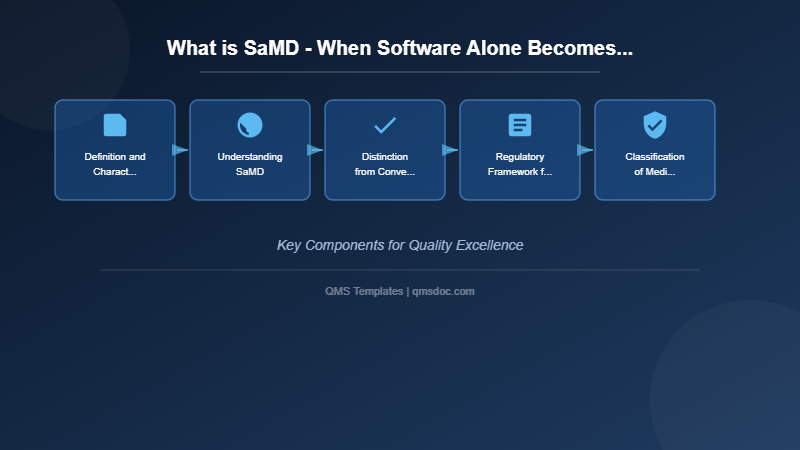
Definition and Characteristics of SaMD
Understanding SaMD
SaMD (Software as a Medical Device) is a concept defined by the International Medical Device Regulators Forum (IMDRF) as “software intended to be used for medical purposes and which is not part of a hardware medical device.” The crucial point is that this software functions as a medical device independently.
Distinction from Conventional Medical Device Software
Understanding the difference from software embedded in conventional medical devices (Software in Medical Device: SiMD) is important. For example, the control software of an MRI system falls under SiMD. In contrast, an electrocardiogram analysis application running on a smartphone qualifies as SaMD.
SaMD is characterized by the following features. It functions independently of hardware, can operate on general-purpose computing platforms such as personal computers, smartphones, and cloud servers, allows for easy updates and version management, and enables rapid distribution and deployment.
Regulatory Framework for SaMD in Japan
In Japan, through the amendment of the Pharmaceuticals and Medical Devices Act (Act on Securing Quality, Efficacy and Safety of Products Including Pharmaceuticals and Medical Devices) in November 2013 (enforced in November 2014), standalone programs also became subject to regulation as medical devices. This represented one of the earliest implementations globally, alongside the US FDA and Europe’s Medical Device Regulation (MDR), establishing a foundation for Japan to play an active role in the digital health field.
Classification of Medical Devices
Like other medical devices, SaMD is subject to risk-based classification:
- Class I (General Medical Devices): Devices with extremely low risk to the human body even in case of malfunction
- Class II (Controlled Medical Devices): Devices with relatively low risk to the human body in case of malfunction
- Class III (Highly Controlled Medical Devices): Devices with relatively high risk to the human body in case of malfunction
- Class IV (Highly Controlled Medical Devices): Devices with high invasiveness to patients where malfunction could directly threaten life
Specific Examples and Application Fields of SaMD
1. Diagnostic Support Systems
With the advancement of AI technology, image diagnostic support systems are rapidly becoming widespread. Examples include software that supports the detection of pulmonary nodules from chest X-ray images and systems that assess the risk of diabetic retinopathy from fundus photographs. These systems play a role in assisting physician diagnoses and reducing the risk of oversight.
2. Digital Therapeutics (DTx)
Digital Therapeutics (DTx) are gaining attention as therapeutic applications. In Japan, the smoking cessation treatment app “CureApp SC Nicotine Dependence Treatment App and CO Checker” was approved for insurance coverage in December 2020, becoming a major topic of discussion. This app demonstrates treatment effects equal to or greater than conventional pharmacotherapy by monitoring patients’ smoking status and providing individualized behavioral therapeutic interventions. Subsequently, multiple DTx products, including hypertension treatment apps, have obtained pharmaceutical approval.
3. Disease Management and Monitoring Systems
SaMD supporting daily health management for chronic disease patients is increasing. Examples include blood glucose management apps for diabetes patients and wearable device-linked software for detecting atrial fibrillation. These promote patient self-management and play a role in seamlessly connecting treatment at medical institutions with daily life.
4. Rehabilitation Support
Rehabilitation support software utilizing VR technology is also emerging. By incorporating gamification elements for motor function recovery after stroke and cognitive function training, these applications aim to maintain patient motivation and improve treatment effectiveness.
Technical Challenges in SaMD Development
Security and Privacy Protection
SaMD handling medical information requires extremely high security standards. Personal health information is among the most confidential types of information, and unauthorized access or information leakage constitutes a serious problem. Developers must pay particular attention to the following aspects: implementing end-to-end encryption, conducting regular security audits, complying with international privacy regulations such as GDPR and HIPAA, and adopting zero-trust security models.
Ensuring Interoperability
In medical settings, diverse systems are in operation, and it is important for SaMD to appropriately integrate with these systems. Challenges include compliance with medical information exchange standards such as HL7 FHIR and integration with existing electronic medical record systems.
Validation and Version Management
While software characteristics enable frequent updates, it is necessary to continuously ensure safety and efficacy as a medical device. Establishing change management processes and appropriate verification of each version is essential.
Regulatory Requirements and Compliance
Quality Management System (QMS)
The development and manufacturing of SaMD requires the establishment of a quality management system compliant with ISO 13485. This includes the following elements: risk management (ISO 14971), software lifecycle process (IEC 62304), usability engineering (IEC 62366), and cybersecurity management.
Clinical Evaluation and Post-Market Surveillance
Appropriate clinical evaluation is necessary to demonstrate the efficacy and safety of SaMD. Unlike conventional medical devices, the utilization of real-world data and continuous performance monitoring play important roles.
Promotion of SaMD Implementation in Japan
DASH for SaMD
In November 2020, the Ministry of Health, Labour and Welfare announced the “Program Medical Device Practical Application Promotion Package Strategy (DASH for SaMD: DX Action Strategies in Healthcare for SaMD).” This strategy aims to promote the practical application of program medical devices through four approaches: early identification of emerging technologies and publication of examination guidelines, unification of consultation windows, examination systems considering the characteristics of program medical devices, and system strengthening for early practical application.
Based on DASH for SaMD, in April 2021, the Program Medical Device Examination Management Office and Program Medical Device Council were established at the Ministry of Health, Labour and Welfare, and the PMDA Program Medical Device Examination Office and unified consultation window were established at the Pharmaceuticals and Medical Devices Agency (PMDA).
IDATEN System
The system for prior confirmation of change plans according to medical device characteristics (commonly known as IDATEN: Improvement Design within Approval for Timely Evaluation and Notice) was introduced through the 2019 amendment of the Pharmaceuticals and Medical Devices Act and implemented in August 2020. For SaMD where improvements are anticipated immediately after approval, this system confirms the change plan itself during the examination process, allowing improvements to be recognized through merely submitting a “notification of minor changes to manufacturing and marketing approval” if within the scope of that plan. This enables significant reduction in examination periods and fees, making it possible to more rapidly provide high-performance medical devices.
Expansion of Certification System
Following the June 2022 Cabinet decision on the “Regulatory Reform Implementation Plan,” efforts are underway to shift SaMD with existing approval records to certification by registered certification bodies according to type and target disease. For SaMD undergoing approval examination by PMDA, examination point information (test conditions for evaluating efficacy and safety, evaluation points, etc.) is being organized and published to improve predictability for development companies.
Insurance Reimbursement Evaluation
In the 2024 fiscal year medical fee revision, evaluation criteria for the usefulness of program medical devices were established. This presents evaluation frameworks for both diagnostic and therapeutic program medical devices, establishing a system where products can receive appropriate evaluation beyond mere pharmaceutical approval. However, while many SaMD products have obtained manufacturing and marketing approval, numerous products exist that are not evaluated in medical fees, making insurance reimbursement strategies important in addition to pharmaceutical approval strategies.
Transformation of Healthcare Brought by SaMD
Improved Accessibility
Unlike physical medical devices, SaMD can be distributed instantly via the internet. This enables access to advanced medical technology transcending geographical constraints. The significance of receiving diagnostic support from specialists is particularly great in regions with limited medical resources.
Realization of Personalized Medicine
The characteristics of SaMD, which can process and analyze large amounts of data, make personalized medicine tailored to each patient’s individual characteristics achievable. By comprehensively analyzing genetic information, lifestyle habits, treatment history, and other factors, optimal treatment policies can be proposed.
Optimization of Medical Costs
By promoting preventive medicine and early diagnosis, there is potential to prevent severe conditions and consequently contribute to reducing medical costs. Additionally, by enabling health management at home, shortening hospital stays and optimizing the number of outpatient visits are also anticipated.
Future Prospects and Challenges
Integration with AI Technology
With the evolution of machine learning and deep learning technologies, the diagnostic accuracy and therapeutic effects of SaMD are dramatically improving. However, many issues remain to be resolved, including explainability of AI decisions (Explainable AI) and algorithm bias problems.
Promotion of International Standardization
In the global medical device market, harmonization of regulatory requirements among countries becomes important. International framework development centered on IMDRF is advancing, with Japan playing an important role as a founding member alongside the United States, Europe, Canada, and Australia. In particular, Japan’s experience with the Pharmaceuticals and Medical Devices Act is being utilized in the international harmonization of SaMD classification frameworks and QMS requirements.
Accumulation of Evidence
To demonstrate the efficacy of SaMD, accumulation of high-quality clinical evidence is essential. Utilization of real-world evidence and development of new clinical evaluation methods are required.
Conclusion
SaMD represents the digital transformation of healthcare. As software functions independently as a medical device, the method of providing healthcare, patient treatment experiences, and the entire healthcare system are undergoing major changes.
However, this transformation cannot be realized through technological progress alone. It is important for regulatory authorities, healthcare professionals, developers, and patients to cooperate and advance while balancing safety and innovation. As a country that implemented SaMD systems ahead of the world, Japan is expected to demonstrate leadership in this field.
The fusion of digital technology and healthcare has only just begun. We must continue advancing toward realizing a society where all people can receive high-quality healthcare while maximizing the possibilities that SaMD brings.
Related Articles
- Regulatory Requirements for Medical Device Software Development
- What Are the Essential Principles for Medical Devices (Japan)?
- Software Validation in Medical Device Companies
- What Are Files in Medical Device Regulatory Affairs?
- Guideline on Determining Medical Device Classification for Software Programs
- Medical Device Software Development
