
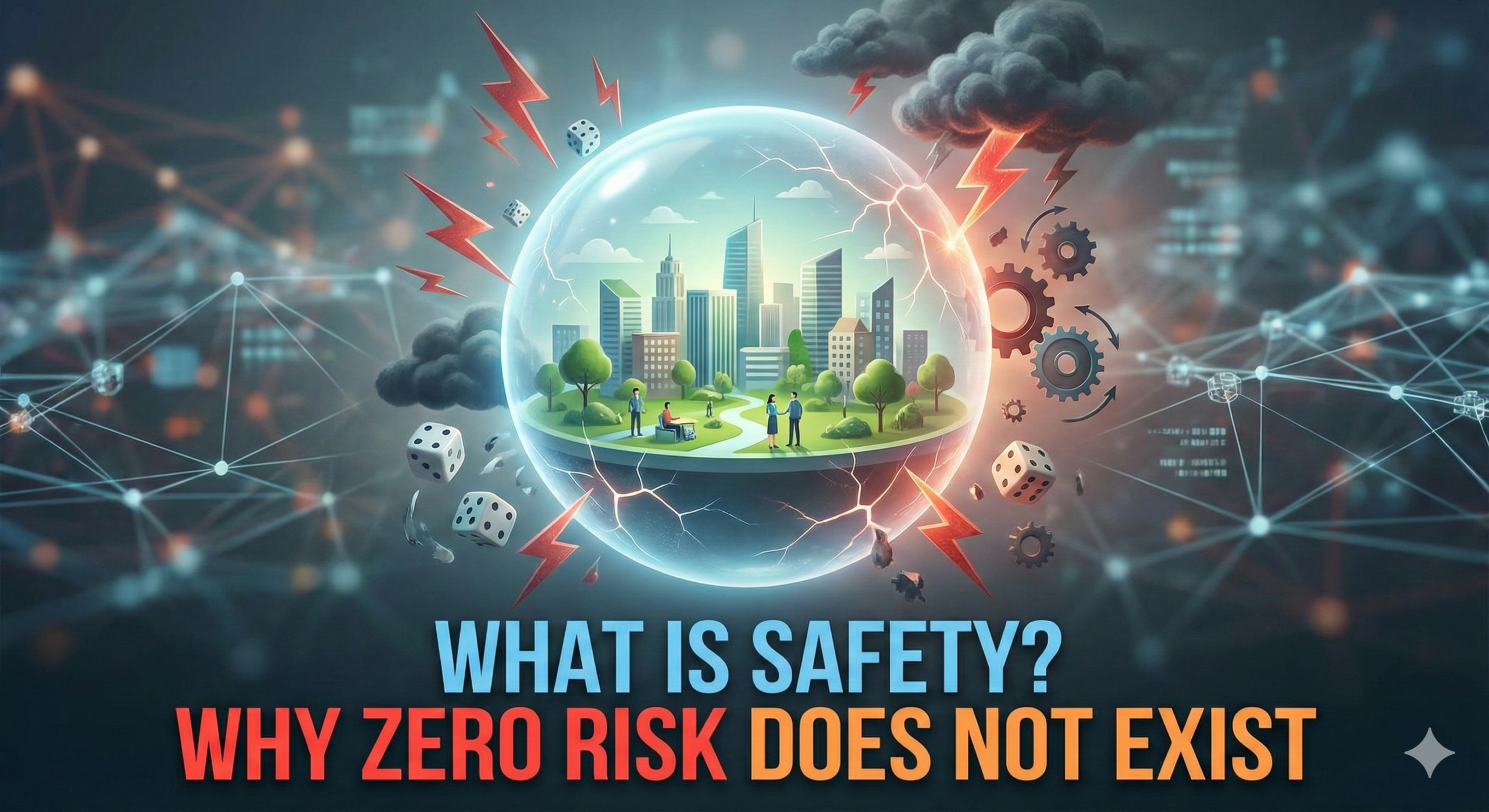
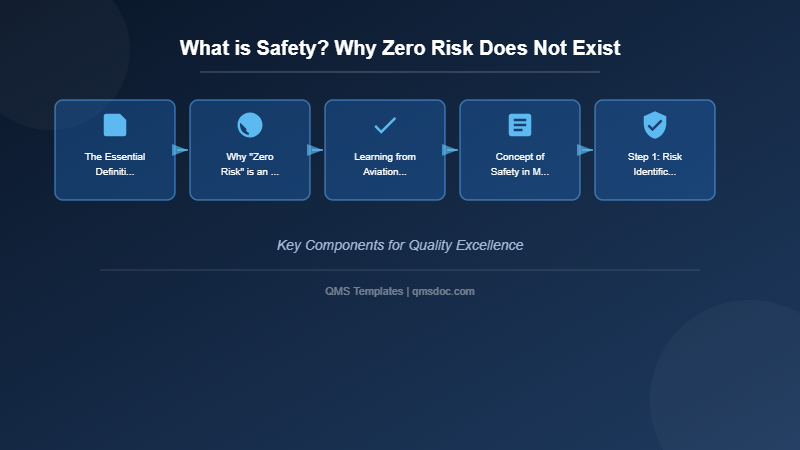
What is Safety? Why Zero Risk Does Not Exist
“This product is safe.” “We provide a safe environment.” We hear such phrases daily. But what does “safety” truly mean? Many people might consider it “a state free from danger.” However, in the worlds of engineering and medicine, the definition of safety is far more pragmatic and, simultaneously, more profound.
“This product is safe.” “We provide a safe environment.” We hear such phrases daily. But what does “safety” truly mean? Many people might consider it …
The Essential Definition of Safety
The international safety standard (ISO/IEC Guide 51:2014) defines safety as “freedom from unacceptable risk.” This definition contains a critical premise—namely, it acknowledges the existence of risk.
In other words, nothing in the world is “completely safe.” What exists is only the boundary between “acceptable risk” and “unacceptable risk.” This concept has been officially adopted and promoted by Japan’s Ministry of Health, Labour and Welfare and Ministry of Economy, Trade and Industry, as well as by the European Medicines Agency (EMA) and other regulatory authorities worldwide.
Why “Zero Risk” is an Illusion
Let us consider a simple example.
Even the everyday act of walking on a sidewalk involves various risks including falling, vehicles veering onto the sidewalk, and falling objects. However, we judge these risks to be “sufficiently small” and walk every day. If we were to pursue “zero risk,” we would be unable to take a single step outside our homes.
This may seem like an extreme example, but industry actually faces this problem. For instance, if we try to set the residual standard for a certain chemical substance at “zero,” as detection technology improves and we can detect “ever smaller amounts,” we would never be able to meet the standard.
Learning from Aviation Safety
Let us consider specific numbers using aircraft accidents as an example.
According to statistics from the International Air Transport Association (IATA), serious accidents occur at a rate of approximately 1 accident per 810,000 flights (based on the five-year average from 2020-2024). Expressed from an individual’s perspective, this calculation means “even if you flew every day, you would encounter an accident once in approximately 2,200 years.”
Meanwhile, the probability of dying in an automobile accident is approximately 2,663 people annually in Japan (based on 2024 data with a population of approximately 125 million), or approximately 1 in 47,000 people. It is clear that aircraft are far safer.
Importantly, the aviation industry does not set a goal of “making crash accidents zero.” This is because it would be technically and economically impossible. Instead, they implement multi-layered safety measures as follows:
Aircraft design: Redundant design that allows continued flight even if multiple safety systems fail simultaneously; Maintenance systems: Regular inspections and preventive parts replacement; Pilot training: Simulator training for all conceivable abnormal situations; Air traffic control systems: Collision avoidance systems and weather monitoring systems.
All of these combined reduce risk to a level that society can accept.
Concept of Safety in Medical Devices
In the field of medical devices, more systematic risk management is conducted based on the international standard ISO 14971:2019.
For example, consider MRI (Magnetic Resonance Imaging). MRI involves the following risks:
Strong magnetic fields: Effects on pacemakers and metal objects; Noise: Effects on hearing; Examination in confined spaces: Possibility of panic attacks; Contrast agents: Risk of allergic reactions.
For these risks, manufacturers and medical institutions take the following step-by-step approach:
Step 1: Risk Identification and Analysis
All potential risks are identified, and their probability of occurrence and severity are evaluated. For example, the risk of “a pacemaker wearer entering the MRI room” would be fatal if it occurred, but can be prevented through appropriate screening.
Step 2: Risk Reduction
Design measures: Installation of emergency stop buttons, display of magnetic field strength; Protective measures: Installation of metal detectors, shielding design; Information provision: Clear warning displays, screening through questionnaires.
Step 3: Evaluation of Residual Risk
It is judged whether the risks that remain even after implementing all measures are acceptable compared to the benefits of MRI diagnosis (such as improved treatment outcomes through early detection).
Understanding Risk-Benefit Balance Through Real Examples
Automobile Example
Approximately 2,663 people die in traffic accidents annually in Japan (2024 data). Nevertheless, automobiles are not banned because of the following benefits:
Freedom of movement: Commuting, going to school, shopping; Economic activities: Logistics, sales activities; Emergency response: Ambulances, fire trucks.
Society considers these benefits and continues to use automobiles while reducing risks through mandatory seatbelt use, speed limits, and severe penalties for drunk driving.
Vaccine Example
Vaccines also have risks of side effects. However, compared to the risks of serious complications and death from infectious diseases, the benefits of vaccination are far greater. This is also a typical example where judgment is made based on “balance between risk and benefit” rather than “zero risk.”
Four Problems Caused by Pursuing Zero Risk
1. Unlimited Cost Increase
If the cost to reduce risk by 90% is 1, reducing it by 99% may cost 10 times more, and reducing it by 99.9% may cost 100 times more. This is called the “law of diminishing marginal utility.”
2. Innovation Stagnation
Excessively strict safety standards hinder the practical application of new technologies. For example, if autonomous vehicles are not approved for being “slightly safer than human driving” but are required to be “overwhelmingly safe,” receiving the benefits of the technology will be significantly delayed.
3. Increase in Other Risks
When one risk is excessively feared, another risk may increase. For example, if you fear airplanes and travel long distances by car instead, the accident risk actually increases.
4. False Sense of Security
When people believe something is “absolutely safe,” they neglect basic precautions. Maintaining appropriate vigilance leads to actual safety.
Practical Approaches We Can Take
1. Think About Risk in Terms of “Probability” and “Impact”
Evaluate calmly along the following two axes without becoming emotional:
Probability of occurrence: How frequently does it occur? Magnitude of impact: How much damage occurs when it happens?
2. Utilize Reliable Information Sources
Government agency statistical data; reports from international organizations (WHO, IATA, etc.); peer-reviewed academic papers.
3. Support Continuous Improvement
Rather than seeking perfection, evaluate gradual improvements according to technological advances.
4. Participate in Risk Communication
Value opportunities for dialogue about risk, such as regional disaster prevention drills, product safety information, and informed consent in medical care.
Conclusion: Safety as a Dynamic Process
“Safety is freedom from unacceptable risk”—this definition provides us with a realistic and constructive perspective.
Safety is not a “static goal” that is finished once achieved. It is a “dynamic process” that is constantly reviewed and improved in response to technological advances, changes in societal values, and the discovery of new risks.
Rather than pursuing the illusion of zero risk, we should understand the balance between risk and benefit, make judgments based on scientific evidence, and continuously improve—this is the true safety culture we should aim for.
The next time you board an airplane, receive an MRI examination at a hospital, or encounter new technology, consider not “Is this absolutely safe?” but rather “Is the risk appropriately managed?” and “Do the benefits outweigh the risks?” That will be the first step toward a wise relationship with safety.
References and Notes
ISO/IEC Guide 51:2014: The current version (third edition) defines safety as “freedom from unacceptable risk.” Note that “acceptable risk” and “tolerable risk” are considered synonymous terms in this standard.
Aviation Safety Statistics: Based on IATA’s 2024 Annual Safety Report (published February 2025). The five-year average (2020-2024) shows one accident per 810,000 flights. There were seven fatal accidents in 2024 among 40.6 million flights, with 244 onboard fatalities.
Japanese Traffic Fatalities: Based on National Police Agency data for 2024, with 2,663 deaths recorded—the third-lowest level since statistics began in 1948.
ISO 14971:2019: The international standard for medical device risk management, which specifies terminology, principles, and a process for managing risks throughout the entire device lifecycle, including software as a medical device and in vitro diagnostic medical devices. The 2019 edition represents significant evolution with enhanced focus on benefit-risk analysis and expanded requirements for production and post-production activities.
Population Estimates: Japan’s population for calculation purposes is approximately 125 million (based on 2024 estimates).
Related FDA QMSR Templates
Streamline your FDA QMSR compliance with our professionally crafted templates:
Related Articles
- What is Risk Analysis?
- What is Quality Risk Management (QRM)?
- What is Functional Risk Assessment (Detailed Risk Assessment)?
- Why Software Risk Management Does Not Quantify Probability of Occurrence
- What is a Risk Management File?
- What Are the Unique Characteristics of the Risk Model for In Vitro Diagnostic Medical Devices (IVDs)?
