
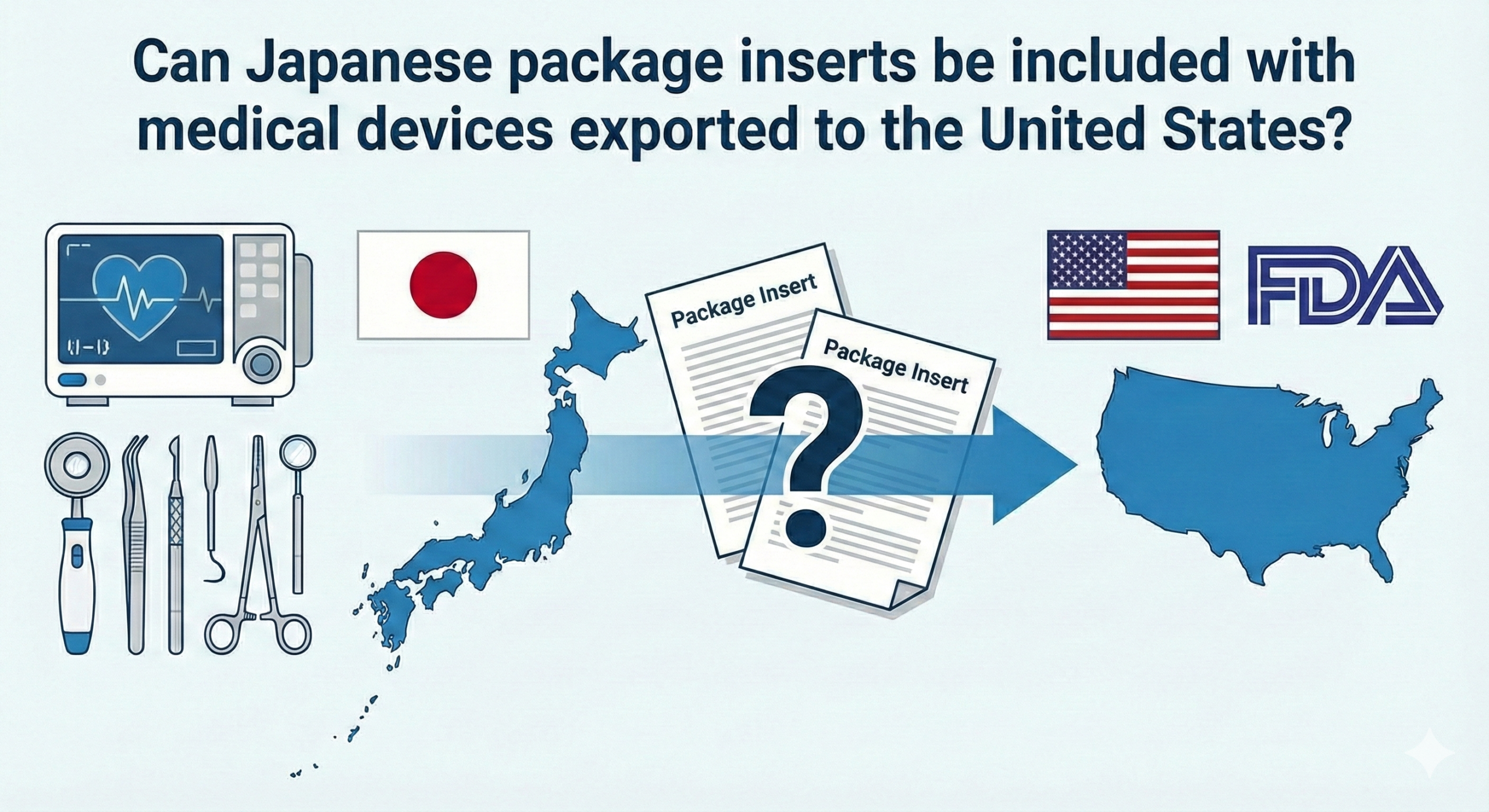
Can Japanese Package Inserts Be Included with Medical Devices Exported to the United States?
Introduction
During a recent seminar, a participant posed the following question, which is frequently raised by medical device manufacturers exporting to multiple countries. Given the practical nature of this inquiry, I would like to provide a detailed explanation here.
During a recent seminar, a participant posed the following question, which is frequently raised by medical device manufacturers exporting to multiple …
“May Japanese package inserts be included with medical devices exported to the United States?”
Basic Response
The answer to this question is that including Japanese package inserts with medical devices for the U.S. market is not recommended. The reason is that under FDA regulation, labeling for the U.S. market (including labels and package inserts) must meet specific requirements, and it is uncertain whether Japanese package inserts satisfy these U.S. labeling requirements.
However, from a practical standpoint, if the Japanese package inserts and other Japanese-language labels and labeling included with the device satisfy U.S. labeling requirements, the inclusion of Japanese package inserts may be considered permissible. This determination must be made based on the specific product and the manner in which it will be used in the U.S. market.
FDA Regulations on Multilingual Labeling
FDA labeling regulations, specifically 21 CFR Part 801.15, contain important provisions regarding labeling that includes foreign language expressions.
21 CFR § 801.15(c)(3) provides as follows:
If the labeling contains any representation in a foreign language, all words, statements, and other information required by or under authority of the act to appear on the label or labeling shall appear on the labeling in the foreign language.
The meaning of this provision is that if Japanese language appears within labeling for the U.S. market, all information required to be displayed in the U.S. market under FDA regulations (such as warning statements, instructions for use, expiration dates, and so forth) must also be displayed in Japanese. Conversely, if only Japanese information is provided without corresponding English information, this constitutes a regulatory violation.
FDA Official Guidance
In the most recent version of FDA labeling guidance, the following clear directive is provided:
All labeling shall be in English with the exception of products distributed solely within Puerto Rico or a U.S. territory where the predominant language is other than English. In these instances the predominant language may be substituted for English. If any representation on the device label or labeling appears in a foreign language, then all required labeling shall also appear in that foreign language.
This guidance clarifies the following principles:
First, for medical devices intended primarily for distribution in the U.S. market, the primary language should be English. Second, when multilingual products are designed to serve both the Japanese market and the U.S. market, Japanese language representations are permissible; however, all information required for the U.S. market must also be provided in Japanese.
Package Labeling and Multilingual Presentation
In practical application, many medical device manufacturers, when producing medical devices for multiple countries, include multiple languages on packaging and labeling. In such cases, including information for various countries (such as Japanese, English, Chinese, and so forth) on the same packaging is permissible.
For example, within Japan there is a trend toward electronic provision of package inserts for medical devices, with QR codes or URLs printed on packaging rather than paper inserts. Printing such URL information on U.S. market packaging simultaneously is generally permissible.
However, when medical devices are intended for the U.S. market, U.S.-directed labeling information must possess prominence. “Prominence” refers to the degree to which information is readily noticeable to and understandable by consumers or users upon first viewing. If U.S. market information is printed inappropriately small or placed in a manner that obscures it, regulatory issues may arise.
Multilingual Provisions in Instructions for Use
Medical device instructions for use (IFU) may likewise be provided in multiple languages. When instructions are provided in multiple languages, each language section must contain all information required in that particular language.
Particularly in the U.S. market, warning statements, caution statements, and critical safety information contained in the IFU must comply with standard warning formats required in the United States. This is based on requirements for medical device warnings as specified in 21 CFR Part 801 Subpart C.
Practical Considerations
When determining whether to include Japanese package inserts with medical devices exported to the United States, it is important to comprehensively consider the following points:
1. Product positioning and distribution strategy in the U.S. market
If the product is sold as an independent medical device in the United States, U.S.-specific labeling is recommended. Conversely, if a product originally developed for the Japanese market is incidentally sold in the U.S. market, inclusion of Japanese language information is more practical.
2. Regulatory classification and labeling requirements
Medical device classification (Class I, Class II, or Class III) affects the complexity of labeling requirements. For higher-class devices with complex requirements, detailed U.S.-directed labeling information is essential.
3. End-user considerations and safety
Whether end-users in the U.S. market (patients, healthcare professionals, medical facilities, and so forth) can understand Japanese is an important consideration. If safety-related information is not properly conveyed, serious issues regarding device use may result.
4. Preparation for FDA inspection
FDA conducts rigorous examination of labeling compliance during manufacturer inspections. In cases of multilingual labeling, documentation demonstrating that all language versions comply with regulatory requirements is necessary.
Conclusion
While including Japanese package inserts with medical devices exported to the United States is not recommended from a regulatory perspective, should manufacturers choose to do so, the following conditions are essential:
(1) The Japanese package insert must satisfy U.S. labeling requirements, (2) the prominence balance between English and Japanese information must be appropriately maintained, and (3) all information presented in Japanese must be accurate with regard to safety and regulatory compliance.
Medical device manufacturers must plan appropriate labeling strategies for each market in advance and ensure product distribution in a manner that satisfies all requirements of the FDA and other applicable regulatory authorities in each country.
Related Articles
- Differences in Change Application Requirements for Medical Device Regulations Between Japan and the United States
- Differences Between Pharmaceuticals and Medical Devices
- The Importance of Design Control in Medical Devices
- Understanding Risk in Pharmaceuticals and Medical Devices
- Why Are Drug Prices So High in the United States?
- The Establishment and Evolution of the United States Pharmacopeia: Building Trust in Medicine Quality
