
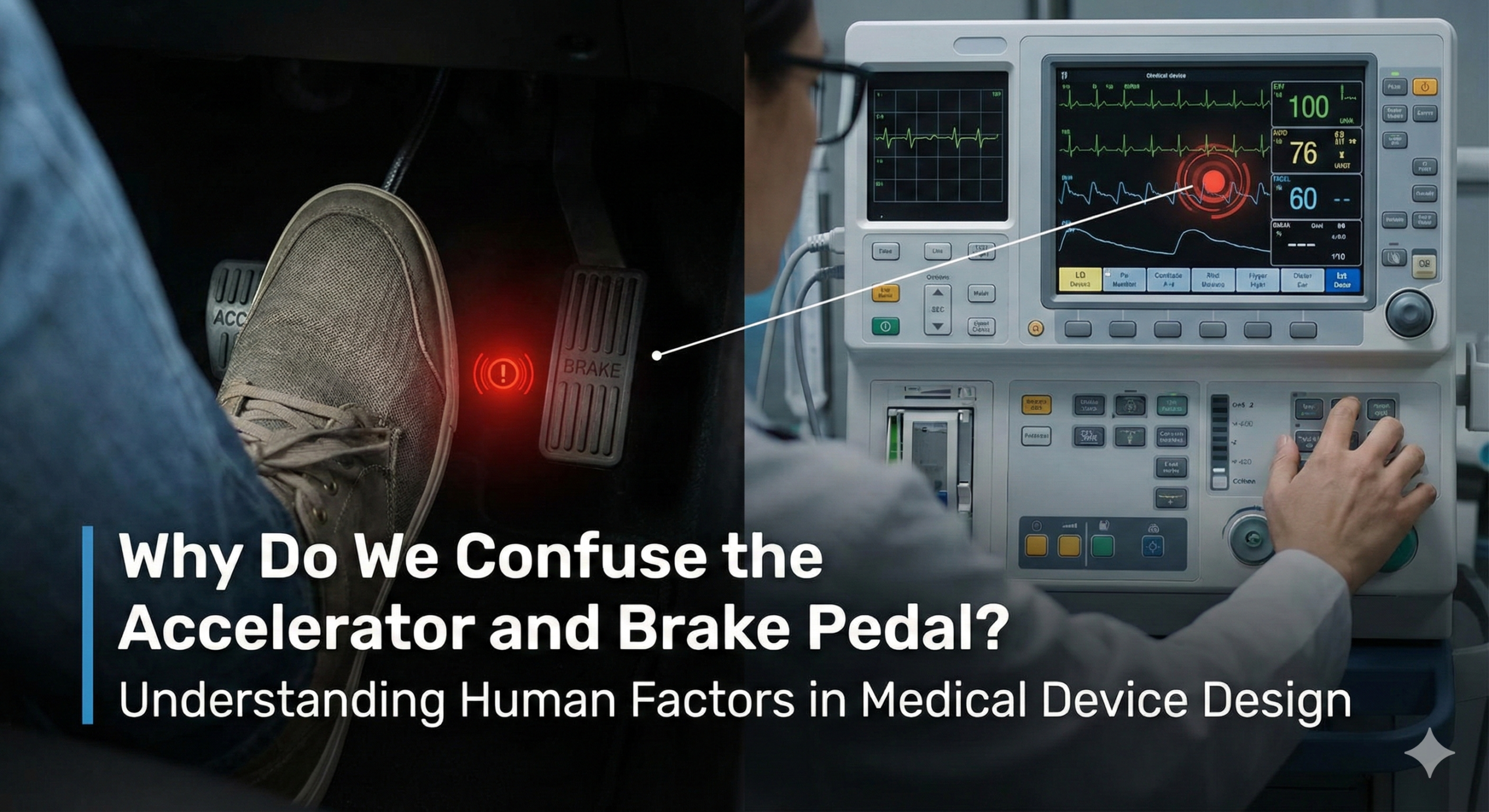
Why Do We Confuse the Accelerator and Brake Pedal? Understanding Human Factors in Medical Device Design
Introduction
In recent years, news reports of traffic accidents caused by confusing the accelerator and brake pedal have become increasingly common. Many readers wonder why such accidents continue to occur repeatedly.
In recent years, news reports of traffic accidents caused by confusing the accelerator and brake pedal have become increasingly common. Many readers w…
The Mechanism of Pedal Confusion
While multiple causes of accelerator-brake confusion accidents have been identified, one significant factor is when attention is diverted during driving. When drivers receive an incoming call on their mobile phones while driving, their attention becomes diminished, and they may inadvertently confuse the accelerator and brake pedals. Similarly, when an unexpected event occurs—such as a person or animal suddenly jumping in front of the vehicle, requiring immediate braking—diminished judgment can lead to the same pedal confusion.
The reason such confusion occurs when attention and judgment are reduced relates to a fundamental human characteristic: we unconsciously tend to select the function we use most frequently in daily life—in other words, the function to which we are most accustomed. During normal driving, the accelerator is pressed more frequently than the brake. Therefore, when attention or judgment diminishes, drivers unconsciously press the accelerator, which they are more familiar with. Although the driver intends to press the brake, they end up pressing the accelerator with considerable force. This results in unexpected acceleration, causing the driver to panic.
Application to Medical Device Design
The same principle applies to medical device design and development. For example, if a device employs operational methods or user interfaces that differ significantly from similar or predecessor products—such as reversing the conventional color coding (red and blue)—users may unconsciously operate the device using methods they are accustomed to from other products, potentially leading to use errors.
Another illustrative example comes from aviation: pilots cannot simultaneously operate multiple aircraft types. A Boeing 787 captain cannot simultaneously pilot a Boeing 777. This industry practice prevents accidents caused by different operational characteristics between aircraft models.
For products where safety is paramount, such as medical devices, design based on Human Factors Engineering (HFE) is essential. Safety design approaches, including fail-safe mechanisms, use-error prevention design, and appropriately designed user interfaces that account for unconscious user habits and cognitive load, are required.
Usability Engineering in Medical Device Design
While usability encompasses “ease of use,” “user satisfaction,” and “aesthetics,” medical device design and development requires above all a device that is “safe” and free from use errors. Therefore, usability engineering applied to medical devices is not an evaluation method for ease of use, but rather an analytical methodology for designing safe medical devices without use errors.
From this perspective, intentionally making something more difficult to use can actually be a valid usability engineering strategy. For instance, disposable lighters intentionally have a stiff ignition mechanism. The purpose is to prevent unexpected ignition due to accidents—such as unintended operation or misuse by children.
The FDA historically preferred the term “Human Factors Engineering” over “usability” because the latter term may incorrectly suggest mere “ease of use.” However, in its 2016 guidance document “Applying Human Factors and Usability Engineering to Optimize Medical Device Design,” the FDA acknowledged that usability and human factors engineering are essentially synonymous, in order to align with international standards.
Revisions to IEC 62366-1 and Implications for Japan
Currently, IEC 62366-1:2015 “Medical devices—Part 1: Application of usability engineering to medical devices” has been established as a Japanese Industrial Standard (JIS), but it is not yet legally positioned as a basic requirement standard in medical device manufacturing and marketing authorization applications. However, the Ministry of Health, Labour and Welfare initiated a public comment period on July 27, 2021, for revisions to “JIS T62366-1 Medical devices—Part 1: Application of usability engineering to medical devices.”
This revision aims to achieve consistency with the referenced standard JIS T14971:2020 (Risk management for medical devices). Internationally, a newer version of IEC 62366-1 was published in 2023, establishing more detailed usability evaluation methodologies.
The major changes in this revision include the following points.
First, regarding “establishment of user interface evaluation planning” and “planning for summative evaluation,” when conducting usability testing, the test environment and conditions of use are clarified to be the “intended use environment” rather than the “actual use conditions” specified in the current standard. Additionally, considering participant characteristics and participant number, the requirement to clearly define “correct use” in relation to hazard-related use scenarios has been added.
Second, regarding observed parameters in testing, “use difficulty” has been newly added as an observation target alongside the current standard’s “use error.” This broadens the evaluation scope to include the burden and complexity users encounter when operating medical devices.
Furthermore, in “conducting summative evaluation regarding usability of the user interface,” analysis of “use difficulty” has been added to the analytical targets alongside “use error” in the summative evaluation. This reflects an evolution toward more comprehensive evaluation of actual user experience in real-world medical device usage environments.
Based on current regulatory trends, after revision, compliance with JIS T62366-1 will likely be legally positioned as a basic requirement standard for medical devices. Medical device manufacturers must continuously monitor international developments in IEC 62366-1 and further strengthen the implementation of usability engineering.
For detailed information, please refer to the Ministry of Health, Labour and Welfare’s Pharmaceutical Affairs Bureau public comment documentation and the latest versions of ISO/IEC international standards.
Summary Table: Evolution of Usability Standards in Medical Device Regulation
| Aspect | Previous Standard (IEC 62366-1:2015) | Current/Revised Standard (IEC 62366-1:2023) | Key Change |
| Test Environment | Actual use conditions | Intended use environment | Broader applicability |
| Evaluation Parameters | Use error only | Use error + Use difficulty | Expanded scope |
| Participant Definition | General specification | Detailed characteristics and number | More rigorous |
| Correct Use Definition | Implicit | Explicitly defined for hazard-related scenarios | Clearer standards |
| Analysis Scope | Limited to errors | Comprehensive including difficulties | Holistic assessment |
Key Takeaway
Medical device usability engineering is fundamentally about preventing use errors and ensuring safe operation, not merely about making devices “easy to use.” By understanding human factors principles—including the unconscious tendency to rely on familiar operational patterns—manufacturers can design devices that account for real-world user behavior and significantly reduce the risk of accidents. As regulatory frameworks continue to evolve globally, adherence to comprehensive usability engineering methodologies will become increasingly important for medical device approval and safety.
Related Articles
- Understanding the Difference Between “Design” and “Design Control” in Medical Devices
- Safe Design of Medical Devices: Understanding Risk Management Fundamentals
- Applying Human Factors and Usability Engineering to Medical Devices(邦訳版)
- Understanding Part 11 in FDA Inspections: Key Considerations for Pharmaceutical and Medical Device Companies
- Preventive Action as Risk Management: Understanding CAPA in Pharmaceutical and Medical Device Industries
- Understanding FMEA in Pharmaceutical and Medical Device Industries
