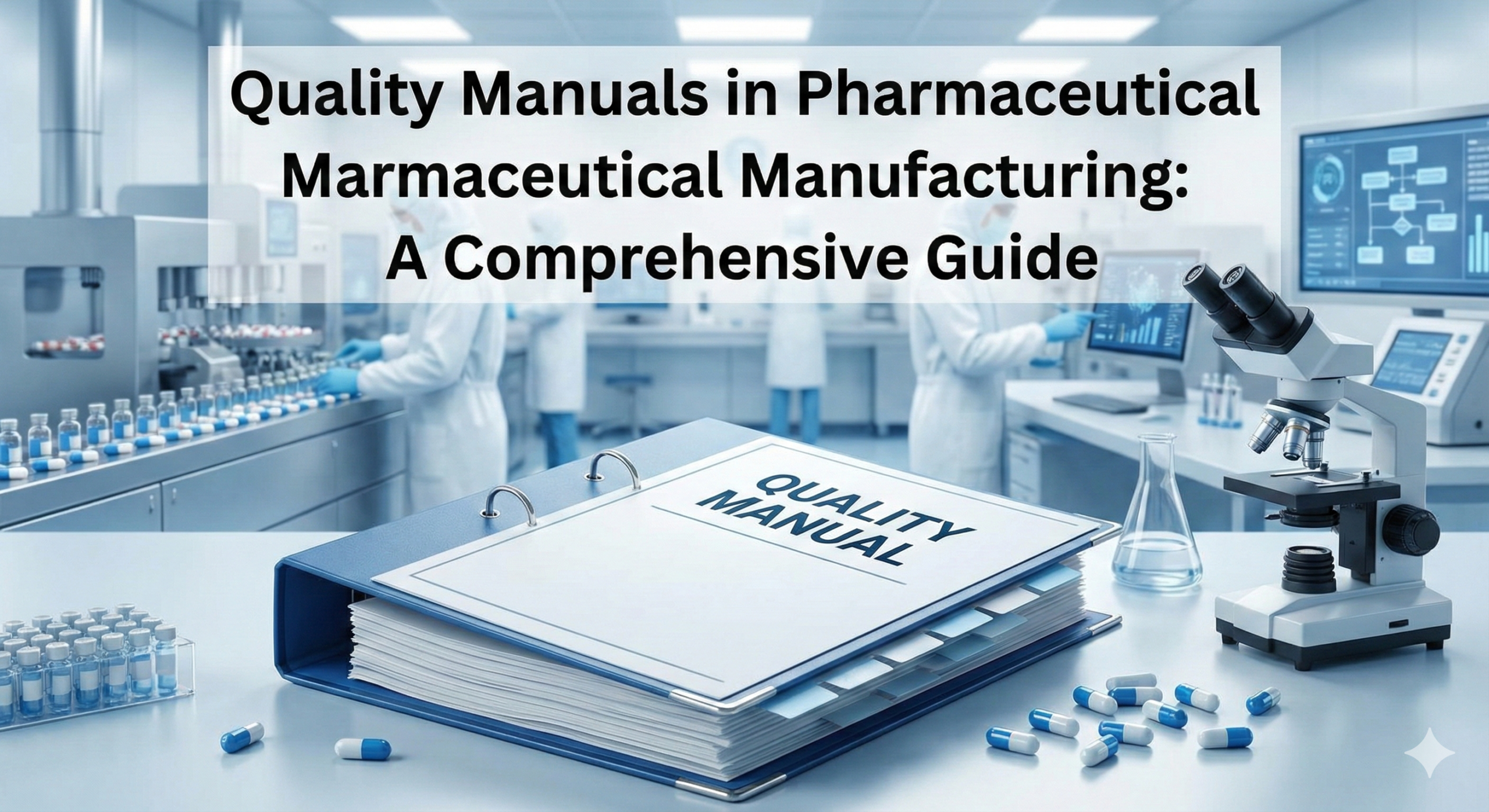
Quality Manuals in Pharmaceutical Manufacturing: A Comprehensive Guide
Historical Context and Regulatory Evolution
Since 1978, the FDA has been working to align its current Good Manufacturing Practice (cGMP) regulations with international quality management standards. In September 2006, the FDA published “Quality Systems Approach to Pharmaceutical CGMP Regulations,” which provided guidance on implementing modern quality systems and risk management approaches to meet the requirements of 21 CFR Parts 210 and 211. This guidance document was developed to help manufacturers integrate quality system concepts derived from ISO 9001:2000 with existing cGMP regulations, thereby creating a comprehensive quality systems model consistent with pharmaceutical manufacturing requirements.
The guidance aimed to support the FDA‘s Pharmaceutical cGMPs for the 21st Century Initiative, announced in August 2002, which sought to integrate quality systems and risk management approaches into existing regulatory programs. This initiative was driven by recognition that the regulatory framework needed modernization to encourage industry adoption of innovative manufacturing technologies.
The ICH Q10 Pharmaceutical Quality System
ICH Q10, finalized in June 2008 and adopted by the FDA in April 2009, provides a harmonized model for an effective pharmaceutical quality system (PQS) applicable throughout the product lifecycle. This guideline was developed based on ISO 9001 quality management principles and regional GMP requirements, though it does not duplicate existing GMP regulations.
ICH Q10 establishes three core objectives for pharmaceutical quality systems:
- Achieve Product Realization: Consistently provide products with quality attributes necessary to meet the needs of patients, healthcare professionals, regulatory authorities, and internal customers (including compliance with marketing authorization).
- Establish and Maintain a State of Control: Use effective monitoring systems for process performance and product quality to provide assurance of continued suitability and capability of processes.
- Facilitate Continual Improvement: Identify and implement improvements in product quality, process performance, variability reduction, innovations, and pharmaceutical quality system enhancements, thereby increasing the ability to consistently fulfill quality requirements.
The guideline covers all phases of the pharmaceutical product lifecycle: pharmaceutical development, technology transfer, commercial manufacturing, and product discontinuation. It applies to systems supporting the development and manufacture of pharmaceutical drug substances (APIs) and drug products, including biotechnology and biological products.
ICH Q10 describes four specific pharmaceutical quality system elements that augment regional GMP requirements:
- Process Performance and Product Quality Monitoring System
- Corrective Action and Preventive Action (CAPA) System
- Change Management System
- Management Review of Process Performance and Product Quality
These elements are enabled by two critical enablers: Knowledge Management and Quality Risk Management (ICH Q9). The quality system elements should be applied appropriately and proportionally to each lifecycle stage, recognizing the differences among and the different goals of each stage.
Quality Management System Documentation Structure
Historically, many pharmaceutical companies have not established comprehensive Quality Management Systems (QMS) based on structured documentation hierarchies. A properly structured QMS follows a hierarchical document framework:
Level 1 – Quality Manual: The top-level document that defines the overall pharmaceutical quality system. The quality manual describes management’s commitment to quality and outlines the scope and structure of the quality system.
Level 2 – Standard Operating Procedures (SOPs): Detailed procedures that implement the policies defined in the quality manual.
Level 3 – Work Instructions and Forms: Specific instructions and documentation templates used in daily operations.
Level 4 – Records: Documentation that provides evidence of compliance with procedures.
This hierarchical structure ensures that quality policies flow from strategic intent (Quality Manual) through operational procedures (SOPs) to actual implementation (work instructions and records).
Comprehensive Scope of Quality Manuals
A pharmaceutical company’s quality manual must encompass all regulated activities throughout the product lifecycle, not solely manufacturing operations. The quality manual should address:
- Pharmaceutical Development and Research: Exploratory research activities and quality considerations in early development
- Non-Clinical Studies: Good Laboratory Practice (GLP) compliance and quality assurance
- Clinical Studies: Good Clinical Practice (GCP) compliance and clinical quality management
- Manufacturing: Good Manufacturing Practice (GMP) for drug substances and drug products
- Distribution: Good Distribution Practice (GDP) and supply chain quality management
- Post-Market Surveillance: Pharmacovigilance and quality monitoring of marketed products
This comprehensive approach reflects the reality that quality assurance is a lifecycle responsibility, extending from initial research through product discontinuation.
Management Responsibility for Quality Manual Development
According to ICH Q10 Section 2.1, senior management has the responsibility to establish the quality policy and ensure that quality objectives are defined, understood, and achieved throughout the organization. The quality manual serves as the documented expression of this management commitment.
Senior management should prepare the quality manual because it defines:
- The organization’s quality policy and strategic quality objectives
- The scope of the pharmaceutical quality system
- How regulatory requirements will be met
- The structure and responsibilities within the quality system
- Resource allocation for quality activities
- The approach to quality risk management
The quality manual must be tailored to the specific products manufactured and the processes employed. Different products present different quality risks, and the quality system should be appropriately scaled to manage these risks effectively. An overly stringent quality system can result in excessive compliance costs that ultimately increase drug prices and burden patients. Conversely, an inadequate quality system fails to protect patient safety and product quality.
Similarly, different organizational structures and business models require different quality system approaches. Some companies conduct comprehensive activities from research and development through manufacturing and distribution (integrated pharmaceutical companies), while others focus solely on manufacturing operations (contract manufacturers) or specific operations such as secondary packaging for multinational companies with limited local operations. The quality manual must reflect the actual scope of activities and appropriately address the associated quality risks.
Integration with Standard Operating Procedures
The quality manual establishes the framework and policies that guide the development of Standard Operating Procedures (SOPs), work instructions, and forms. These lower-level documents must be consistent with and implement the principles defined in the quality manual.
Historically, many pharmaceutical companies have operated without a quality manual, relying only on SOPs and forms. This approach is fundamentally inadequate because it lacks the strategic foundation and management oversight required for effective quality management. Without a quality manual:
- There is no documented management commitment to quality
- Quality policies may be inconsistent across departments
- The rationale for procedures may not be clear
- It is difficult to ensure procedures are appropriately risk-based
- Management review of the quality system is compromised
Current Regulatory Landscape and International Harmonization
Medical Device Sector Developments
In February 2024, the FDA issued a final rule amending 21 CFR Part 820 to create the Quality Management System Regulation (QMSR), which incorporates ISO 13485:2016 by reference. This regulation, effective February 2, 2026, represents a significant harmonization effort for medical device quality systems. Notably, the QMSR explicitly requires quality manuals, which were not mandated under the previous Quality System Regulation (QSR).
While the QMSR applies specifically to medical devices, it demonstrates the FDA’s commitment to harmonization with international standards and the importance of quality manuals as foundational quality system documents.
Pharmaceutical Sector Requirements
For pharmaceutical manufacturing, the FDA continues to reference the 2006 Quality Systems Approach guidance and ICH Q10 as the framework for modern pharmaceutical quality systems. While Parts 210 and 211 do not explicitly mandate quality manuals by name, effective implementation of ICH Q10 and modern quality system principles requires a documented quality manual as described in Section 1.8 of ICH Q10.
Japanese Regulatory Requirements
Japan’s Pharmaceuticals and Medical Devices Agency (PMDA), which became a member of the Pharmaceutical Inspection Co-operation Scheme (PIC/S) in July 2014, conducts GMP inspections based on the Ministerial Ordinance on Standards for Manufacturing Control and Quality Control for Drugs and Quasi-drugs. The Japanese regulatory system has been harmonized with international GMP standards through PIC/S membership.
PMDA conducts risk-based GMP inspections for high-risk products including new drugs, biological products, and biotechnology products. The PMDA underwent its first PIC/S re-assessment in March 2025, which confirmed that Japan’s GMP inspection capabilities meet international standards established by PIC/S.
While PMDA provides site master file (SMF) templates and guidance materials, comprehensive quality manual examples specifically for pharmaceutical manufacturing may be limited on publicly accessible platforms. Companies operating in Japan must ensure their quality systems comply with Japanese GMP requirements while maintaining consistency with ICH Q10 principles.
European Union Requirements
The EU GMP Guide, particularly Annex 1 (revised and effective August 25, 2023) and other annexes, establishes quality system requirements for pharmaceutical manufacturers operating in European markets. ICH Q10 has been adopted throughout the EU, and quality manuals consistent with ICH Q10 principles are expected.
Quality Manual Content Requirements
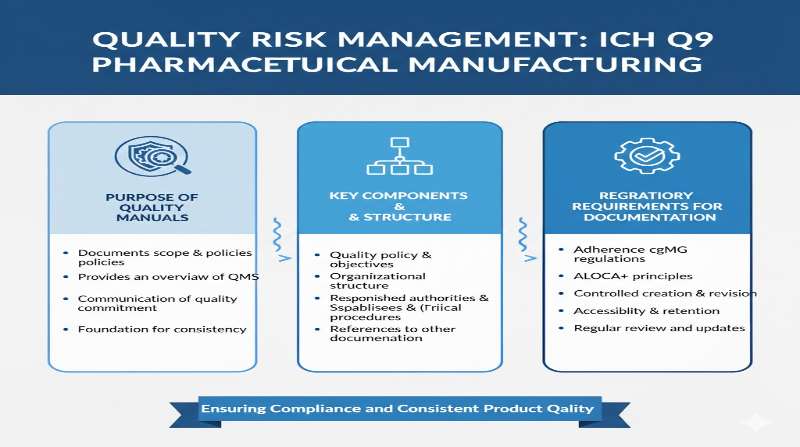
According to ICH Q10 Section 1.8, the quality manual should include or reference:
- Quality Policy: Senior management’s documented commitment to quality
- Scope of the Pharmaceutical Quality System: Definition of what activities and sites are covered
- Identification of quality system processes and their interactions: Process mapping and relationships
- Management responsibilities: Clear definition of roles and accountability
The quality manual may also reference supporting documentation such as:
- Organizational structure and responsibilities
- Quality objectives and key performance indicators
- Description of quality system elements (CAPA, change control, management review, monitoring)
- Approach to quality risk management and knowledge management
- Outsourced activities and supplier management
- Training and competency requirements
- Document and data management systems
- Internal audit programs
- Management review processes
Common Inadequacies in Current Practice
Many quality manual examples, including some reference materials provided by regulatory agencies, focus narrowly on manufacturing (GMP) operations without addressing the full product lifecycle. A quality manual that covers only manufacturing operations and does not comprehensively address all quality system elements cannot serve as an effective foundation for a pharmaceutical quality system.
Specific inadequacies commonly observed include:
- Limited Scope: Covering only manufacturing while excluding development, clinical trials, and distribution
- Incomplete GMP Coverage: Not addressing all aspects of pharmaceutical manufacturing (e.g., APIs, finished products, packaging)
- Lack of Lifecycle Perspective: Failing to address technology transfer, continual improvement, and product discontinuation
- Insufficient Management Responsibilities: Not clearly defining senior management’s quality responsibilities
- Missing Enablers: Not adequately addressing quality risk management and knowledge management
Relationship to ISO 9001 and Other Standards
While ICH Q10 is informed by ISO 9001 quality management principles, it is specifically designed for the pharmaceutical industry. The pharmaceutical quality system requirements go beyond generic ISO 9001 requirements by:
- Emphasizing product lifecycle approach from development through discontinuation
- Integrating pharmaceutical-specific risk management (ICH Q9)
- Addressing regulatory compliance requirements specific to pharmaceutical products
- Incorporating pharmaceutical development concepts (ICH Q8)
- Recognizing the critical nature of pharmaceutical products for patient safety
Some pharmaceutical companies maintain both ISO 9001 certification and ICH Q10-compliant quality systems. In such cases, the quality manual may integrate both sets of requirements, demonstrating how ISO 9001 clauses align with ICH Q10 elements and regional GMP requirements.
Implementation Recommendations
For pharmaceutical companies seeking to develop or enhance their quality manuals:
- Secure Senior Management Commitment: The quality manual must reflect genuine management commitment and strategic intent, not merely regulatory compliance.
- Conduct Gap Assessment: Evaluate current quality system documentation against ICH Q10 requirements to identify missing elements.
- Define Appropriate Scope: Clearly define what lifecycle stages, products, and sites are covered by the quality system.
- Apply Risk-Based Approach: Scale quality system requirements based on product risks, process complexity, and lifecycle stage.
- Ensure Consistency: Verify that the quality manual aligns with and guides existing SOPs and work instructions.
- Integrate Enablers: Incorporate quality risk management and knowledge management throughout the quality system.
- Establish Review Mechanisms: Define how the quality manual will be maintained, reviewed, and updated.
- Provide Training: Ensure all personnel understand the quality policy, quality system structure, and their roles within it.
Conclusion
The quality manual serves as the foundational document for a pharmaceutical company’s quality management system. It expresses senior management’s commitment to quality, defines the scope and structure of the quality system, and provides the framework for all quality-related procedures and activities.
Effective quality manuals must encompass the full product lifecycle from development through discontinuation, address all regulated activities including research, clinical trials, manufacturing, and distribution, and implement the principles of ICH Q10 including the four quality system elements and two enablers.
Many pharmaceutical companies have historically operated without comprehensive quality manuals, relying instead on SOPs and forms alone. This approach is inadequate for modern pharmaceutical quality management. Development of a robust quality manual, tailored to the company’s specific products, processes, and organizational structure, is essential for establishing an effective pharmaceutical quality system that ensures patient safety, product quality, and regulatory compliance.
As regulatory harmonization continues globally, with initiatives such as the FDA’s QMSR for medical devices demonstrating increasing alignment with international standards, the importance of well-structured quality management systems built on comprehensive quality manuals will only increase. Companies that proactively develop robust quality manuals consistent with ICH Q10 principles will be better positioned for regulatory inspections, operational excellence, and ultimately, their mission of delivering safe and effective medicines to patients.
Related Articles
- Is Senior Management Responsible for GMP Compliance?
- The Importance of Supplier Management (Revised Edition)
- The Future of Japan’s GDP (Good Distribution Practice)
- Revision of Japan’s GMP Ministerial Ordinance
- The Importance of Supplier Management
Related FDA QMSR Templates
Streamline your FDA QMSR compliance with our professionally crafted templates: