On Continuous Improvement
Kaizen: From Japan to the World
The Japanese word “Kaizen” (改善) has become internationally recognized terminology. The concept of continuous improvement has played a central role in the global success of Japanese manufacturing.
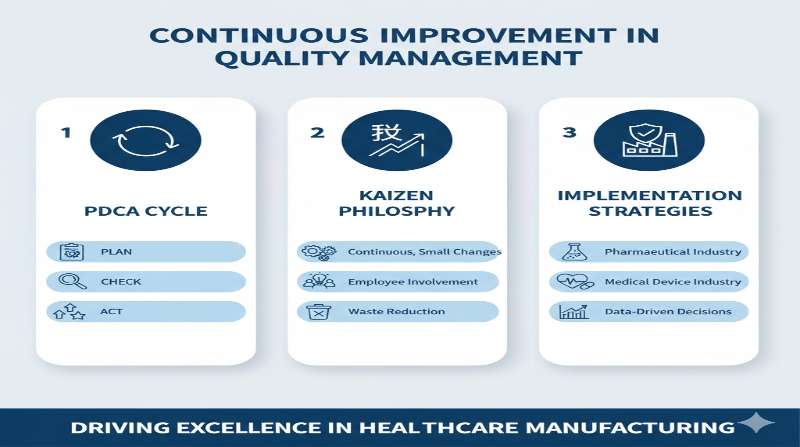
💡 継続的改善は品質マネジメントシステムの核心であり、PDCAサイクルを通じて組織の品質文化を醸成します。
In the 1970s, particularly following the 1973 oil crisis, Japanese automobiles rapidly gained market share in the United States. At that time, Japanese cars were not only more affordable than American cars but also had fewer defects and superior fuel efficiency. Threatened by this development, America’s Big Three automakers conducted thorough research into Japanese quality control methods. This research brought particular attention to Toyota Motor Corporation’s “Kaizen System” and the “Toyota Production System (TPS).”
The Origins of Kaizen and Dr. W. Edwards Deming’s Contribution
The concept of Kaizen in Japan was actually deeply influenced by quality control ideas brought from the United States. After World War II, with support from the General Headquarters (GHQ) of the Allied occupation forces, American statistician Dr. W. Edwards Deming visited Japan in 1950 and introduced Statistical Process Control (SPC) methodology to Japanese industry. Dr. Deming’s teachings emphasized the importance of data-driven continuous improvement, which became deeply embedded in Japanese corporate culture.
Japanese companies, including Toyota, adapted Dr. Deming’s teachings to their own culture and practices, developing the unique philosophy of “Kaizen.” In the 1950s, Toyota introduced Quality Control Circles, establishing a system where all employees participated in improvement activities. These efforts became the foundation for the later Toyota Production System (TPS) and, along with concepts such as “Just-In-Time” and “Jidoka” (automation with a human touch), gained worldwide recognition.
In 1960, the Japanese government awarded Dr. Deming the “Second Order Medal of the Sacred Treasure” in recognition of his contributions to Japanese quality control. Additionally, the Union of Japanese Scientists and Engineers (JUSE) established the Deming Prize in 1951 to honor companies that achieved excellence in quality control. Toyota received the Deming Prize in 1965 and became the first company to win the Japan Quality Medal in 1970.
The Reverse Import of Kaizen to the West and the Birth of CAPA Systems
In the 1980s, witnessing the success of Japanese companies, Western businesses sought to adopt Japanese improvement methods. Masaaki Imai’s 1986 book “Kaizen: The Key to Japan’s Competitive Success” became a catalyst for widely introducing the Kaizen concept to Western business communities.
Within this context, the U.S. Food and Drug Administration (FDA) developed its own regulatory requirements to strengthen quality management systems in the medical device and pharmaceutical industries. One such requirement was the CAPA (Corrective Action and Preventive Action) system. CAPA was formally introduced in 2006 as part of the Quality Systems Guidance under FDA 21 CFR Part 820.100. This guidance later formed the foundation for the ICH Q10 Guideline (International Council for Harmonisation Guideline on Pharmaceutical Quality Systems).
While CAPA shares philosophical commonalities with Japanese “Kaizen,” it evolved as a more regulatory and systematic approach. The CAPA system requires identification of product and quality problems, analysis of root causes, implementation of corrective actions, and preventive actions to prevent similar problems from occurring. The system consists of two components: “Corrective Action,” which addresses problems after they occur, and “Preventive Action,” which proactively identifies and addresses potential risks.
International Harmonization of Quality Systems in Pharmaceutical and Medical Device Industries
Currently, the pharmaceutical and medical device industries require the implementation of Quality Management Systems (QMS) that comply with global standards. The major standards and guidelines include the following:
Medical Device Industry: ISO 13485 and FDA QMSR
For quality management systems in medical devices, ISO 13485:2016 has been widely adopted as an international standard. This standard specifies requirements for a quality management system throughout the entire lifecycle of medical devices, from design, development, manufacturing, storage, distribution, installation, service provision, to final disposal.
In ISO 13485:2016, corrective action (Clause 8.5.2) and preventive action (Clause 8.5.3) are clearly separated, with specific requirements defined for each. Corrective action aims to eliminate the causes of nonconformities that have already occurred and prevent recurrence, while preventive action aims to identify causes of potential nonconformities and prevent their occurrence.
Critical Recent Development: FDA QMSR Implementation in February 2026
On February 2, 2024, the U.S. FDA finalized amendments to the previous Quality System Regulation (QSR, 21 CFR Part 820), establishing the new Quality Management System Regulation (QMSR). This regulation becomes effective on February 2, 2026.
The most significant change in the QMSR is the “incorporation by reference” of ISO 13485:2016. This harmonizes FDA regulatory requirements with international standards, making it easier for medical device manufacturers operating globally to comply with multiple regulatory systems. However, it is important to note that the QMSR includes additional requirements deemed necessary by the FDA beyond ISO 13485:2016, so ISO 13485 certification alone does not constitute full compliance with FDA regulations.
Under the QMSR, management review reports, internal audit reports, and supplier audit reports—previously exempt from FDA inspection—will become subject to inspection. Additionally, risk management processes are explicitly required to be applied throughout the entire product lifecycle.
Pharmaceutical Industry: ICH Q10
In the pharmaceutical industry, the ICH Q10 Guideline (Pharmaceutical Quality System) functions as a global standard for quality systems. ICH Q10 was developed by the International Council for Harmonisation (ICH) in 2008 and provides a model for a Pharmaceutical Quality System (PQS) that covers the entire lifecycle of pharmaceuticals, from development through manufacturing to post-market activities.
The four core elements of ICH Q10 include:
- Process Performance and Product Quality Monitoring System: A system for continuously monitoring manufacturing processes and product quality to detect trends early
- Corrective Action and Preventive Action (CAPA) System: A system for identifying root causes of problems, implementing corrective actions, and taking preventive measures to prevent recurrence
- Change Management System: A system for systematically evaluating, approving, and implementing changes to processes, equipment, and raw materials
- Management Review: A mechanism for senior management to periodically review process performance and product quality and identify improvement opportunities
ICH Q10 has a complementary relationship with European GMP (Good Manufacturing Practice) guidelines and U.S. FDA 21 CFR Parts 210 and 211. It is positioned not as a replacement for regional GMP requirements but as a supplement and enhancement to them.
Challenges Facing Japanese Companies
The concept of “Kaizen,” created by Japanese companies, has been systematized and regulated in forms such as CAPA and ICH Q10, and reverse-imported as a global standard. However, this process has created an ironic situation.
Differences in Management Styles
Western and Japanese management methods are fundamentally different. In Western companies, the primary role of managers is to supervise and ensure that subordinates properly execute their duties according to established procedures. Therefore, the creation of detailed Standard Operating Procedures (SOPs) is considered essential. While workers typically do not constantly refer to procedure manuals during work (just as one does not read a driving manual while driving), documented procedures are necessary for managers to verify the appropriateness of work and implement corrective measures when problems occur.
In Japan, on the other hand, the primary role of managers is coordination and negotiation with other departments. Department personnel execute their duties based on their own experience and expertise, solving problems through team networks and cooperative systems. For this reason, Japanese companies have been able to develop and manufacture high-quality products without necessarily requiring detailed procedure manuals.
Challenges in Adapting to Global Standards
However, in the pharmaceutical and medical device industries, implementing quality systems that comply with global standards is a regulatory requirement. The moment that “Kaizen,” originating in Japan, was systematized and regulated as CAPA and ICH Q10, many Japanese companies faced difficulties in implementation.
According to FDA inspection data, CAPA-related observations are among the most frequent citations in inspections of medical device manufacturers. CAPA-related citations also rank high among Warning Letters. This is a challenge common to companies worldwide, not just Japanese companies, but Japanese companies particularly struggle with the transition from traditional bottom-up, tacit knowledge-based management styles to top-down, documentation-focused Western styles.
Specific challenges include:
- Insufficient Root Cause Analysis (RCA): Analysis stops at superficial causes without delving into true root causes
- Lack of Corrective Action Effectiveness Verification: Corrective actions are implemented but their effectiveness is not quantitatively verified
- Neglect of Preventive Action: Excessive focus on addressing problems that have already occurred (corrective action) leads to neglect of addressing potential risks (preventive action)
- Inadequate Documentation: Even when CAPA activities are conducted, they are not properly documented, making it impossible to provide evidence during inspections
- Delays in Timely Response: CAPA implementation takes excessive time, failing to meet the requirement of “without undue delay”
Future Direction and Concerns
In the future, Japanese companies will be compelled to transition to top-down Western-style management systems. However, there is an important concern here. There is a possibility that the culture of continuous improvement through frontline wisdom and ingenuity, which has been a strength of Japanese companies, will be lost, and companies will become mired in formalistic procedure manuals and rigid work processes.
Originally, CAPA and ICH Q10 are frameworks for promoting continuous quality improvement and protecting patient safety. However, if these are treated merely as compliance checklists and approached only formally, there is a danger that quality will deteriorate rather than improve.
What is important is to meet the requirements of global standards while maintaining and developing the spirit of “Kaizen” that Japanese companies have cultivated—that is, the culture of all employees participating and achieving great results by accumulating small improvements. To do this, the following initiatives are required:
- Utilize procedure manuals not just as “tools for management” but as “tools for knowledge sharing and personnel development”
- View the CAPA system not just as problem response but as an opportunity for organizational learning and continuous improvement
- Build a system where frontline personnel proactively make improvement proposals that are appropriately evaluated and implemented
- Have top management genuinely commit to fostering a quality culture and provide necessary resources
Conclusion
“Kaizen” has spread from Japan to the world and has now become a fundamental concept in quality systems for the pharmaceutical and medical device industries. With the implementation of FDA QMSR in February 2026, the international proliferation of ISO 13485:2016, and the establishment of ICH Q10, harmonization of global quality management will further advance.
The challenge for Japanese companies is to comply with these global standards while not losing the essence of “Kaizen” they created—the spirit of continuous improvement and a culture of participation by all. By truly understanding global standards and integrating them with their own culture, rather than ending with formalistic compliance, companies should be able to achieve higher quality and competitiveness.
The author expects Japanese companies to overcome this transitional period and continue to demonstrate their high quality in global markets. However, at the same time, the author is deeply concerned that excessive bureaucracy and formalistic procedure manuals may lead to the loss of former strengths. It is necessary to share this concern and work together as an industry toward true improvement of quality culture.
Related Articles
- Understanding Quality Systems in Pharmaceutical and Medical Device Industries
- Why ISO-9001 Certification Alone Does Not Guarantee Quality Improvement
- The Critical Importance of Root Cause Analysis
- The Importance of Root Cause Analysis in CAPA
- The Declining Quality Culture in Japan: A Critical Analysis with Current Regulatory Perspectives
📌 関連テンプレート: CAPA手順書テンプレート
Related FDA QMSR Templates
Streamline your FDA QMSR compliance with our professionally crafted templates: