Dynamic Electronic Records and Static Electronic Records in Raw Data
Understanding Raw Data
Definition of Raw Data
The definition of raw data is specified in FDA‘s Good Laboratory Practice (GLP) regulation, 21 CFR Part 58.3(k):
💡 動的電子記録と静的電子記録の区別は、データインテグリティ管理戦略の基盤であり、適切な管理措置の選択に不可欠です。
“Raw data means any laboratory worksheets, records, memoranda, notes, or exact copies thereof, that are the result of original observations and activities of a nonclinical laboratory study and are necessary for the reconstruction and evaluation of the report of that study. In the event that exact transcripts of raw data have been prepared (e.g., tapes which have been transcribed verbatim, dated, and verified accurate by signature), the exact copy or exact transcript may be substituted for the original source as raw data. Raw data may include photographs, microfilm or microfiche copies, computer printouts, magnetic media, including dictated observations, and recorded data from automated instruments.”
In essence, raw data is the first recording of information where no prior record existed—the original observation or measurement. The concept is critical for ensuring data integrity and study reconstruction in regulated environments.
True Copies and Certified Copies
In situations where records are generated on media subject to deterioration (such as thermal paper that may fade or discolor over time), it is permissible to create an exact copy and substitute it for the original record. However, this substitution requires specific documentation:
- The copy must be an exact reproduction of the original
- The person who made the copy must sign and date the copy
- The copy must be verified as accurate
Such accurate reproductions of original records are referred to as “True Copies” or “Certified Copies.” This practice ensures that critical information is preserved even when the original recording medium is not stable for long-term retention.
Static Electronic Records versus Dynamic Electronic Records
Fundamental Definitions
The distinction between static and dynamic electronic records is crucial for data integrity compliance and is defined in FDA’s Data Integrity and Compliance with Drug CGMP Guidance:
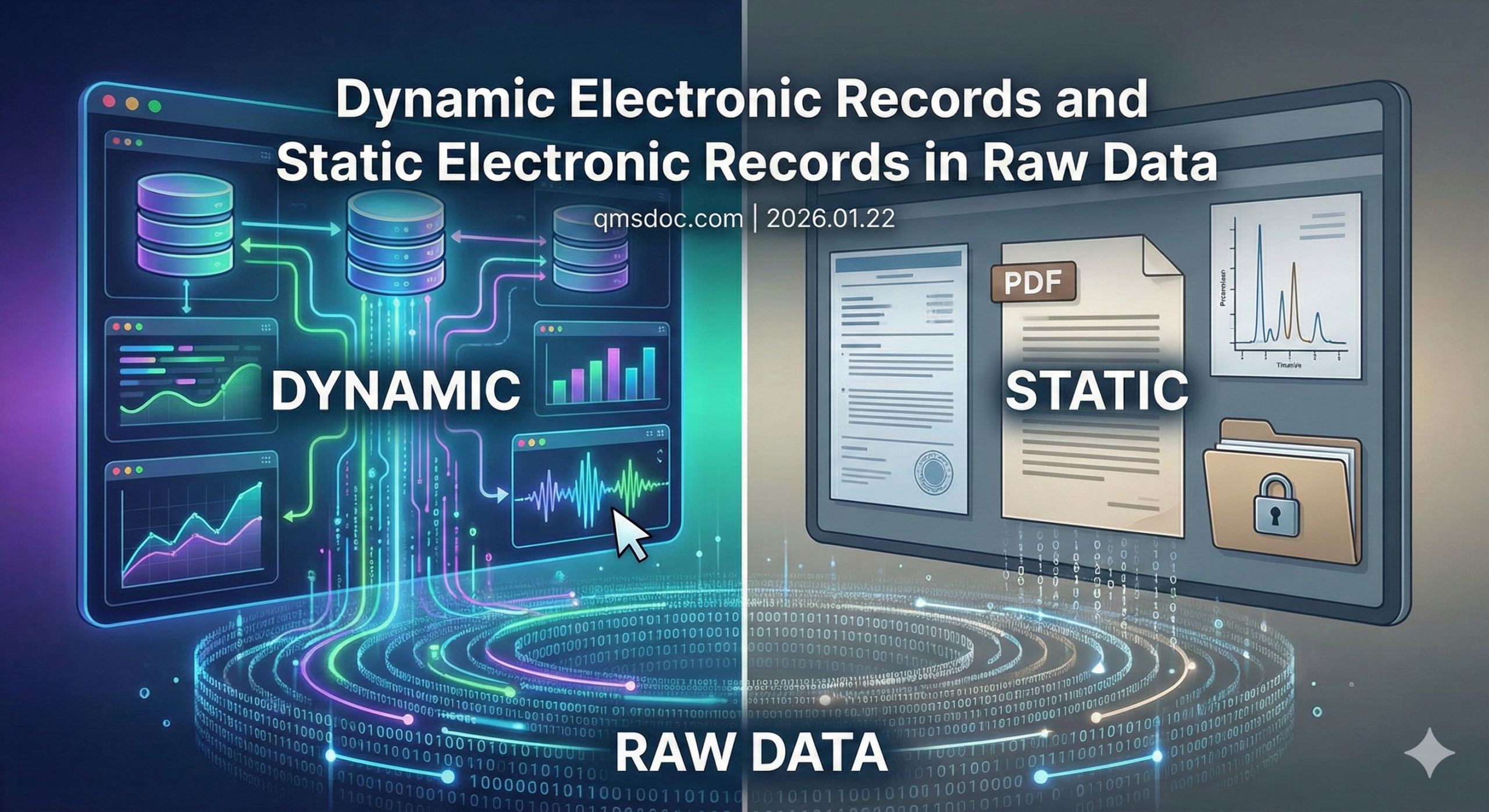
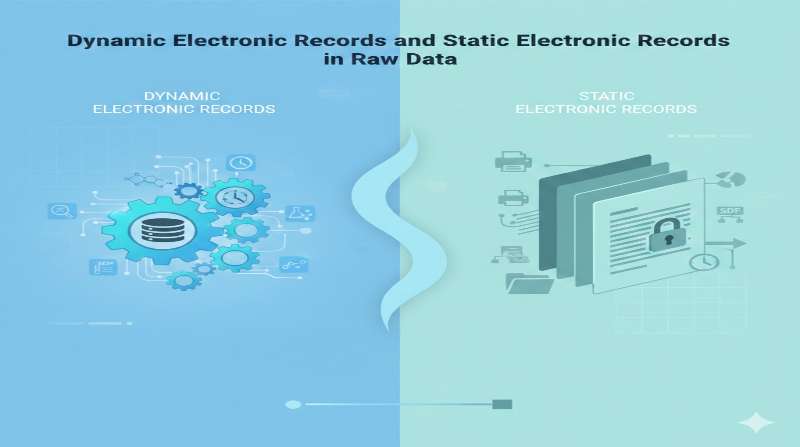
Static Electronic Records are fixed-format data that cannot be interacted with or manipulated. Examples include:
- Paper printouts
- PDF documents
- Static images or photographs
- Scanned documents
Dynamic Electronic Records are records whose format allows interaction between the user and the record content. Examples include:
- Video recordings
- Chromatographic binary data files
- Database records
- Spreadsheets with formulas
- Spectroscopic data files
The key distinguishing characteristic is whether the user can interact with the data to reveal additional information, perform queries, reprocess data, or examine hidden elements.
Practical Implications for Data Integrity
Video and Photographic Examples
Consider a video recording of a smoke test (e.g., Smog Chamber Test). The complete video represents the dynamic electronic record—it captures the entire event over time and can be reviewed repeatedly. If a single frame is extracted as a photograph, this static image does not constitute a True Copy of the original dynamic record. The photograph loses the temporal information, continuity, and the ability to observe the complete event sequence. Therefore, the photograph cannot serve as raw data when the original recording was dynamic in nature.
Chromatographic Data: A Critical Case Study
Chromatographic data provides the most commonly encountered example in pharmaceutical laboratories where the distinction between static and dynamic records has significant regulatory implications.
Dynamic Chromatographic Data (Binary Files) possess several critical capabilities:
- Reanalysis and reprocessing with different integration parameters
- Baseline adjustment and expansion of obscured regions
- Examination of peak purity and hidden peaks
- Interrogation of the complete injection sequence (including incomplete or aborted runs)
- Access to method parameters, instrument settings, and system suitability data
- Review of audit trails documenting any changes to data or methods
Static Chromatographic Data (Paper Printouts) lack these capabilities:
- Cannot be reprocessed or reintegrated
- Limited ability to examine baseline or obscured regions
- No access to underlying metadata or method parameters
- No audit trail of processing decisions
- Cannot verify peak integration algorithms
Regulatory Perspective on Chromatographic Data
FDA Position
According to FDA‘s Data Integrity Guidance and clarifications in 21 CFR 211.180(d) and 21 CFR 211.68(b):
“Electronic records from certain types of laboratory instruments—whether stand-alone or networked—are dynamic, and a printout or a static record does not preserve the dynamic record format that is part of the complete original record.”
The FDA explicitly states that paper chromatograms are not acceptable as raw data or True Copies when the original data was generated electronically. The printed chromatogram does not include:
- Injection sequence information
- Instrument method parameters
- Integration method details
- Complete audit trail
- Metadata associated with the analysis
MHRA and PIC/S Requirements
The UK Medicines and Healthcare Products Regulatory Agency (MHRA) and the Pharmaceutical Inspection Co-operation Scheme (PIC/S) have issued comprehensive data integrity guidance that aligns with FDA expectations:
From MHRA GxP Data Integrity Guidance:
“Data must be retained in a dynamic form where this is critical to its integrity or later verification. If the computerised system cannot be maintained, records should be archived according to a documented archiving strategy.”
The guidance explicitly recognizes that when data is generated in a dynamic state electronically, paper copies cannot be considered as raw data.
Common Industry Practice and Compliance Gaps
In Japan and many other jurisdictions, there has been a historical practice of retaining printed chromatograms as raw data while discarding the underlying binary data files. This practice is non-compliant with current FDA, MHRA, and international regulatory expectations.
Regulatory inspectors from FDA, MHRA, and other authorities consider this practice a serious data integrity violation because:
- It prevents complete reconstruction of the analytical work
- It eliminates the ability to verify data processing decisions
- It removes critical metadata and audit trails
- It potentially obscures data manipulation or selective reporting
Critical Requirement: Binary chromatographic data files must never be deleted. They must be retained throughout the required record retention period with appropriate backups and disaster recovery provisions.
Understanding Dynamic Records in Database Systems
Similar principles apply to database systems used in analytical work. Database-formatted dynamic electronic records allow authorized users to:
- Query and search data across multiple parameters
- Perform trend analysis and statistical evaluations
- Generate custom reports from underlying raw data
- Trace data lineage and relationships
- Display hidden fields and complete datasets
- Adjust display parameters without altering underlying data
These capabilities are essential for complete data review and regulatory inspection. A static report generated from a database does not preserve these interactive capabilities and therefore cannot serve as a substitute for the dynamic record.
Requirements for True Copies of Dynamic Electronic Records
According to 21 CFR 211.180(d) and 21 CFR 212.110, True Copies of dynamic electronic records must meet specific criteria:
- Format Compatibility: The copy must be created and maintained in the original format or in a compatible format that:
- Preserves the content and meaning of the original record
- Maintains the dynamic nature of the original data
- Includes all associated metadata
- Accessibility: Suitable reader software and copying equipment (including media readers) must be:
- Readily available throughout the retention period
- Properly maintained and validated
- Compatible with archived data formats
- Metadata Preservation: All contextual information must be retained, including:
- User identification
- Date and time stamps
- Instrument identification
- Method parameters
- Audit trails of any changes
- System configuration information
- Verification: The True Copy process must include:
- Documented procedures for creating copies
- Verification that the copy is complete and accurate
- Identification of the person certifying the copy
- Their authority to create certified copies
Data Integrity Principles: ALCOA+
Modern regulatory expectations for data integrity are often summarized by the acronym ALCOA+, which encompasses both traditional ALCOA principles and additional requirements:
| Principle | Meaning | Application to Electronic Records |
| Attributable | Data must be attributable to the person who generated it | Electronic signatures, user IDs, audit trails must link data to specific individuals |
| Legible | Data must be readable and permanent | Electronic records must remain readable throughout retention period; format obsolescence must be managed |
| Contemporaneous | Data must be recorded at the time of the activity | Timestamps must be accurate; manual transcription from memory is unacceptable |
| Original | Original record or True Copy must be preserved | Dynamic electronic data in original or compatible format must be retained |
| Accurate | Data must be correct, error-free, and complete | Validation of computerized systems; data verification procedures |
| Complete | All data must be available | No selective deletion; failed runs and OOS results must be retained |
| Consistent | Data must be in chronological sequence | Timestamps must be reliable; no ability to backdate entries |
| Enduring | Records must be durable for their retention period | Proper archival strategy; readable backup systems |
| Available | Records must be readily retrievable for review | Electronic records and metadata must be accessible for inspection |
Special Considerations for Simple Instruments
Not all electronic instruments generate dynamic data. Some basic equipment produces static records as the original data:
Examples of instruments that may generate static original records:
- Analytical balances (printing directly to paper)
- pH meters (with paper printout only)
- Conductivity meters (paper readout)
When these instruments generate a paper printout as the original record (not derived from stored electronic data), the printout itself serves as raw data and must be retained. However, modern versions of these instruments increasingly include data storage capabilities, and when electronic storage is available, the electronic record becomes the primary record.
Important distinction: If the instrument stores electronic data internally or transmits data to a computer system, the electronic record is dynamic and takes precedence over any paper printout, even if the printout is generated simultaneously.
Migration and Archival of Dynamic Electronic Records
Challenges in Long-Term Retention
As technology evolves, organizations face challenges in maintaining dynamic electronic records:
- Software applications may become obsolete
- Hardware platforms may be discontinued
- Data formats may become unsupported
- Operating systems may no longer be compatible
Archival Strategy Requirements
Regulatory guidance from FDA, MHRA, and PIC/S requires documented archival strategies that address:
- Format Migration: Plans for converting data to current formats while preserving content and meaning
- Reader Availability: Ensuring appropriate software and hardware remain available throughout the retention period, which may involve:
- Maintaining legacy systems in operational condition
- Migrating to new formats with validation of the migration process
- Using format-independent archival solutions
- Validation of Migration: Any data migration must be validated to ensure:
- Complete transfer of all data and metadata
- Preservation of data integrity and meaning
- Ability to reconstruct original records
- Documentation: The archival strategy must document:
- Retention schedules
- Storage locations and backup procedures
- Access controls
- Migration plans and validation
- Disaster recovery provisions
Global Regulatory Harmonization
While this article primarily references FDA requirements, similar principles have been adopted globally:
- European Union: EU GMP Annex 11 (Computerised Systems) and EudraLex Volume 4 Chapter 4
- WHO: Good Data and Records Management Practices
- PIC/S: Guide to Good Manufacturing Practice, PI-041 on Data Integrity
- OECD: GLP Data Integrity Guidance Document
- Health Canada: Good Manufacturing Practices Guidelines
- Japan MHLW: Although historically more accepting of paper records, increasing harmonization with international standards
These regulations and guidance documents share common themes emphasizing:
- Data integrity throughout the data lifecycle
- Retention of complete, original electronic records
- Proper controls over computerized systems
- Audit trails and metadata preservation
Practical Recommendations for Compliance
For Laboratory Management
- Inventory all data-generating systems and classify them as producing static or dynamic records
- Implement comprehensive data governance policies addressing the complete data lifecycle
- Establish documented procedures for True Copy creation when necessary
- Develop archival strategies that address format obsolescence
- Ensure adequate storage infrastructure for long-term retention of electronic records
- Implement appropriate access controls limiting who can modify or delete data
- Train personnel on data integrity principles and the importance of preserving dynamic records
For Laboratory Analysts
- Never delete electronic raw data files after printing
- Follow established procedures for data capture and processing
- Document all reprocessing with appropriate justification
- Understand which records are static versus dynamic in your laboratory
- Report any data integrity concerns through appropriate channels
- Maintain contemporaneous records of all analytical work
For Quality Assurance
- Audit data integrity practices regularly
- Review audit trails on a risk-based frequency
- Verify backup and recovery procedures are functioning properly
- Ensure archival strategies are implemented and effective
- Monitor compliance with ALCOA+ principles
- Assess vendor systems for data integrity capabilities before purchase
Conclusion
The distinction between dynamic and static electronic records is fundamental to data integrity in regulated industries. Raw data must be retained in a form that preserves its original content, meaning, and capability for complete review and reconstruction.
For chromatographic and other analytical data generated as dynamic electronic records, paper printouts are insufficient and cannot serve as raw data or True Copies. The underlying binary data files with complete metadata must be retained throughout the required retention period.
Compliance with current FDA, MHRA, PIC/S, and other international regulatory expectations requires:
- Understanding which records in your laboratory are static versus dynamic
- Implementing appropriate controls for electronic records
- Retaining dynamic electronic records with full metadata
- Never deleting electronic raw data files
- Establishing validated archival strategies for long-term retention
Organizations that continue practices of retaining only paper chromatograms while discarding electronic files are at significant risk of regulatory findings and must urgently revise their procedures to achieve compliance with current data integrity expectations.
References and Resources
Primary Regulatory Citations:
- 21 CFR Part 58 – Good Laboratory Practice for Nonclinical Laboratory Studies
- 21 CFR Part 211 – Current Good Manufacturing Practice for Finished Pharmaceuticals
- 21 CFR Part 212 – Current Good Manufacturing Practice for Positron Emission Tomography Drugs
- 21 CFR Part 11 – Electronic Records; Electronic Signatures
FDA Guidance Documents:
- Data Integrity and Compliance with Drug CGMP: Questions and Answers (December 2018)
- Questions and Answers on Current Good Manufacturing Practice Requirements—Records and Reports
International Guidance:
- MHRA GxP Data Integrity Guidance and Definitions (March 2018)
- PIC/S PI-041 Good Practices for Data Management and Integrity in Regulated GMP/GDP Environments (2021)
- WHO Technical Report Series, Annex 5: Guidance on Good Data and Record Management Practices (2016)
- OECD GLP Data Integrity Guidance Document (2021)
Note: This article provides guidance based on current regulatory requirements as of early 2025. Organizations should consult with qualified regulatory professionals and review the most current versions of applicable regulations and guidance documents when implementing data integrity programs.
Related Articles
- Understanding CFR: The Foundation of U.S. Regulatory Framework
- The Birth of 21 CFR Part 11: A Historical Perspective
- The Four Unsolvable Challenges of Part 11
- Understanding the “Typewriter Excuse” in FDA 21 CFR Part 11 Compliance
- Why Printouts Cannot Be Trusted: Understanding the Vulnerability of Paper-Based Document Management
📌 関連テンプレート: データインテグリティ手順書テンプレート
Related FDA QMSR Templates
Streamline your FDA QMSR compliance with our professionally crafted templates: