
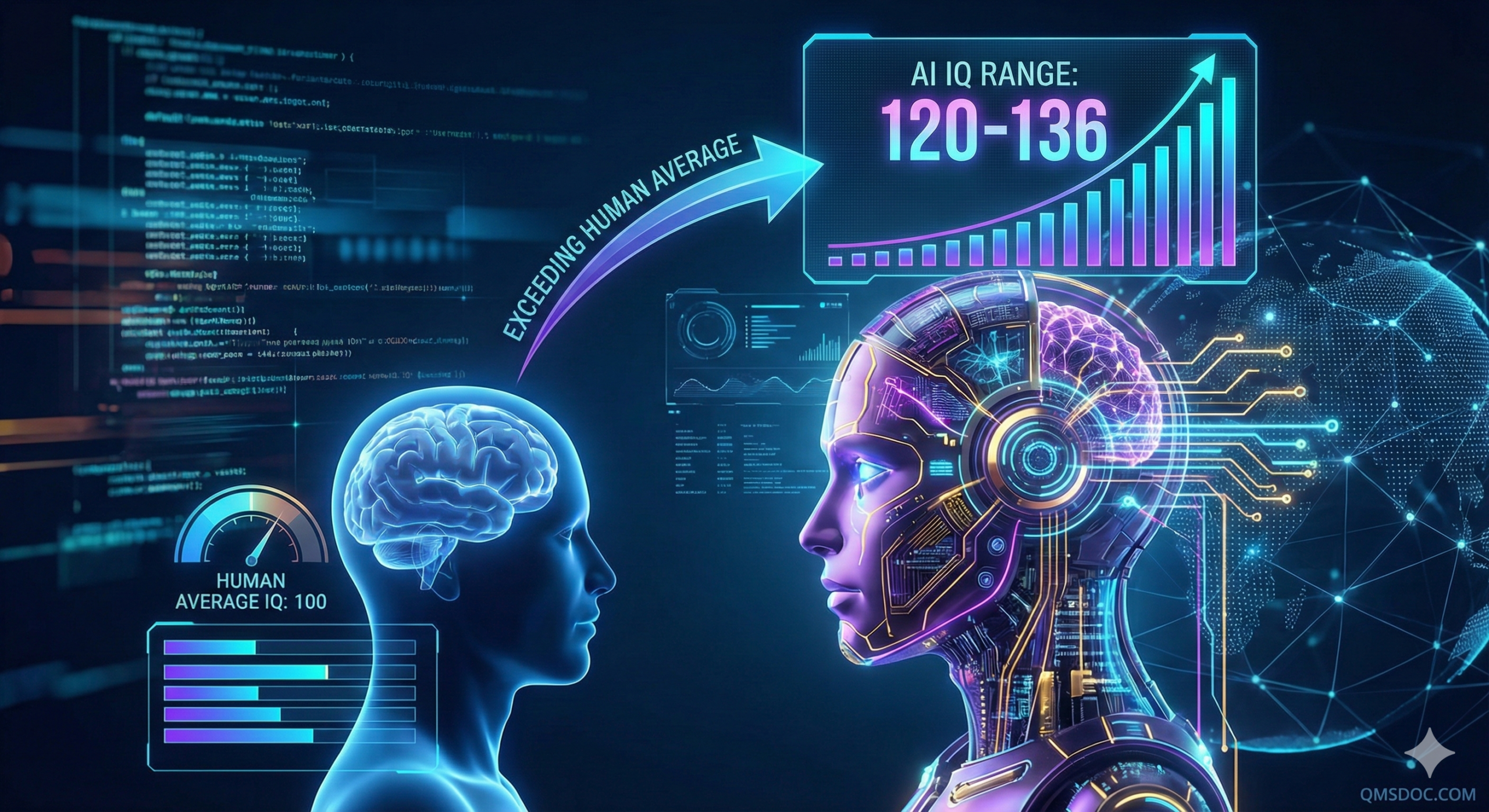
AI IQ Scores Range from 120 to 136, Exceeding the Human Average of 100
In 2025, shocking data emerged in the world of AI research. When the latest large language models were evaluated using IQ tests, their scores reached approximately 120 to 136 depending on the model, significantly surpassing the human average of 100. What does this figure signify? And how should we interpret and respond to this fact? This article examines the practical implications of rising AI intelligence levels and explores future prospects.
The Meaning of IQ Scores of 120-136: Comparison with Human IQ Distribution
IQ (Intelligence Quotient) represents a numerical expression of results from standardized cognitive ability tests. Generally, IQ tests are designed with an average of 100 and a standard deviation of 15. An IQ score above 130 statistically corresponds to the top 2% of the population.
The specific distribution is as follows:
Table 1: Human IQ Distribution
| IQ Range | Population Percentage | Classification |
| 85-115 | Approximately 68% | Average intelligence |
| 115-130 | Approximately 14% | Superior |
| 130 and above | Approximately 2% | Very superior |
In other words, the highest-performing AI models (such as OpenAI’s “o3” model) have reached an intelligence level attained by only about 2 out of 100 people.
Characteristics of AI in IQ Testing
Notably, AI not only achieves high scores but also demonstrates distinctive scoring patterns. In humans, it is typical to have strengths and weaknesses across different areas such as verbal ability, logical thinking, and spatial recognition. However, the latest AI models show balanced high scores across many domains.
There is an important caveat, however. Current IQ tests are designed for humans, and whether AI scores are obtained through the same cognitive processes as humans remains subject to debate. AI relies partly on pattern matching and memory derived from vast amounts of data, and may arrive at correct answers through mechanisms different from human “understanding.” This point is actively discussed within the AI research community.
Furthermore, according to third-party organizations such as TrackingAI.org, while AI models record high scores on publicly available tests (such as Mensa Norway), their scores on unpublished (offline) tests not included in training data can drop by approximately 20 points (for example, o3 scored 136 on public tests but 116 on offline tests). This suggests the possibility that test questions may be included in training data, and caution is necessary when evaluating AI IQ scores. Nevertheless, the fact that offline scores of 116 (corresponding to the top 15%) have been recorded demonstrates that AI is surpassing the cognitive abilities of the average human.
With that premise, AI demonstrates particular excellence in the following areas:
Pattern Recognition Ability: AI shows high performance in identifying regularities from complex data.
Language Understanding and Reasoning: AI demonstrates extremely high capabilities in multilingual contextual understanding and logical reasoning.
Knowledge Integration: The ability to combine knowledge from different fields to generate new insights has also improved.
Specific Impacts in Professional Practice
1. Changes in Collaboration Across Professional Fields
High-IQ AI demonstrates the potential to collaborate at an equal or superior level with many professional occupations.
Application in Legal Practice
In contract review and legal risk analysis, AI has already reached a level where it can provide analysis equivalent to that of attorneys. In September 2025, research published by LegalBenchmarks.ai reported that AI’s reliability in drafting contracts reached 73.3% (Gemini 2.5 Pro), exceeding the highest human attorney performance of 70%. The average reliability of human attorneys was approximately 57%, showing that AI significantly outperformed average attorneys.
Particularly noteworthy is AI’s ability to warn of potential risks. The same study showed a striking difference: specialized AI tools provided risk warnings in 83% of cases involving high-risk clauses, whereas human attorneys provided no warnings (0%).
In practice, many law firms have established collaborative systems where AI identifies potential problems in contracts and human attorneys make final judgments.
Medical Diagnostic Support
In diagnostic imaging accuracy, AI increasingly demonstrates capabilities equal to or exceeding those of specialists. In July 2025, Microsoft’s research team published MAI-DxO (an AI diagnostic system integrated with OpenAI’s o3 model), which achieved an 85.5% accuracy rate on 304 difficult cases from the New England Journal of Medicine. In the same study, the average accuracy rate of 21 general practitioners and primary care physicians was 20%.
However, this research was conducted under special conditions. Participating physicians were prohibited from using books, the internet, or consulting colleagues, which differs from actual clinical practice environments. It is also important to note that the comparison group consisted of general practitioners rather than specialists.
On the other hand, a meta-analysis published in March 2025 by a team from Osaka Metropolitan University and others in npj Digital Medicine reported that the overall diagnostic accuracy of generative AI was approximately 52.1%, significantly inferior to specialists. These two contrasting datasets indicate the practical reality that “the latest AI can perform at specialist level under certain conditions, but generally available models are still in development.”
2. Application in Educational Settings
High-intelligence AI is bringing significant transformation to the education sector.
Individually Optimized Learning
AI can accurately assess each student’s level of understanding and develop optimal learning plans. This fine-grained responsiveness is made possible by high cognitive abilities.
Evolution of the Teacher’s Role
As AI takes on much of knowledge transmission, teachers can allocate more time to supporting students’ emotional needs and fostering creativity. This has the potential to qualitatively improve education.
3. Expansion into Creative Work
Traditionally, creativity was considered uniquely human, but with the emergence of high-intelligence AI, this boundary is becoming blurred.
Design Work
In logo design and web design, AI can generate multiple excellent proposals in a short time. Designers can use AI proposals as a starting point to create more refined work.
Strategic Planning
In developing business strategies, AI can analyze vast amounts of data and identify opportunities and risks that humans might overlook. This enables more accurate decision-making.
Skills Required for Collaboration with High-Intelligence AI
1. Ability to Formulate Appropriate Questions
The higher the AI’s IQ, the more important it becomes to determine “what to ask.” By posing excellent questions, one can maximize AI’s capabilities.
For example, rather than simply asking “Tell me how to increase sales,” the ability to formulate specific, structured questions is required, such as “Analyze customer data and market trends from the past three years and identify the customer segments with the highest growth potential.”
2. Ability to Critically Evaluate AI Output
Even high-IQ AI is not perfect. Rather than accepting its judgments and proposals uncritically, the ability to evaluate them critically from a human perspective and make necessary modifications is important.
Particular attention should be paid to the following:
- Verifying the transparency of AI’s reasoning process
- Checking for data bias or omissions
- Evaluating ethical and social impacts from a human perspective
3. Ability to Optimize Division of Roles Between AI and Humans
Even in the era of high-intelligence AI, not everything should be delegated to AI. The judgment to discern what should be entrusted to AI and what humans should handle is required.
As general guidelines:
- Routine and logical judgments: Delegate to AI
- Ethical judgments and value judgments: Performed by humans
- Early stages of creative ideation: Human-AI collaboration
- Execution and verification: Delegate to AI with human oversight
Future Prospects and Challenges
Predictions for 2026 and Beyond
Further IQ Improvements
According to analysis by TrackingAI.org (Maxim Lott and colleagues), AI intelligence scores improved at a pace of approximately 2.5 points per month from May 2024 to October 2025. Reports indicate that some models recorded IQ scores above 140 by the end of 2025, and further improvements are expected beyond 2026. However, whether this trend will continue is uncertain and may fluctuate due to technological breakthroughs or constraints.
Integration of Multimodal Intelligence
With the proliferation of AI capable of integrating and processing information in all formats—text, images, audio, video—the possibility of achieving more human-like comprehensive intelligence becomes real.
Challenges to Address
Standardization of Measurement Methods
Current IQ tests are designed for humans, and whether they accurately measure AI intelligence is debatable. Among experts, there is a view that “Mensa-style tests cannot provide realistic IQ scores for AI,” and concurrent use of more comprehensive benchmarks such as ARC-AGI, MMLU, and Humanity’s Last Exam is recommended. Establishing AI-specific intelligence evaluation standards is necessary.
Development of Ethical Guidelines
Establishing clear guidelines on how much to trust high-intelligence AI judgments and in which domains humans should make final decisions is an urgent matter.
Redesign of Education Systems
In an era where AI IQ exceeds the human average, what kind of education should humans receive? Rather than just acquiring knowledge, emphasis needs to be placed on cultivating more distinctly human abilities such as creativity, empathy, and ethical judgment.
Conclusion
The fact that AI IQ has reached 120-136 is not merely a technical milestone. It indicates the need to fundamentally reconsider the relationship between humans and AI.
What matters is not viewing AI’s high intelligence as a threat, but utilizing it as a powerful partner to augment human capabilities. While leveraging AI’s strengths in logical thinking and pattern recognition, humans should focus on areas where they still maintain advantages: creativity, empathy, and ethical judgment. By establishing such role divisions, new forms of collaboration where humans and AI leverage each other’s strengths can be realized.
The year 2025 marked precisely such a turning point. Building social systems, organizational structures, and educational methods premised on coexistence with high-intelligence AI will be key to navigating the coming era. Rather than fearing technological evolution, our mission is to harness it as an ally and create a richer future.
Note on Sources and Verification: This article is based on publicly available research and reports from 2025. While specific studies are cited, readers should note that AI capabilities continue to evolve rapidly, and performance metrics may vary depending on test conditions and methodologies. The ethical and practical implications discussed represent ongoing considerations in the field rather than settled conclusions.

Comment