
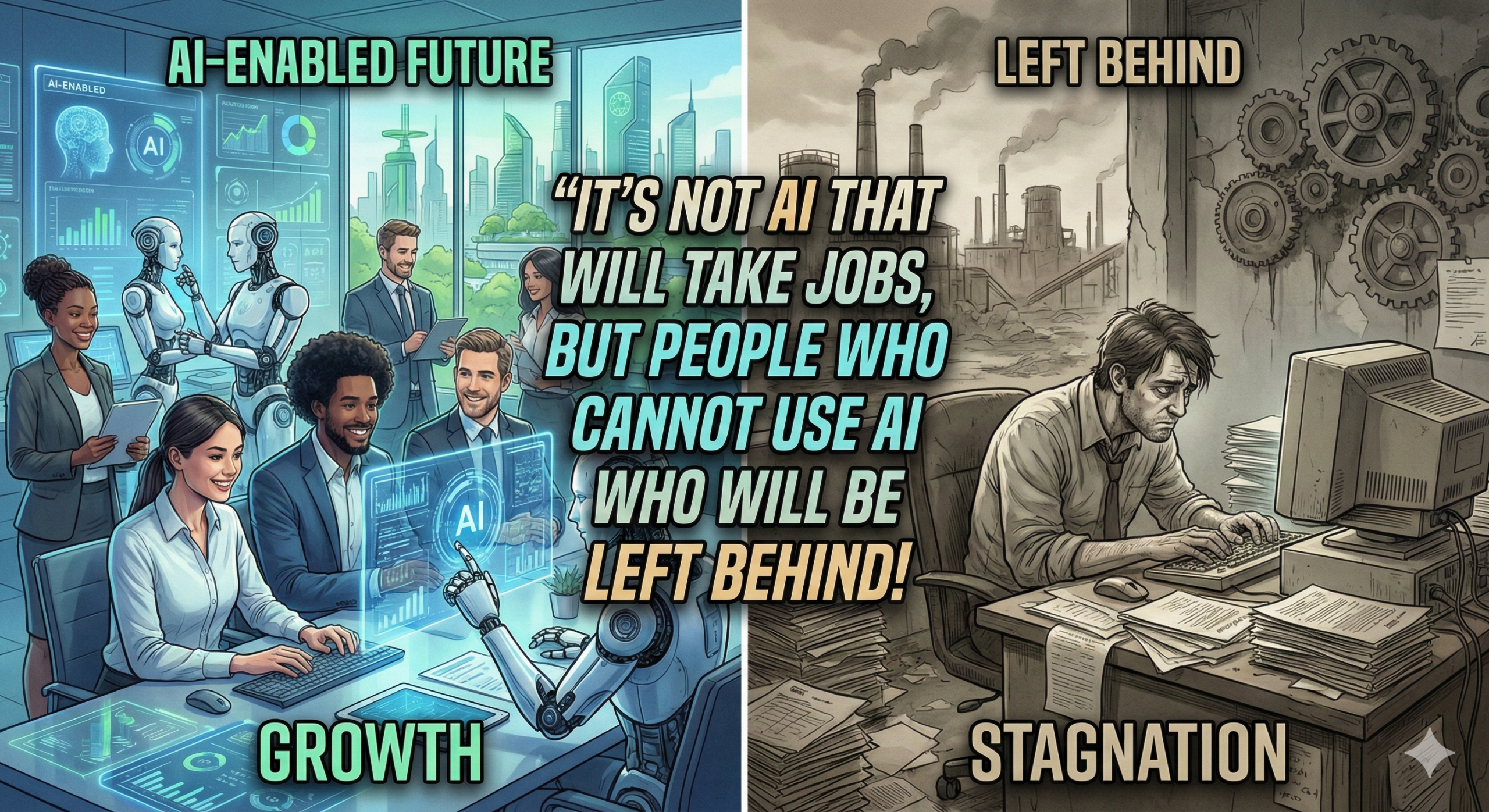
It’s Not AI That Will Take Jobs, But People Who Cannot Use AI Who Will Be Left Behind
The True Nature of Misunderstood “AI Threat Theory”
Every time we hear the phrase “AI will take our jobs,” many people feel anxious. However, this very way of framing the question fails to capture the essence of the problem. As of 2025, the real challenge we face is not “whether AI will take our jobs” but rather “whether we can master AI.”
Let us look back at the era of the Industrial Revolution. It is said that many artisans lost their jobs due to the advent of the steam engine, but in reality, a gap emerged between “people who could use machines” and “those who could not.” The structure remains unchanged in the age of AI. What matters is how we engage with AI as a new partner.
From “Using” to “Delegating”: A Fundamental Shift in How We Work
Traditionally, AI has been positioned as an advanced tool—like machine translation tools or data analysis software—operating within clearly defined instructions given by humans. However, agent-based AI, which has rapidly proliferated since 2024, is fundamentally changing this relationship.
Agent-based AI refers to systems that autonomously plan, select necessary tools, and execute tasks in response to given objectives. For example, when asked to “prepare materials for next month’s sales meeting,” AI autonomously performs a series of tasks: analyzing past data, gathering information, creating graphs, integrating materials, and even sending review requests.
This shift is transforming the human role from “executing detailed tasks” to “setting appropriate goals and making final judgments.” In other words, the era has arrived not of “using” AI, but of “delegating” to AI.
Changes in Practical Work Settings: A Paradigm Shift Through Concrete Examples
Consider customer support operations as an example. Traditionally, operators handled cases one by one while referring to FAQs. Today, however, a system is becoming commonplace where AI agents handle initial responses completely, escalating only complex cases or those requiring emotional consideration to human operators.
This change has freed human operators from simple inquiries, allowing them to concentrate on more advanced problem-solving and relationship building with customers. AI has not “taken away” jobs but rather “upgraded” human work.
Similar changes are occurring in market research. Previously, analysts collected data, analyzed it, and created reports. Now, AI monitors market trends 24/7, detects significant changes, and automatically generates reports. The analyst’s role has evolved to making strategic judgments based on information provided by AI.
Skills Needed in the New Era
In an age of “delegating” to AI, the skills required have changed significantly. Here are three particularly important skills:
AI Management Capability
This is similar to managing subordinates but requires communication based on understanding AI’s characteristics. It involves setting appropriate goals for AI agents, evaluating their results, and providing feedback. Specifically, the ability to set clear objectives rather than vague instructions and to appropriately judge AI outputs is required.
Creative Problem-Setting Ability
While AI excels at finding solutions to given problems, discerning “what should be solved” remains a human role. Moreover, since AI handles execution, humans can now devote more time to discovering and defining more essential problems. The importance of this ability has increased more than ever before.
Continuous Learning Attitude
AI technology evolves daily. In a world where what was impossible yesterday becomes possible today, a commitment to continuous learning is essential. The curiosity to actively try new AI tools as they emerge and explore their possibilities has become indispensable for business professionals going forward.
Organizational Transformation in Corporations
Since entering 2025, many companies have been reorganizing based on the premise of AI. An increasing number of companies are establishing “AI Collaboration Departments,” separate from traditional IT departments, to optimize human-AI collaboration.
There is also a trend toward flattening organizational hierarchies as AI takes on coordination tasks typically performed by middle management. With project management AI automating progress tracking and resource allocation, the role of traditional managers is shifting from “management” to “strategic planning” and “human resource development.”
Preparations to Start Immediately
What should individuals begin with? We recommend the following three steps:
Step 1: Try Familiar AI Tools
First, actually use AI tools applicable to daily work. Various AI tools are already available for writing assistance, data analysis, schedule management, and more. Rather than seeking perfection, it is important to simply try them first.
Step 2: Refine Communication Skills with AI
There are techniques for giving appropriate instructions to AI and obtaining desired results. This skill, called prompt engineering, will become increasingly important going forward. Learn effective communication methods with AI, such as specific and clear instructions, step-by-step questioning, and providing feedback.
Step 3: Enhance AI Literacy
By understanding AI’s basic mechanisms and limitations, you can utilize it more effectively. AI is not a magic box but a system operating based on specific principles. Understanding these characteristics enables judgment about what to delegate to AI and what humans should handle.
Understanding AI regulations and ethical frameworks is also becoming crucial. The European Union’s AI Act, adopted in 2024 and being implemented in phases, classifies AI systems by risk level and imposes corresponding obligations. Similar regulatory movements are emerging in other regions as well. International standards such as the ISO/IEC 42001 AI Management System are also being developed, and understanding these frameworks enhances the ability to use AI responsibly.
Future Outlook: A Symbiotic Society of Humans and AI
In the latter half of 2025, multi-agent systems where multiple AI agents cooperate to accomplish complex tasks are expected to see practical implementation. Examples are emerging where sales AI, marketing AI, and customer support AI collaborate to optimize the entire customer experience.
Simultaneously, the importance of transparency and accountability in AI decision-making is growing. Some countries and regions are moving to mandate the establishment of AI ethics committees for companies above a certain scale. As the scope of delegation to AI expands, its appropriate management and supervision become more critical.
In designing and operating AI systems, human-centered AI design principles are gaining prominence. These principles emphasize respecting human dignity, ensuring fairness and non-discrimination, protecting privacy, and maintaining transparency. Organizations utilizing AI are increasingly required not merely to pursue efficiency but to incorporate these ethical perspectives.
Conclusion: Not to Fear, But to Make an Ally
The fear that “AI will take our jobs” is a natural reaction to new technology. However, as history shows, technological evolution has not eliminated work but changed its nature. The same applies to the age of AI.
The real threat is not AI itself but the inability to master AI. The productivity gap between those who can use AI and those who cannot will widen exponentially. This gap is the true meaning of the word “left behind.”
What matters is directing the time and energy created by delegating to AI toward more creative and human activities. Strategic thinking, empathetic communication, generation of innovative ideas—these remain human domains.
AI is not an enemy but the strongest partner. Those who recognize this and actively make AI their ally will pioneer the next era. Why not take a small step starting today? The future is open to those who take action.
Key Skills Comparison: Traditional vs. AI Era
| Aspect | Traditional Work Environment | AI-Delegated Work Environment |
| Primary Focus | Task execution and process management | Goal setting and strategic judgment |
| Required Technical Skills | Tool operation and manual processing | AI management and prompt engineering |
| Decision-Making | Based on personal experience and available data | Based on AI-analyzed insights and human judgment |
| Learning Approach | Periodic training and skill updates | Continuous learning and adaptation |
| Collaboration | Primarily human-to-human | Human-AI partnership with multi-agent systems |
| Value Creation | Time spent on execution | Time invested in creative problem-solving |
Understanding AI Risk Categories (Based on EU AI Act Framework)
| Risk Level | Definition | Examples | Requirements |
| Unacceptable Risk | AI systems posing clear threats to safety, rights, or democracy | Social scoring by governments, real-time biometric identification in public spaces | Prohibited |
| High Risk | AI systems with significant potential impact on health, safety, or fundamental rights | AI in critical infrastructure, employment decisions, law enforcement | Strict compliance requirements including risk assessment, data governance, human oversight |
| Limited Risk | AI systems with specific transparency obligations | Chatbots, emotion recognition systems | Transparency requirements (users must be informed they’re interacting with AI) |
| Minimal Risk | AI systems with little to no risk | AI-enabled video games, spam filters | No specific obligations beyond general law |
Understanding these categories helps organizations and individuals implement AI responsibly while maximizing its benefits.

Comment