
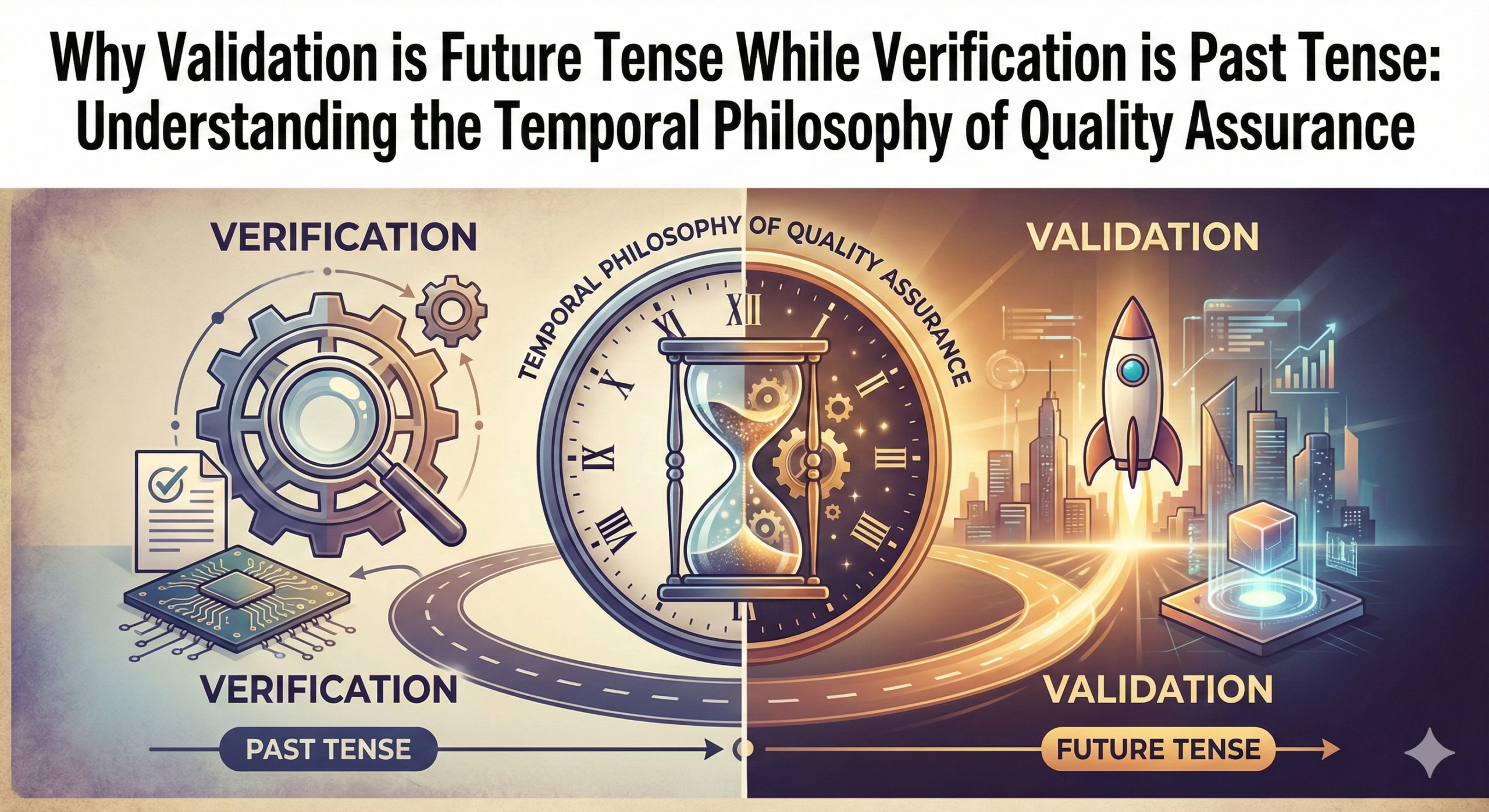
In the pharmaceutical, medical device, and software development industries, validation and verification serve as cornerstones of quality assurance. The temporal distinction—the “tense”—inherent in these terms provides a crucial key to understanding the fundamental nature of quality assurance activities.
The Temporal Direction of Quality Assurance
Validation is articulated in the future tense as “demonstrating that a system or process will consistently produce products meeting predetermined specifications.” Conversely, verification is expressed in the past tense as “confirming that products have been manufactured according to design specifications.”
This temporal distinction is not merely grammatical nuance. International regulatory documents, including FDA guidance and EU GMP (EudraLex Volume 4), define validation as an activity that “establishes documented evidence which provides a high degree of assurance that a specific process will consistently produce a product meeting its predetermined specifications and quality attributes.” This positions validation as a forward-looking confirmation of process capability over time.
According to FDA 21 CFR Part 211.100(a), process validation is defined as establishing documented evidence demonstrating with a high degree of assurance that a specific process will consistently produce a product meeting predetermined specifications. Similarly, EU GMP Annex 15 emphasizes that qualification and validation are performed to demonstrate that facilities, systems, and equipment are suitable for their intended use and consistently perform as intended.
The ICH Q7 Good Manufacturing Practice Guide for Active Pharmaceutical Ingredients further clarifies that validation studies should reinforce GMP and be conducted in accordance with defined procedures, with results and conclusions recorded.
Validation: Assurance for the Future
The essence of validation lies in “establishing predictability.” It is a scientific endeavor to demonstrate that a system or process will continue to generate expected quality outcomes consistently into the future.
Understanding Validation Through Concrete Examples
Consider a newly introduced tablet manufacturing line. Validation involves the following verifications:
Performance confirmation under various conditions: Will the line produce tablets of identical quality during hot and humid summer conditions as well as cold and dry winter conditions?
Demonstration of long-term stability: Will quality be maintained one year, two years, and beyond into the future?
Capability to respond to anomalies: Will the system operate normally after recovery from a power outage?
Consistency across operators: Will identical results be obtained whether Operator A or Operator B performs the operations?
All of these verifications address “various scenarios that may occur in the future,” making validation quintessentially a “future-tense” activity.
The Three Stages of Process Validation
Modern regulatory frameworks recognize validation as a lifecycle approach. According to FDA Process Validation Guidance (2011), process validation consists of three stages:
| Stage | Description | Temporal Nature |
|---|---|---|
| Stage 1: Process Design | Understanding the process and identifying critical process parameters and quality attributes | Future-oriented: designing for consistent performance |
| Stage 2: Process Qualification | Confirming that the process design is capable of reproducible commercial manufacturing | Future-oriented: demonstrating capability before routine production |
| Stage 3: Continued Process Verification | Ongoing assurance that the process remains in a state of control | Both future and past: using past data to ensure future performance |
This lifecycle approach demonstrates that validation is not a one-time event but a continuous commitment to ensuring future quality outcomes.
Verification: Confirmation of the Past
Verification possesses the characteristic of “confirming actual results.” It is an activity that confirms completed work or manufactured products meet established specifications and requirements, documenting those results as records.
Understanding Verification Through Concrete Examples
Using the same tablet manufacturing line, verification is implemented in the following situations:
Inspection of today’s manufactured tablets: Do weight, hardness, and dissolution meet specifications?
Operational confirmation after system changes: After software updates, did the system operate correctly?
Confirmation after periodic maintenance: After parts replacement, is specified performance being achieved?
Reconciliation of work records: Did operators perform work according to procedures?
All of these are confirmations of “things that have already occurred,” making them “past-tense” activities.
Verification in Regulatory Context
ISO 9000:2015 defines verification as “confirmation, through the provision of objective evidence, that specified requirements have been fulfilled.” This definition emphasizes the retrospective nature of verification—it examines what has already been accomplished.
In the context of ISO/IEC/IEEE 15288:2023 (Systems and software engineering — System life cycle processes), verification is described as providing objective evidence that a system or system element fulfills its specified requirements and characteristics. This involves examining completed work products against their specifications.
Practical Distinction in CSV Implementation
In Computerized System Validation (CSV) practice, understanding this temporal distinction clarifies the purpose and timing of each activity.
The Relationship Between Validation and Verification in Project Flow
1. Pre-System Implementation (Validation)
Central question: “Will this system continue to meet GMP requirements for the next 10 years?”
Activities include risk assessment, design review, and predictive performance evaluation. These activities align with GAMP 5 (Second Edition, 2022) guidance, which emphasizes a risk-based, science-driven approach to validation that focuses on patient safety, product quality, and data integrity.
2. Post-System Operation (Verification)
Central questions: “Was this month’s data recorded accurately?” “Was last week’s system change implemented appropriately?”
Activities involve confirming actual operational results and creating records. According to FDA 21 CFR Part 11 (Electronic Records; Electronic Signatures), these verification activities must ensure that electronic records are trustworthy, reliable, and equivalent to paper records.
3. Complementary Relationship
The interplay between validation and verification can be understood as follows:
- Validation provides “assurance of future quality”
- Verification periodically confirms “that this assurance is functioning”
- Through this cycle, system reliability is maintained long-term
This relationship is particularly important in the context of data integrity. The ALCOA+ principles (Attributable, Legible, Contemporaneous, Original, Accurate, plus Complete, Consistent, Enduring, and Available) require both forward-looking validation to prevent data integrity issues and retrospective verification to detect and correct them.
A Universal Concept Transcending Industries
This “future-tense and past-tense” conceptualization is widely recognized not only in the pharmaceutical and medical device industries but also in software development and general quality assurance fields.
ISO 9001:2015 (Quality management systems — Requirements) incorporates both validation and verification concepts, requiring organizations to determine and provide resources needed to ensure valid results when monitoring or measuring is used to verify conformity to requirements.
In software engineering, ISO/IEC/IEEE 12207:2017 (Systems and software engineering — Software life cycle processes) distinguishes between verification (confirming that work products properly reflect specified requirements) and validation (confirming that products fulfill their intended use in their intended environment). Even in this context, the temporal distinction holds: verification looks backward at what was specified, while validation looks forward to actual use.
English-language regulatory documents and guidelines clearly distinguish this temporal nuance, establishing it as an internationally common understanding.
Contemporary Regulatory Trends and Their Implications
Recent regulatory developments have reinforced the importance of understanding validation and verification as complementary activities:
FDA’s Pharmaceutical Quality/CMC Program: The modernization of pharmaceutical quality assessment emphasizes a lifecycle approach where validation establishes initial process understanding (future-oriented) and verification provides continuous confirmation (past-oriented) throughout the product lifecycle.
EU GMP Annex 11 (Computerized Systems): The revised guidance emphasizes that validation should ensure systems are fit for intended use throughout their lifecycle, while verification activities (such as periodic review and testing) confirm ongoing compliance.
ICH Q12 (Technical and Regulatory Considerations for Pharmaceutical Product Lifecycle Management): This guideline reinforces that established conditions (validated parameters) must be continuously verified throughout the product lifecycle to ensure they remain in a state of control.
GAMP 5 Second Edition (2022): The updated guidance emphasizes a more flexible, risk-based approach to validation while maintaining the fundamental principle that validation provides prospective assurance and verification provides retrospective confirmation.
The Role of Risk Management in Validation and Verification
Modern quality systems integrate risk management throughout the validation and verification lifecycle. ICH Q9(R1) (Quality Risk Management) provides a framework that applies to both activities:
| Aspect | Validation Context | Verification Context |
|---|---|---|
| Risk Identification | Identifying potential future failure modes | Identifying actual deviations from specifications |
| Risk Assessment | Evaluating likelihood and impact of future failures | Assessing significance of observed deviations |
| Risk Control | Implementing controls to prevent future failures | Implementing corrections for identified failures |
| Risk Communication | Documenting validation rationale and strategy | Documenting verification results and decisions |
| Risk Review | Periodic review of validation status | Ongoing review of verification findings |
This integration demonstrates that while validation and verification have different temporal orientations, they work together within a comprehensive quality risk management framework.
Practical Implementation: Validation and Verification in Action
To illustrate the practical application of these concepts, consider the implementation of a new Laboratory Information Management System (LIMS):
Validation Phase (Future-Tense Activities):
- Conducting User Requirements Specification (URS) to define what the system must do
- Performing Design Qualification (DQ) to verify the design meets requirements
- Executing Installation Qualification (IQ) to confirm proper installation
- Carrying out Operational Qualification (OQ) to demonstrate the system operates as intended under various conditions
- Performing Performance Qualification (PQ) to prove the system consistently produces acceptable results
These activities collectively answer the question: “Will this LIMS continue to meet our quality requirements under all foreseeable conditions?”
Verification Phase (Past-Tense Activities):
- Reviewing audit trails to confirm all data changes were properly documented
- Checking that electronic signatures were applied correctly for completed analyses
- Confirming that yesterday’s batch release testing followed approved procedures
- Verifying that last week’s system backup was successful and restorable
- Validating that the monthly system performance metrics met acceptance criteria
These activities answer the question: “Did the LIMS operate correctly and produce valid results during the period under review?”
Data Integrity: Where Validation and Verification Converge
The concept of data integrity provides an excellent illustration of how validation and verification work together. According to MHRA GXP Data Integrity Guidance (2018) and FDA Data Integrity and Compliance with Drug CGMP Guidance (2018), organizations must ensure data integrity throughout the data lifecycle.
Validation’s role in data integrity (future-tense): Design and implement systems with technical and procedural controls that will prevent data integrity issues before they occur. This includes access controls, audit trails, data backup systems, and electronic signature mechanisms.
Verification’s role in data integrity (past-tense): Regularly review audit trails, check for data anomalies, investigate deviations, and confirm that data integrity controls functioned as intended. This includes periodic data reviews, audit trail reviews, and self-inspections.
Without proper validation, systems may lack necessary controls, making data integrity breaches likely. Without proper verification, even well-validated systems may deteriorate over time without detection. Both are essential for maintaining data integrity.
Summary: The Essence of Quality Assurance Revealed Through Temporal Perspective
Within the seemingly simple distinction that “validation is future-tense, verification is past-tense” lies a profound philosophy of quality assurance activities:
Validation = Predictive Assurance (Will it continue to be acceptable?)
Verification = Confirmation of Actual Results (Was it acceptable this time?)
Understanding this fundamental difference clarifies why both activities are necessary and what should be implemented at which timing. For quality assurance professionals and all those involved in quality, being conscious of this temporal distinction represents the first step toward achieving genuine quality assurance.
This temporal understanding is not merely academic—it has practical implications for resource allocation, planning, and risk management. Organizations that clearly distinguish between validation and verification can more effectively:
- Allocate resources appropriately between proactive (validation) and reactive (verification) activities
- Plan validation activities strategically to address future risks
- Design verification activities efficiently to confirm past performance
- Integrate both approaches into a comprehensive quality management system
- Communicate quality assurance strategies clearly to regulators and stakeholders
In the evolving landscape of pharmaceutical and medical device quality assurance, where regulatory expectations continue to advance toward more sophisticated risk-based approaches, this fundamental understanding of validation and verification as temporal concepts remains as relevant and essential as ever. The future of quality assurance lies not in choosing between validation and verification, but in understanding how these complementary activities work together across the temporal spectrum to ensure product quality and patient safety.
References and Regulatory Framework
This article draws upon the following regulatory documents and international standards:
- FDA 21 CFR Part 211 – Current Good Manufacturing Practice for Finished Pharmaceuticals
- FDA 21 CFR Part 11 – Electronic Records; Electronic Signatures
- FDA Process Validation: General Principles and Practices (2011)
- FDA Data Integrity and Compliance with Drug CGMP Guidance (2018)
- EU GMP EudraLex Volume 4 – Good Manufacturing Practice Guidelines
- EU GMP Annex 11 – Computerized Systems
- EU GMP Annex 15 – Qualification and Validation
- ICH Q7 – Good Manufacturing Practice Guide for Active Pharmaceutical Ingredients
- ICH Q9(R1) – Quality Risk Management
- ICH Q12 – Technical and Regulatory Considerations for Pharmaceutical Product Lifecycle Management
- GAMP 5 Second Edition (2022) – A Risk-Based Approach to Compliant GxP Computerized Systems
- ISO 9000:2015 – Quality management systems — Fundamentals and vocabulary
- ISO 9001:2015 – Quality management systems — Requirements
- ISO/IEC/IEEE 12207:2017 – Systems and software engineering — Software life cycle processes
- ISO/IEC/IEEE 15288:2023 – Systems and software engineering — System life cycle processes
- MHRA GXP Data Integrity Guidance (2018)
These references provide the regulatory and technical foundation for understanding validation and verification as complementary quality assurance activities with distinct temporal orientations.

Comment