
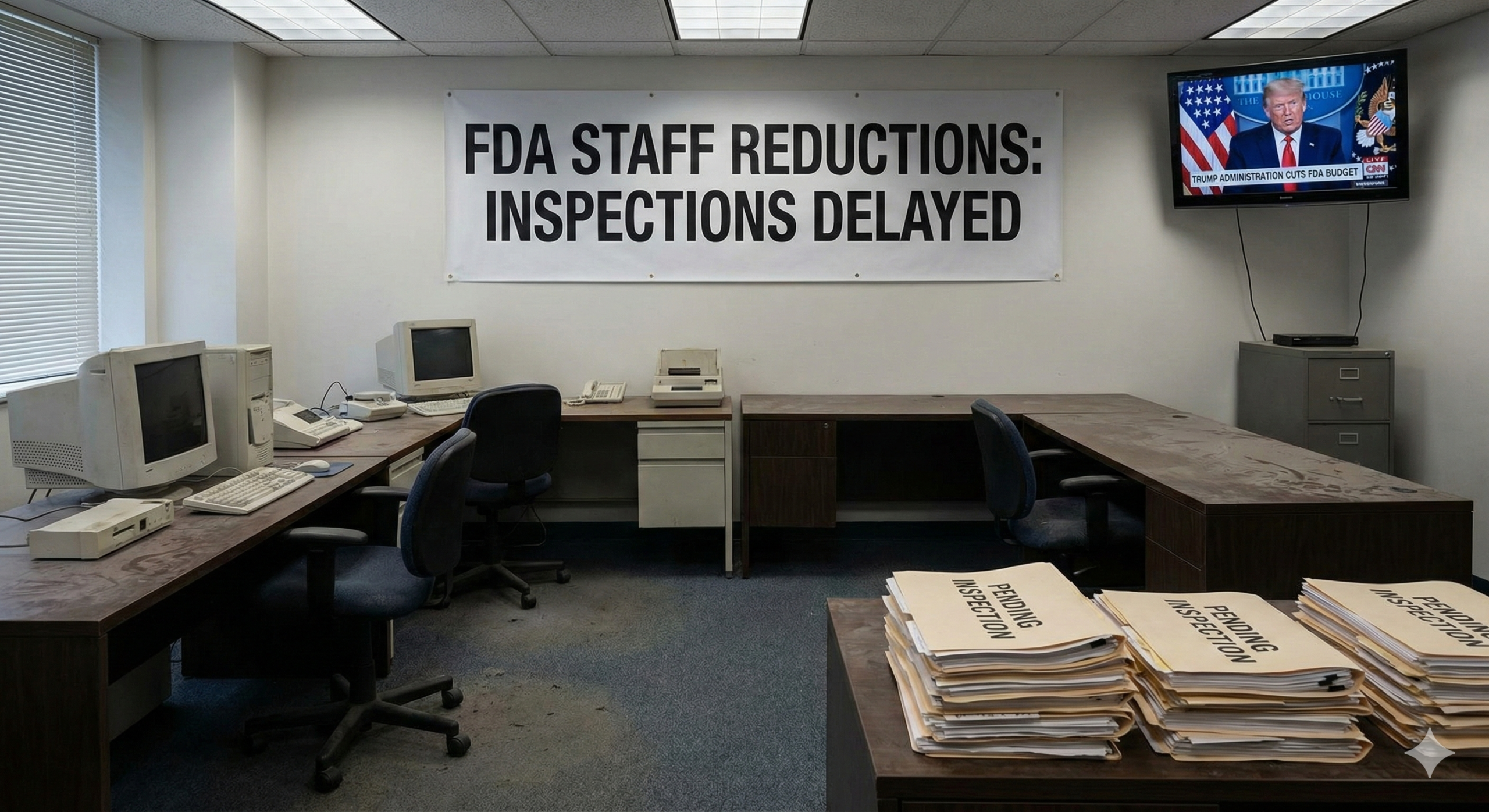
Impact of FDA Staff Reductions on Inspections Under the Trump Administration
Introduction: Overview of FDA Organizational Reform
In January 2025, shortly after the inauguration of President Donald Trump’s second term, significant personnel reductions were implemented across federal government agencies. The U.S. Food and Drug Administration (FDA) was among the agencies targeted for staff reductions. Under the leadership of Secretary Robert F. Kennedy Jr. at the Department of Health and Human Services (HHS), reforms involving substantial workforce reductions have been implemented across HHS, including the FDA. According to reports, the initial plan called for the elimination of approximately 3,500 positions at the FDA alone.
Throughout 2025, these reductions were implemented in phases, and their impacts became increasingly evident as the year progressed. This article focuses specifically on the FDA’s inspection functions and explains how staff reductions are affecting food and drug safety assurance.
What Are FDA Inspections: The Front Line Protecting Our Safety
FDA inspections are critical activities that investigate domestic and international manufacturing facilities to confirm that food and drugs meet federal regulatory standards. Inspectors rigorously examine factory sanitation conditions, manufacturing processes, quality control systems, and record-keeping practices.
FDA inspection activities are primarily conducted based on the following regulations:
Federal Food, Drug, and Cosmetic Act (FD&C Act): The fundamental legislation granting FDA the authority to conduct on-site inspections of manufacturing facilities.
For pharmaceuticals: Verification of compliance with Current Good Manufacturing Practice (cGMP) regulations (21 CFR Parts 210 and 211).
For foods: Verification of compliance with preventive control rules under the Food Safety Modernization Act (FSMA) (21 CFR Part 117, among others).
For medical devices: Verification of compliance with Quality System Regulation (QSR, 21 CFR Part 820).
Without such inspections, the safety of medicines and foods we use daily could be compromised. The FDA typically employs a risk-based approach, conducting more frequent inspections of higher-risk facilities.
Reality of the Reductions: The Contradictory “Inspector Preservation” Policy
The Trump administration and Secretary Kennedy Jr. initially promised that FDA inspectors themselves would be excluded from reduction targets. However, the actual personnel reductions have presented a complex picture. According to reports throughout 2025, while “inspectors will be maintained” was publicly stated, significant impacts have occurred to the critical support systems that enable inspections.
Particularly serious is the large-scale reduction of essential support staff for inspections. Specifically, the following issues have emerged:
Reduction of Travel Coordinators: Over 50 staff members who arranged inspectors’ travel worldwide were terminated, placing the burden of booking flights, hotels, and ground transportation on the inspectors themselves. This has created a situation where inspectors cannot focus on their core professional duties.
Termination of Quality Assurance Personnel: Quality assurance staff, analytical chemists, and microbiologists were terminated, and the Food Emergency Response Network (FERN) quality testing program was reportedly suspended until September 2025. FERN is a critical testing network for responding to food-related emergencies and intentional contamination.
Reduction of Inspection Support Staff: Approximately 170 inspection support personnel were terminated, affecting the entire process of inspection planning, scheduling, execution, and report preparation. These staff members played important roles in data management, record organization, and preliminary investigations.
Termination of Food Laboratory Scientists: Scientists in food testing laboratories were terminated, creating contradictory situations. Testing laboratories are responsible for analyzing samples collected during inspections, a critical function, and reduced capacity directly undermines inspection effectiveness.
Specific Impacts on Inspections: Confusion in the Field
Due to these reductions, FDA inspection activities have experienced the following specific impacts:
Impact on Inspection Preparation and Implementation
Reduced Inspection Preparation Time: Because inspectors must now arrange their own travel, the time available for pre-inspection preparation, completion of previous inspection reports (Form 483 and Establishment Inspection Reports), and learning about new technologies and regulatory changes has significantly decreased.
Delayed Inspection Reporting: The reduction in support staff has caused delays in post-inspection report preparation and follow-up activities. This also affects verification of corrective actions by companies.
Interruption of Food Safety Testing
Impact on Avian Influenza Testing: Efforts to improve testing for highly pathogenic avian influenza (HPAI) were interrupted, reportedly affecting safety verification of milk, cheese, and pet food in particular. From 2024 to 2025, H5N1 avian influenza infection in dairy cattle was confirmed, making dairy product safety monitoring a particularly important issue.
Reduced Laboratory Capacity: The reduction of analytical chemists and microbiologists has decreased the capacity to process food samples, extending the time required for result reporting.
Impact on Foreign Inspections
Suspension of Unannounced Inspections: The reduction of staff responsible for quickly securing interpreters worldwide led to the suspension of the pilot program for unannounced foreign inspections. Foreign inspections are extremely important given that many pharmaceutical active ingredients (APIs) and finished products are manufactured overseas.
Difficulties in International Cooperation: Coordination with foreign regulatory authorities and activities based on Mutual Recognition Agreements (MRAs) may also be affected.
Closure of Regional Testing Facilities
Closure of San Francisco Laboratory: The closure of this important regional testing facility has significantly reduced food and drug testing capacity in the West Coast region. Regional laboratories played important roles in food safety incidents requiring rapid response and import product testing.
Financial Issues
Problems with Inspection Travel Expenses: Cases have been reported where inspectors have canceled inspections because reimbursement of travel expenses has been delayed. Federal employees typically advance travel costs temporarily and receive reimbursement later, but processing delays have created personal financial burdens.
Why This Matters: Expert Warnings
These changes are not merely government efficiency measures but issues that directly affect health and safety in our daily lives. Experts have raised the following concerns:
Impact on Food Safety
Increased Food Poisoning Risk: Experts are concerned that weakened inspection systems will lead to decreased food safety and increased food poisoning risks. An estimated 48 million people in the United States contract foodborne illnesses annually, and reduced inspections could worsen these numbers.
Impact on FSMA Implementation: The Food Safety Modernization Act, enacted in 2011, is groundbreaking legislation emphasizing preventive approaches, but its effective implementation requires adequate inspection capacity. Reduced inspections make achieving the law’s objectives more difficult.
Impact on Drug Safety
Risk of Reduced Drug Quality: Former FDA principal scientists have warned that “the loss of experienced leadership in key centers regulating the safety of food, drugs, and medical devices poses high risks.” Drug quality issues can lead not only to reduced efficacy but also to direct health harm to patients.
Impact on Drug Shortages: In recent years, shortages of critical drugs have become a serious problem in the United States. Reduced inspection capacity may delay early detection of manufacturing problems, potentially exacerbating drug shortages.
Long-term Impacts
Former FDA Commissioner David Kessler (1990-1997) has criticized current reductions as “unplanned” and pointed out that the loss of expertise will adversely affect long-term safety assurance. FDA inspectors and scientists accumulate specialized knowledge through years of experience and training, and such losses cannot be recovered quickly.
Loss of Institutional Memory: The departure of experienced staff leads to loss of “institutional memory” including past cases, industry trends, and effective inspection methods.
Interruption of Talent Development: Training new inspectors typically takes 2-3 years, but without sufficient experienced staff to provide guidance, talent development itself becomes difficult.
Future Outlook: Replacement with Contract Workers and Challenges
To address FDA staff reductions, replacement of some functions with contract workers is being considered, but this may create new problems:
Limitations of Contract Worker Utilization
Continuity of Expertise: Contract workers are temporary employees, making long-term accumulation and transfer of specialized knowledge difficult. FDA inspections require highly specialized skills and experience, which are difficult to develop through short-term contracts.
Conflict of Interest Concerns: If contract workers may potentially work for regulated companies in the future, concerns about fairness and objectivity may arise.
Questionable Cost Efficiency: While personnel cost reductions may appear beneficial short-term, long-term cost efficiency is questionable when considering costs for training, managing contract workers, and maintaining continuous quality.
Structural Challenges in Personnel Recruitment
Recruitment and Retention Difficulties: The FDA has historically faced challenges in recruiting and retaining staff due to better compensation in the private sector. The Government Accountability Office (GAO) highlighted this issue in a 2022 report, noting particular difficulties in recruiting and retaining scientists and technical specialists.
Impact of Current Workforce Reductions: Staff reductions and organizational instability may further deter talented individuals interested in FDA careers. This creates a vicious cycle making long-term personnel recruitment even more difficult.
Chronic Inspection Capacity Shortage
Increase in Uninspected Facilities: With numerous uninspected facilities already existing before the pandemic, further reduction in inspection capacity is concerning. As of the early 2020s, thousands of domestic and foreign facilities were reportedly not being inspected at recommended frequencies.
Limitations of Risk-Based Inspections: Resource constraints may further strengthen risk-based approaches. While this is rational in terms of concentrating on high-risk facilities, it risks delayed problem detection at facilities considered lower risk.
Impact on Approval Processes
Delays in New Drug and Medical Device Approvals: The approval processes for new drugs and medical devices may also be delayed due to support staff reductions. Manufacturing facility inspections are critical steps in new product approvals, and reduced inspection capacity directly affects approval timelines.
Impact on Innovation: Approval delays can adversely affect pharmaceutical and medical device companies’ research and development investments, ultimately delaying patients’ access to new treatments.
International Context and Comparisons
Comparisons with other major regulatory authorities are also important:
Comparison with European Medicines Agency (EMA)
The European Medicines Agency conducts pharmaceutical inspections in cooperation with EU member state regulatory authorities. Since 2022, EMA has been advancing inspection efficiency and digitalization, focusing on capacity building rather than personnel reductions.
Comparison with Pharmaceuticals and Medical Devices Agency (PMDA)
Japan’s PMDA is also advancing strengthened international cooperation and adoption of risk-based inspections, but premised on maintaining basic inspection capacity.
International Council for Harmonisation (ICH) Developments
ICH promotes international harmonization of pharmaceutical regulations, with ensuring inspection quality and consistency as important goals. Reduced U.S. inspection capacity may also affect international harmonization efforts.
Conclusion: The Importance of Balanced Safety Assurance
While government efficiency and waste reduction are important goals, they must not undermine the fundamental function of protecting public health and safety. FDA inspections are the front line for ensuring food and drug safety, and their functional decline affects us all.
While official statements indicate “inspectors will be maintained,” the reality is that practical inspection capacity has declined due to collapsed support systems. What became clear throughout 2025 is that inspection capacity cannot be measured by the number of inspectors alone. Effective inspections are only possible when diverse functions supporting inspections—travel arrangements, data management, laboratory analysis, and report preparation—are integrated.
Future Challenges
Ensuring Transparency: More transparent disclosure of information about the reality and impacts of reductions is needed. The FDA should regularly publish inspection numbers, coverage rates, trends in violations discovered, and similar data.
Science-Based Decisions: Organizational restructuring and personnel allocation should be based on scientific evidence and risk assessment rather than ideology.
Long-term Perspective: Careful consideration is needed to ensure short-term cost reductions do not lead to increased long-term public health costs. The economic and social costs of foodborne illnesses and drug incidents may far exceed inspection costs.
Maintaining International Cooperation: In a globalized supply chain, international regulatory cooperation is essential. Reduced U.S. inspection capacity may also affect cooperative relationships with other countries.
How to balance government efficiency and safety assurance will be a major challenge for the Trump administration and society as a whole. While pursuing efficiency is important, it should be done based on scientific evidence and with careful evaluation of long-term public health impacts. Maintaining an appropriate inspection system to protect public health continues to be strongly required.
Attention must be paid to the gap between official agency statements and field realities, and ongoing developments must be monitored. After 2026, the actual impacts of these reductions are expected to become clearer, and policy adjustments as needed are anticipated.

Comment