
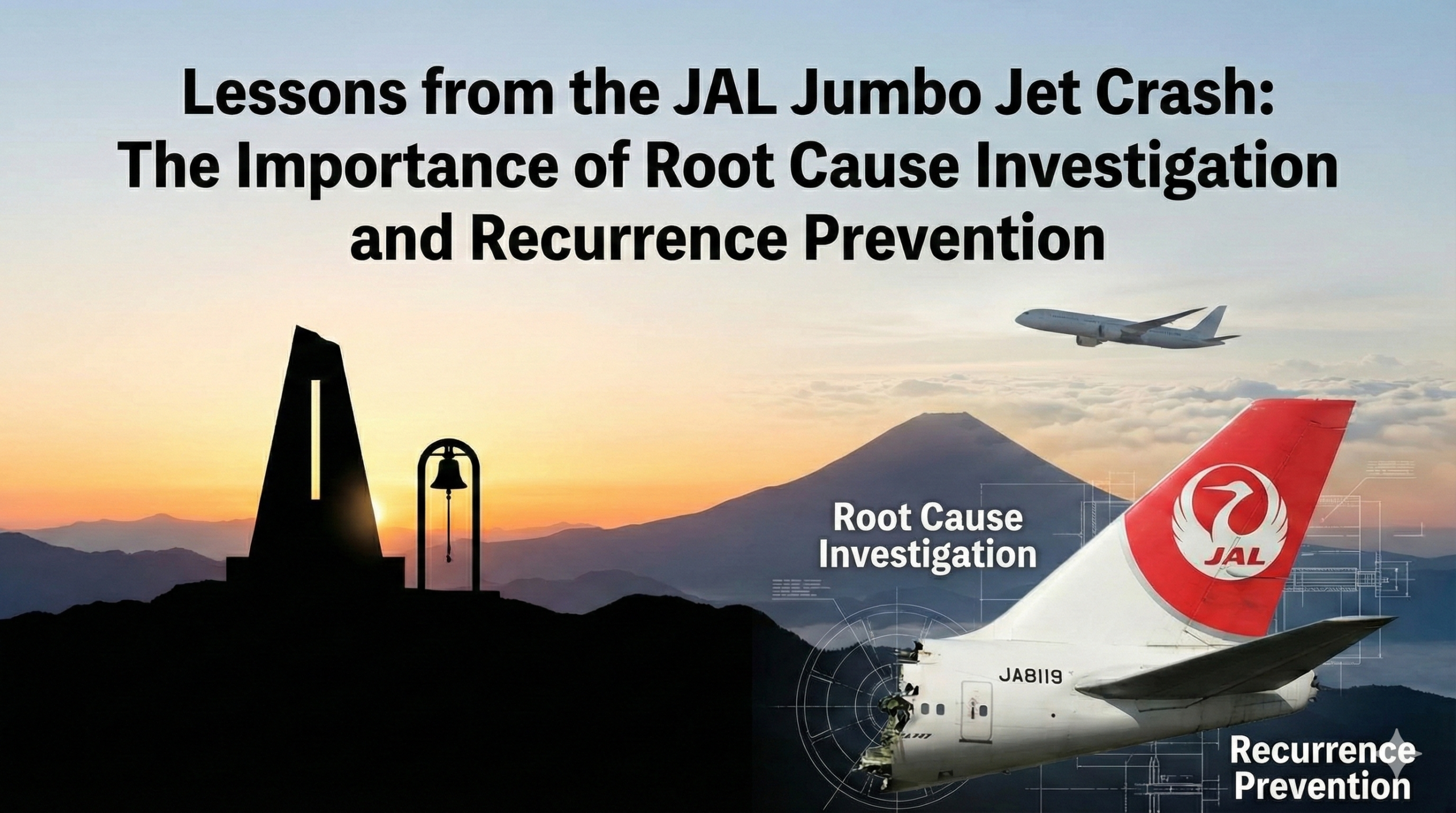
Root Cause Investigation and Recurrence Prevention Are Paramount – Lessons Learned from the JAL Jumbo Jet Crash
Overview of the JAL Flight 123 Accident
On August 12, 1985 (Showa 60), the worst disaster in Japanese aviation history occurred. Japan Airlines Flight 123, a Boeing 747SR-100 aircraft (registration JA8119), departed Haneda Airport at 18:00 bound for Itami Airport in Osaka. However, just 12 minutes after takeoff, the aircraft entered an abnormal state and continued 32 minutes of uncontrolled flight before crashing into Mount Osutaka in Ueno Village, Tano District, Gunma Prefecture. Of the 524 people on board, 520 lost their lives, making this the deadliest single-aircraft accident in aviation history.
Technical Investigation of the Accident Cause
According to the report published in 1987 by the Aircraft Accident Investigation Commission of the Ministry of Transport (now the Japan Transport Safety Board), the direct cause of the accident was the failure of the aft pressure bulkhead. Specifically, the following technical facts were revealed:
Repair Method Error: The accident aircraft had undergone repairs by Boeing Company technicians following a tail strike incident at Osaka International Airport in 1978. During this repair, a critical error occurred where a “single-row” rivet joint (one row) was used in a location that required a “double-row” joint (two rows of rivets).
Fatigue Failure Mechanism: The improper repair caused stress concentration, leading to progressive crack propagation. After 15,030 flight cycles (approximately seven years of operation), the stress reached the fracture threshold and the bulkhead catastrophically failed.
Inspection Deficiencies: The detailed inspection based on Boeing Service Bulletin No. 747-53A-1228 was not conducted, and reliance on visual inspection alone prevented early detection of the crack. The service bulletin, issued in 1978 following the repair, specifically called for ultrasonic and eddy current inspections of the bulkhead repair area, but these were not performed by Japan Airlines maintenance personnel.
While the technical cause has been clearly established, the organizational and systemic root causes—why such an obvious repair error occurred and why it was not detected during inspection processes—remain inadequately investigated to this day.
Differences in Criminal Liability Pursuit Between Japan and the United States
In pursuing responsibility for the accident, there were significant differences between Japan and the United States:
Japan: A former Boeing maintenance supervisor and Japan Airlines maintenance personnel were referred to prosecutors on charges of professional negligence resulting in death and injury (1987). However, they were ultimately granted a suspension of prosecution.
United States: The National Transportation Safety Board (NTSB) investigation did not result in criminal prosecution. The Federal Aviation Administration (FAA) imposed an administrative penalty of $2.25 million on Boeing (1987), but no individual criminal charges were filed.
This difference reflects the contrasting legal approaches to aviation accidents in the two countries. In the United States, criminal liability is typically not pursued in aviation accidents unless “willful misconduct” or “gross negligence” is established. This approach stems from the perspective that accident recurrence prevention requires an environment where personnel can testify without fear of prosecution, thereby ensuring full disclosure of safety-critical information.
In contrast, Japan tends to pursue criminal liability more broadly, without such distinctions. Due to this difference, Boeing refused Gunma Prefectural Police’s request to interview repair personnel, citing U.S. federal regulations (14 CFR §831.7, which protects certain accident investigation information from disclosure). Furthermore, because no formal request was made under the Mutual Legal Assistance Treaty (MLAT) between Japan and the United States, compulsory testimony was not realized. This legal impasse significantly hindered the investigation’s ability to obtain detailed accounts of the repair process and organizational factors that contributed to the error.
“Prosecutorial Agreement System” and the Evolution of Safety Culture
The “prosecutorial agreement system” (gōi seido, often referred to as “plea bargaining” in English) introduced through the 2018 amendment to Japan’s Code of Criminal Procedure allows for the reduction of criminal penalties in exchange for testimony or evidence under specific conditions. However, the current situation is as follows:
Scope of Application: Primarily limited to organized crime (violations of the Antimonopoly Act, Financial Instruments and Exchange Act, etc.), with limited applicability to accidents caused by professional negligence.
Aviation Accident Application Record: As of 2025, there are no cases of application in aviation accident investigations.
Systemic Issues: The balance between individual criminal liability and corporate accountability remains unresolved. The system’s design does not adequately address the unique characteristics of aviation accidents, where systemic failures often involve multiple organizations and complex technical factors.
Meanwhile, aviation safety culture has steadily evolved. Japan Airlines introduced a “Just Culture” policy in 2004, fostering a culture that does not punish reporters of accidents or incidents caused by unintentional errors. This policy distinguishes between honest mistakes, at-risk behavior, and reckless behavior, applying different consequences to each category. As a result, more than 30,000 voluntary safety reports are processed annually, contributing to early detection of potential risks. This represents a more than tenfold increase from pre-Just Culture implementation levels.
Internationally, the International Civil Aviation Organization (ICAO) amended Annex 13 in 2020 to explicitly promote a “non-punitive reporting culture.” Additionally, ICAO’s Annex 19 (Safety Management Systems), which became applicable in 2013 and was updated in 2016, requires states to establish safety management frameworks that encourage voluntary reporting without fear of punitive action. These developments demonstrate an international trend toward prioritizing recurrence prevention over liability pursuit in aviation safety culture.
The Critical Importance of Root Cause Investigation
From an accident prevention perspective, the most important task is to clarify the root cause—”why such a situation occurred.” It is essential to pursue not only superficial causes but also systemic defects, weaknesses, inadequacies, contradictions, and ambiguities.
While the technical direct cause of the JAL Flight 123 accident was clarified, the Aircraft Accident Investigation Commission report (1987) identified the following as unresolved issues:
Deficiencies in the Repair Design Approval Process: The FAA’s delegation system, whereby certification authority is delegated to manufacturers through the Organization Designation Authorization (ODA) program, allowed Boeing to approve its own repair designs without independent FAA review. This conflict of interest contributed to the approval of the defective repair design.
Inadequacies in Repair Implementation Records: Boeing’s work records contained ambiguities and lacked the detailed documentation necessary to verify that the repair was performed according to approved specifications. Specifically, the repair records did not clearly indicate whether single-row or double-row splice plates were used.
Problems with Japan Airlines’ Maintenance Record Management: Insufficient transfer of repair details during aircraft delivery and subsequent maintenance planning. The airline’s maintenance planning system did not incorporate Boeing’s service bulletin recommendations for enhanced inspection of the repair area.
The insufficient analysis of these organizational and institutional factors undeniably delayed essential safety improvements beyond mere technical corrections. Modern accident investigation methodologies, such as the Systems-Theoretic Accident Model and Processes (STAMP) developed by MIT Professor Nancy Leveson, provide frameworks for analyzing such complex sociotechnical system failures, but these were not available or widely applied at the time of the Flight 123 investigation.
The Dilemma Between Liability Pursuit and Recurrence Prevention
When accident investigations emphasize “finding culprits,” the likelihood of evidence concealment and testimony refusal by involved parties increases significantly. Under such circumstances, elucidating the fundamental causes becomes difficult, and as a result, the risk of recurrence of similar tragic accidents escalates.
This fact was clearly manifested in the Flight 123 accident investigation. Boeing refused to cooperate with Gunma Prefectural Police interview requests, and due to differences in judicial procedures between Japan and the United States, detailed testimony from repair personnel could not be obtained. This became one factor that hindered detailed analysis of the repair process.
What is truly important is not punishing individuals but establishing mechanisms to prevent the recurrence of similar disasters. This raises the difficult question of how to balance two societal imperatives: the pursuit of judicial justice and the improvement of safety.
The International Air Transport Association (IATA) and Flight Safety Foundation have consistently advocated for the separation of accident investigation from judicial proceedings. The European Union’s Regulation (EU) No 996/2010 explicitly protects safety information from being used in judicial or administrative proceedings, recognizing that such protection is essential for effective safety investigations.
Evolution of Safety Measures and Implementation of Lessons Learned
Following the JAL Flight 123 accident, aviation safety initiatives have significantly evolved across multiple dimensions:
Technical Improvements
FAA Airworthiness Directive 87-21-08: Mandated enhanced inspection of pressure bulkheads for all Boeing 747 aircraft, requiring ultrasonic and eddy current inspections at specified intervals.
Revision of Repair Standards: The Society of Automotive Engineers (SAE) established AIR 4844 (first published in 2003, revised in 2018) titled “Guidance for Standardization of Aircraft Structural Repairs,” providing comprehensive standards for repair design, implementation, and inspection.
Structural Health Monitoring (SHM) Systems: Advanced aircraft such as the Boeing 787 and Airbus A350 incorporate technology that monitors the condition of structural components in real-time using embedded sensors. These systems can detect fatigue crack initiation and propagation before they reach critical lengths, providing early warning for maintenance intervention.
Digital Twin Technology: Modern aircraft manufacturers are implementing digital twin systems that create virtual replicas of physical aircraft, enabling predictive maintenance and fatigue life modeling based on actual operating conditions rather than statistical averages.
Institutional Reforms
Japan: Amendment of the Aviation Act (1999, significantly revised in 2001 following the establishment of the Japan Transport Safety Board in 2008) established “Aircraft Accident and Incident Reporting Rules,” introducing a voluntary reporting system. The Aviation Safety Information Sharing system (JASC) was subsequently established to facilitate industry-wide information sharing.
International: ICAO’s Global Aviation Safety Plan (GASP), first published in 2007 and updated regularly (current version: 2023-2025), strengthened information-sharing frameworks. The plan established State Safety Programmes (SSP) as a mandatory requirement for all ICAO member states.
EUROCONTROL’s REXT Tool: Development and international dissemination of methodologies for analyzing organizational factors, based on the Human Factors Analysis and Classification System (HFACS) and other accident analysis frameworks.
Safety Management Systems (SMS): ICAO Annex 19, which became applicable in November 2013, requires all service providers to implement formal SMS frameworks. This represents a paradigm shift from reactive safety management to proactive and predictive risk management.
Cultural Transformation
Japan Airlines Safety Reporting System: Processes more than 30,000 voluntary reports annually, enabling early detection of potential risks. The system is supported by dedicated safety promotion staff who analyze reports and disseminate lessons learned throughout the organization.
FAA’s Aviation Safety Action Program (ASAP): Operation of an anonymous reporting system allowing concerns to be reported without fear of penalties. Under ASAP, air carriers, employees, and the FAA work together to identify and reduce risk in aviation operations. As of 2024, more than 80 U.S. airlines and repair stations participate in ASAP programs.
Just Culture: Cultivation of a culture that does not punish reporters of accidents or incidents caused by unintentional errors, while maintaining accountability for reckless behavior and willful violations. This concept, popularized by David Marx’s work on Just Culture principles, distinguishes between human error, at-risk behavior, and reckless behavior, applying proportionate responses to each.
Confidential Safety Reporting Systems: Many countries have established independent safety reporting systems, such as the UK’s CHIRP (Confidential Human Factors Incident Reporting Programme), which accept reports from aviation professionals with guarantees of confidentiality and immunity from prosecution.
These initiatives demonstrate a transition toward a safety culture that emphasizes “cause investigation and recurrence prevention” over “finding culprits.”
Comparison of Safety Culture Approaches
The following table illustrates the fundamental differences between traditional punitive approaches and modern safety culture approaches:
| Aspect | Traditional Punitive Approach | Modern Safety Culture Approach |
| Primary Focus | Individual accountability and punishment | System improvement and learning |
| Reporting Incentive | Fear of consequences discourages reporting | Protection encourages voluntary reporting |
| Investigation Goal | Identify responsible parties | Identify systemic weaknesses |
| Information Flow | Limited due to fear of liability | Open sharing promotes collective learning |
| Error Perspective | Personal failure to be punished | Opportunity for system improvement |
| Long-term Impact | Concealment of problems, recurring incidents | Continuous improvement, reduced risk |
| Regulatory Philosophy | Compliance through enforcement | Safety through collaboration |
Lessons to Be Learned from the Accident
The lessons we should learn from the JAL Flight 123 accident are multifaceted, but the most important points are as follows:
The Importance of Thoroughly Pursuing “Why” in Aviation Safety: Effective accident investigation must move beyond identifying what happened to understanding why it happened at multiple levels of causation. This requires examining not only technical failures but also organizational processes, regulatory oversight, and cultural factors that created conditions for failure.
Cultivation of a Culture That Prioritizes Recurrence Prevention Over Individual Liability Pursuit: Safety culture research, including the work of James Reason and Sidney Dekker, has consistently demonstrated that punitive approaches to human error undermine safety by discouraging the reporting and analysis of safety-critical information. Modern aviation safety depends on creating environments where personnel can report errors, near-misses, and safety concerns without fear of retribution.
Institutional Design That Allows Involved Parties to Provide Information Without Fear: Legal and regulatory frameworks must protect those who provide safety information from punitive consequences. This includes protection of safety data, separation of safety investigations from judicial proceedings, and immunity provisions for voluntary safety reporting. The EU’s protection of safety information under Regulation 996/2010 and the U.S. ASAP program exemplify such frameworks.
The Need for Systemic Improvements Beyond Individual Failures: The Flight 123 accident resulted from failures at multiple levels: design, manufacturing, quality assurance, regulatory oversight, and maintenance planning. Effective prevention requires addressing weaknesses at all levels of the sociotechnical system, not merely focusing on the actions of individuals at the “sharp end” of operations.
Establishment of International Cooperation Frameworks and Promotion of Information Sharing: Aviation is an inherently global enterprise, and safety improvements in one country benefit the entire international aviation community. Organizations such as ICAO, IATA, Flight Safety Foundation, and regional safety organizations facilitate the sharing of safety information, lessons learned, and best practices across national boundaries. The Commercial Aviation Safety Team (CAST) in the United States and the European Strategic Safety Initiative (ESSI) exemplify successful multinational safety collaboration.
Implementation of Proactive and Predictive Safety Management: Modern safety management has evolved from reactive responses to accidents toward proactive identification of hazards and predictive analysis of risk. This includes the use of Safety Management Systems (SMS), Flight Data Monitoring (FDM) programs, Line Operations Safety Audits (LOSA), and advanced data analytics to identify precursors to accidents before they occur.
To pass on the lessons learned from the accident to the next generation and ensure that similar tragedies are never repeated, approaches from both institutional reform and organizational culture transformation are necessary. Above all, it is essential to place the value of “recurrence prevention over liability pursuit” at the core of safety culture. By never allowing the memory of the Osutaka accident to fade and continuing unceasing efforts toward improving aviation safety, we can provide the greatest memorial to the 520 victims.
Contemporary Relevance and Future Challenges
Nearly four decades after the Flight 123 accident, the aviation industry faces new challenges that require continued application of the lessons learned:
Increasing System Complexity: Modern aircraft incorporate highly integrated systems with software-intensive controls, creating new failure modes that require sophisticated analysis methodologies. The Boeing 737 MAX accidents (2018, 2019) demonstrated that system complexity, combined with inadequate pilot training and certification processes, can create catastrophic safety gaps even in modern aircraft.
Globalization of Aviation Supply Chains: Aircraft manufacturing and maintenance now involve complex global supply chains with multiple tiers of suppliers across many countries. This distribution of responsibilities creates challenges for quality assurance, regulatory oversight, and maintenance of institutional knowledge. The lessons of Flight 123 regarding repair documentation and quality control remain highly relevant in this globalized context.
Cybersecurity Threats: As aircraft become increasingly connected and software-dependent, cybersecurity emerges as a critical safety concern. The principles of defense-in-depth, redundancy, and comprehensive testing that evolved from mechanical safety failures must now be applied to digital systems.
Economic Pressures and Safety Culture: Economic pressures on airlines, particularly low-cost carriers and those in emerging markets, can create tensions with safety culture. Maintaining the primacy of safety over cost considerations requires vigilant regulatory oversight and strong organizational safety cultures that resist production pressure.
Training and Experience in Automated Environments: As aircraft automation increases, maintaining pilot proficiency and ensuring adequate understanding of system operation becomes increasingly challenging. The Flight 123 crew’s heroic efforts to control the damaged aircraft demonstrated exceptional airmanship; maintaining such skills in increasingly automated environments requires careful consideration of training methodologies.
The Flight 123 accident reminds us that safety is not a destination but a continuous journey requiring constant vigilance, learning from failures, and commitment to systemic improvement. The 520 lives lost on that August evening in 1985 must continue to inspire our collective efforts to make aviation safer for all.
This article is dedicated to the memory of the 520 victims of Japan Airlines Flight 123 and their families. May their sacrifice continue to guide aviation safety improvements worldwide.

Comment