
Introduction to Amendment Methodologies
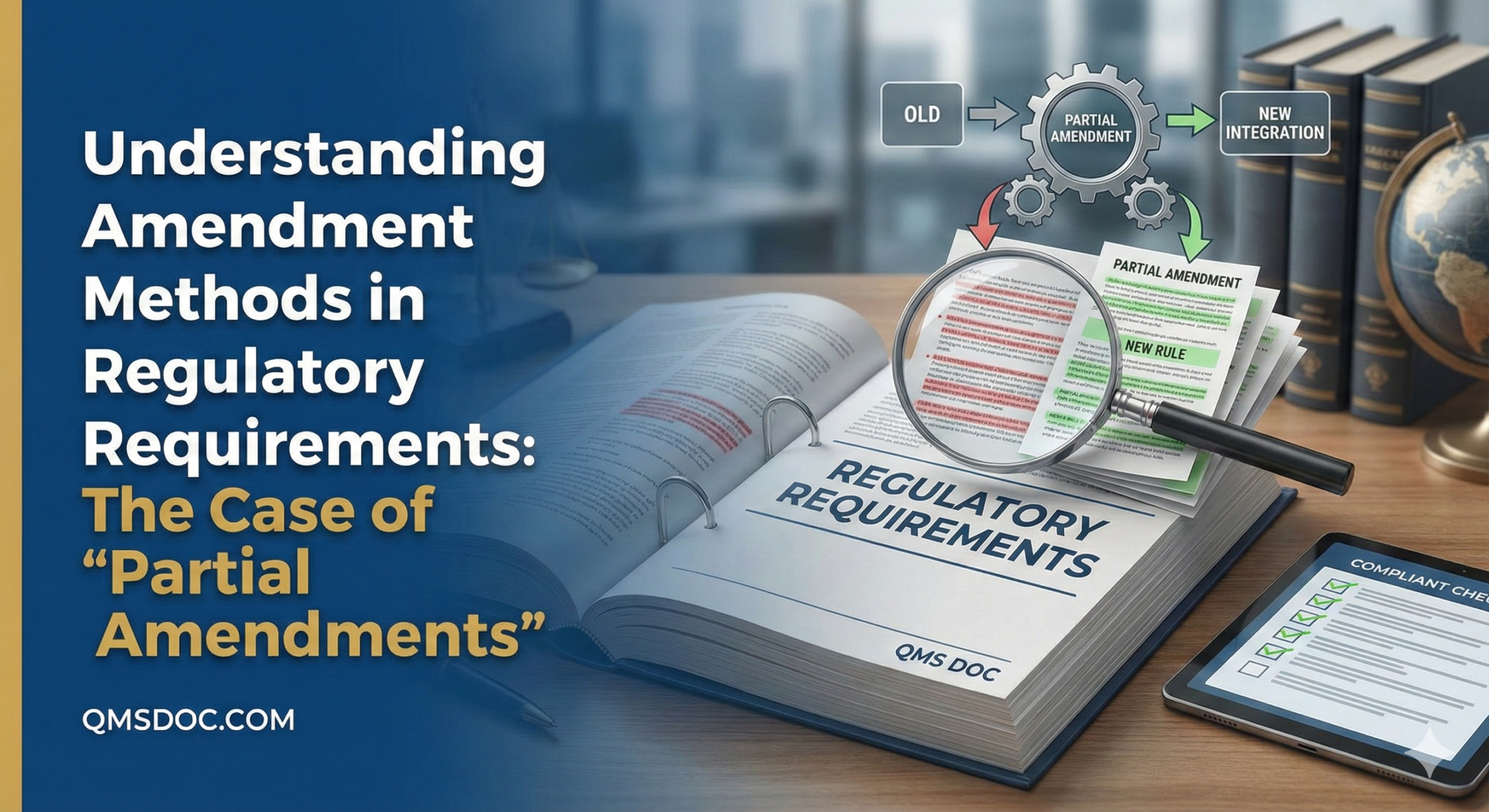
When regulations and legal requirements undergo revision, legislators have two fundamental approaches available: “complete amendment” (全改正, zenkaiseī) and “partial amendment” (一部改正, ichibu kaiseī). It is crucial to understand that “partial amendment” does not necessarily mean that only a small portion of the regulation is being changed. Rather, these terms refer to distinct methodological approaches to how amendments are documented and implemented.
Complete Amendment versus Partial Amendment
Complete amendment involves comprehensively rewriting all provisions of a regulation from beginning to end. In this approach, the entire text of the regulation is replaced with new wording, regardless of whether every section has actually been modified. This method creates a fresh, integrated document that incorporates all changes.
Partial amendment, in contrast, employs what is known as the “amendment clause method” (araimebun or kaimebun in Japanese). This technique uses prescriptive language such as “Article X shall be amended to read as follows,” “the following words shall be deleted,” or “the following provision shall be added.” The amendment document specifies precisely what changes are to be made to the existing text, rather than reproducing the entire regulation.
Consequently, the volume of changes does not determine whether an amendment is classified as “complete” or “partial.” A partial amendment can actually involve more extensive substantive changes than a complete amendment. The distinction lies in the documentary method employed.
The Primary Rationale: Maintaining Article Number Stability
The principal reason for utilizing the partial amendment method is to preserve the stability of article and section numbers throughout the regulatory framework. When article numbers remain unchanged, organizations and stakeholders that reference these regulations in their standard operating procedures (SOPs), work instructions, quality manuals, and other documentation can continue to cite the same article numbers without requiring comprehensive revision of their internal documents.
Consider the implications if the chapter and article numbers in Japan’s GMP Ministerial Ordinance (GMP Shōrei) or QMS Ministerial Ordinance (QMS Shōrei) were to change. Companies would face the substantial burden of revising all internal procedures, training materials, and quality system documentation that cross-references these regulations. The ripple effect would extend throughout their entire quality management systems.
This consideration was undoubtedly a significant factor in the decision to employ the partial amendment method for recent revisions to both the GMP and QMS Ministerial Ordinances, which were updated to achieve greater international harmonization with standards such as PIC/S GMP Guidelines and ISO 13485:2016.
The Amendment Clause Method: How Additions Are Handled
Under the partial amendment methodology, when new requirements or articles need to be added to a regulation, they are inserted using a numbering convention that preserves the sequence of existing articles. For example, if a new provision needs to be inserted after Article 3, it would be designated as “Article 3-2” (第3条の2). If an additional provision is subsequently needed, it becomes “Article 3-3” (第3条の3), and so forth. This approach ensures that the original article numbering remains intact, minimizing disruption to existing reference systems.
The Amendment Clause Method: Advantages and Challenges
The amendment clause method (araimebun) has been established as the standard approach for legal amendments in Japan, offering several distinct advantages. Most notably, it allows amendments to be expressed with precision and conciseness, clearly identifying exactly which portions of the regulation are being modified. Legal practitioners and regulatory specialists can readily identify the scope of changes without comparing lengthy documents.
However, this method also presents a significant challenge: it can be difficult for non-specialists to immediately understand what has been changed and how the amended regulation will read after the changes take effect. The amendment document does not present the final, integrated text but rather provides instructions for modifying the existing text. This requires readers to mentally or manually apply the specified changes to the original regulation to understand the final result.
The Comparative Table Approach: An Evolving Solution
To address the comprehensibility challenge inherent in the amendment clause method, an alternative or supplementary approach has been developed: the “before-and-after comparative table” (shinkyū taishōhyō). This format presents the text before amendment in one column and the text after amendment in an adjacent column, allowing readers to directly compare the old and new versions.
Currently, there is variation in how these comparative tables are used across different levels of Japanese legislation:
For Laws (National Statutes): The before-and-after comparative table remains a reference document that accompanies the official amendment law, which is still written using the amendment clause method. The comparative table serves to aid understanding but is not itself the operative legal document.
For Ministerial Ordinances: Many ministries have adopted the comparative table format as the official method of amendment itself. In these cases, the comparative table is not merely a reference document but constitutes the actual amendment regulation. This represents a significant shift toward more transparent and accessible regulatory drafting.
The recent amendments to the GMP Ministerial Ordinance exemplify this comparative table approach. The official amendment document presents changes in a side-by-side format, making it substantially easier for regulated entities to understand the nature and scope of modifications.
Important Consideration: Omission of Unchanged Articles
When reviewing before-and-after comparative tables, it is essential to understand that articles that remain unchanged are typically omitted from the table. The comparative table displays only those provisions that have been modified, added, or deleted. This means that if an article is not shown in the comparative table, it remains in force with its original wording unchanged.
This practice serves to keep the amendment document manageable in size and to focus attention on actual changes. However, it requires readers to understand that the absence of an article from the comparative table indicates continuity rather than deletion. To understand the complete, amended regulation, one must consider both the comparative table (showing changes) and the original regulation (for unchanged provisions).
Context: Recent Amendments to GMP and QMS Ministerial Ordinances in Japan
To provide practical context for these amendment methodologies, it is helpful to understand recent regulatory developments in Japan’s pharmaceutical and medical device sectors.
GMP Ministerial Ordinance Amendments (April 2021)
The GMP Ministerial Ordinance (Iyakuhin oyobi Iyaku Butsugai-hin no Seizō Kanri oyobi Hinshitsu Kanri no Kijun ni kan suru Shōrei) was significantly amended through Ministry of Health, Labour and Welfare Ordinance No. 90 of 2021, published on April 28, 2021, and entering into force on August 1, 2021. These amendments were designed to achieve greater international harmonization, particularly with the Pharmaceutical Inspection Co-operation Scheme (PIC/S) GMP Guidelines, which serve as the international standard for pharmaceutical manufacturing quality.
Key areas of enhancement included:
- Integration of pharmaceutical quality system concepts aligned with ICH Q10 (Pharmaceutical Quality System)
- Strengthened requirements for data integrity throughout the product lifecycle
- Enhanced quality assurance functions with clearer organizational responsibilities
- More robust quality risk management requirements aligned with ICH Q9
- Improved product quality review and stability monitoring provisions
- Strengthened supplier management and control requirements
The amendments employed the partial amendment method with before-and-after comparative tables, allowing companies to identify changes while maintaining the existing article numbering system that their quality management systems already referenced.
QMS Ministerial Ordinance Amendments (March 2021)
The QMS Ministerial Ordinance (Iryō Kiki oyobi Tai Gai Shindanyō Iyakuhin no Seizō Kanri oyobi Hinshitsu Kanri no Kijun ni kan suru Shōrei) underwent comprehensive revision through Ministry of Health, Labour and Welfare Ordinance No. 60 of 2021, published on March 26, 2021. This amendment was specifically designed to harmonize Japanese medical device quality requirements with the international standard ISO 13485:2016 (Medical devices — Quality management systems — Requirements for regulatory purposes).
The amendments incorporated:
- Risk-based approaches to quality management system processes
- Enhanced software validation requirements for both embedded software in medical devices and software used in quality management processes
- Strengthened design and development verification and validation requirements
- More detailed requirements for product technical files (equivalent to Device Master Records)
- Enhanced requirements for management review and continual system effectiveness evaluation
A three-year transitional period was established, concluding in March 2024, during which manufacturers could operate under either the previous or amended requirements. Since the transition period ended, all regulated entities must now comply with the amended QMS Ministerial Ordinance requirements.
International Harmonization Trends
These amendment activities in Japan reflect a broader global trend toward harmonization of pharmaceutical and medical device quality requirements. Similar harmonization efforts are underway in other major regulatory jurisdictions:
United States: The FDA finalized the Quality Management System Regulation (QMSR) in January 2024, formally incorporating ISO 13485:2016 by reference into 21 CFR Part 820. This rule takes effect in February 2026 and represents the FDA’s commitment to international harmonization of medical device quality system requirements.
European Union: The Medical Device Regulation (MDR, EU 2017/745) and In Vitro Diagnostic Regulation (IVDR, EU 2017/746) both align closely with ISO 13485:2016 principles. European standard EN ISO 13485:2016 includes annexes that map the standard’s requirements to specific MDR and IVDR provisions.
Global Programs: The Medical Device Single Audit Program (MDSAP) enables a single regulatory audit to satisfy the requirements of multiple countries (including the United States, Canada, Australia, Brazil, and Japan), with ISO 13485 serving as the foundational standard. This program significantly reduces the burden on manufacturers operating in multiple markets.
Practical Implications for Regulated Organizations
Understanding these amendment methodologies has several practical implications for organizations subject to GMP and QMS requirements:
-
Document Management Strategy: When regulations undergo partial amendment using comparative tables, organizations should:
- Carefully review the comparative tables to identify all modified provisions
- Remember that omitted articles remain unchanged and continue in effect
- Update their quality management system documentation to reflect substantive changes in requirements
- Revise cross-references in SOPs and work instructions only where article content has actually changed, not where article numbers remain stable
-
Training and Communication: Organizations should ensure that quality assurance personnel, compliance staff, and relevant operational personnel understand both what has changed in the regulations and what remains the same. The comparative table format facilitates this communication when properly explained.
-
Gap Analysis: When regulations are amended, organizations should conduct gap analyses comparing their current quality management systems against the new requirements. The comparative table format makes it easier to identify specific areas requiring attention, as changes are visually highlighted.
-
Regulatory Intelligence: Organizations should maintain systems for tracking regulatory amendments, understanding that partial amendments using comparative tables will be the predominant method for ministerial ordinance changes in Japan. This format will continue to be used for future updates as international standards evolve.
Comparison with Amendment Practices in Other Jurisdictions
Different countries employ varying approaches to regulatory amendment:
United States: The U.S. Code of Federal Regulations typically uses a section-by-section amendment approach similar to Japan’s partial amendment method. However, the U.S. also publishes a complete, consolidated version of regulations after each amendment in the Federal Register and on electronic databases, making the final integrated text readily accessible.
European Union: EU regulations and directives often employ numbered recitals and articles. Amendments typically specify which articles are being modified, similar to the partial amendment approach. The EU also maintains consolidated versions of regulations that incorporate all amendments, published on the EUR-Lex database.
International Organizations: When ISO standards are revised, the International Organization for Standardization typically publishes entirely new editions of standards rather than amendment documents. Each edition supersedes the previous version. This is analogous to the complete amendment method, though ISO also publishes documents identifying key changes between editions.
Conclusion: The Evolution Toward Transparency in Regulatory Drafting
The evolution of amendment methodologies in Japanese regulatory practice—from traditional amendment clauses alone to amendment clauses supplemented by comparative tables, and in some cases to comparative tables as the primary amendment format—reflects a broader commitment to regulatory transparency and accessibility. This evolution recognizes that while the amendment clause method offers technical precision and article number stability, the comparative table format significantly enhances comprehension for the regulated community.
For organizations navigating GMP and QMS requirements, understanding these amendment methodologies is not merely an academic exercise but a practical necessity. Proper interpretation of amended regulations requires recognizing:
- The distinction between partial and complete amendments is methodological, not scope-based
- Article number stability achieved through partial amendments preserves the integrity of existing quality system documentation
- Before-and-after comparative tables show only modified provisions; omitted articles remain in effect unchanged
- The comparative table format, while more accessible, still requires careful reading to distinguish between unchanged text, modified text, added provisions, and deleted provisions
- International harmonization efforts will continue to drive regulatory amendments in coming years
As regulatory requirements continue to evolve in response to technological advances, international harmonization initiatives, and lessons learned from quality incidents, regulated organizations must develop robust systems for identifying, interpreting, and implementing regulatory changes. Understanding the amendment methodologies discussed in this article provides the foundation for effectively managing these ongoing compliance obligations.
References and Further Reading
For those seeking deeper understanding of these topics, the following resources are recommended:
- House of Councillors Legislative Bureau Column: “Araimebun” – Legal Partial Amendment Method (参議院法制局コラム「改め文」)
- GMP Ministerial Ordinance Amendment: Ministry of Health, Labour and Welfare Ordinance No. 90 of 2021, with explanatory guidance (Notification No. 0428-2 of 2021)
- QMS Ministerial Ordinance Amendment: Ministry of Health, Labour and Welfare Ordinance No. 60 of 2021, with explanatory guidance (Notification No. 0326-4 of 2021)
- ISO 13485:2016: Medical devices — Quality management systems — Requirements for regulatory purposes
- PIC/S GMP Guide: Good Manufacturing Practice Guide for Medicinal Products (PE 009)
- FDA Quality Management System Regulation: Final Rule published February 2, 2024, effective February 2, 2026
This article is intended for educational and informational purposes. Organizations should consult with qualified regulatory affairs professionals and legal counsel when interpreting specific regulatory requirements applicable to their operations.
Key Takeaway: This article provides a comprehensive analysis of understanding amendment methods in regulatory requirements: the case of partial amendments, covering essential requirements, best practices, and implementation strategies for pharmaceutical and medical device quality professionals.
Related Articles
- ECG Devices Used in Ambulances: Understanding Medical Device Classification and Regulatory Requirements
- Understanding Labels and Labeling: Regulatory Requirements for Medical Devices
- Understanding CFR: The Foundation of U.S. Regulatory Framework
- Understanding Data Retention Requirements in Pharmaceutical Regulations
- Have Part 11 Inspections Disappeared? Understanding Current Regulatory Trends
- Understanding Regulatory Audits: Purpose, Misconceptions, and Modern Approaches
Related FDA QMSR Templates
Streamline your FDA QMSR compliance with our professionally crafted templates: