
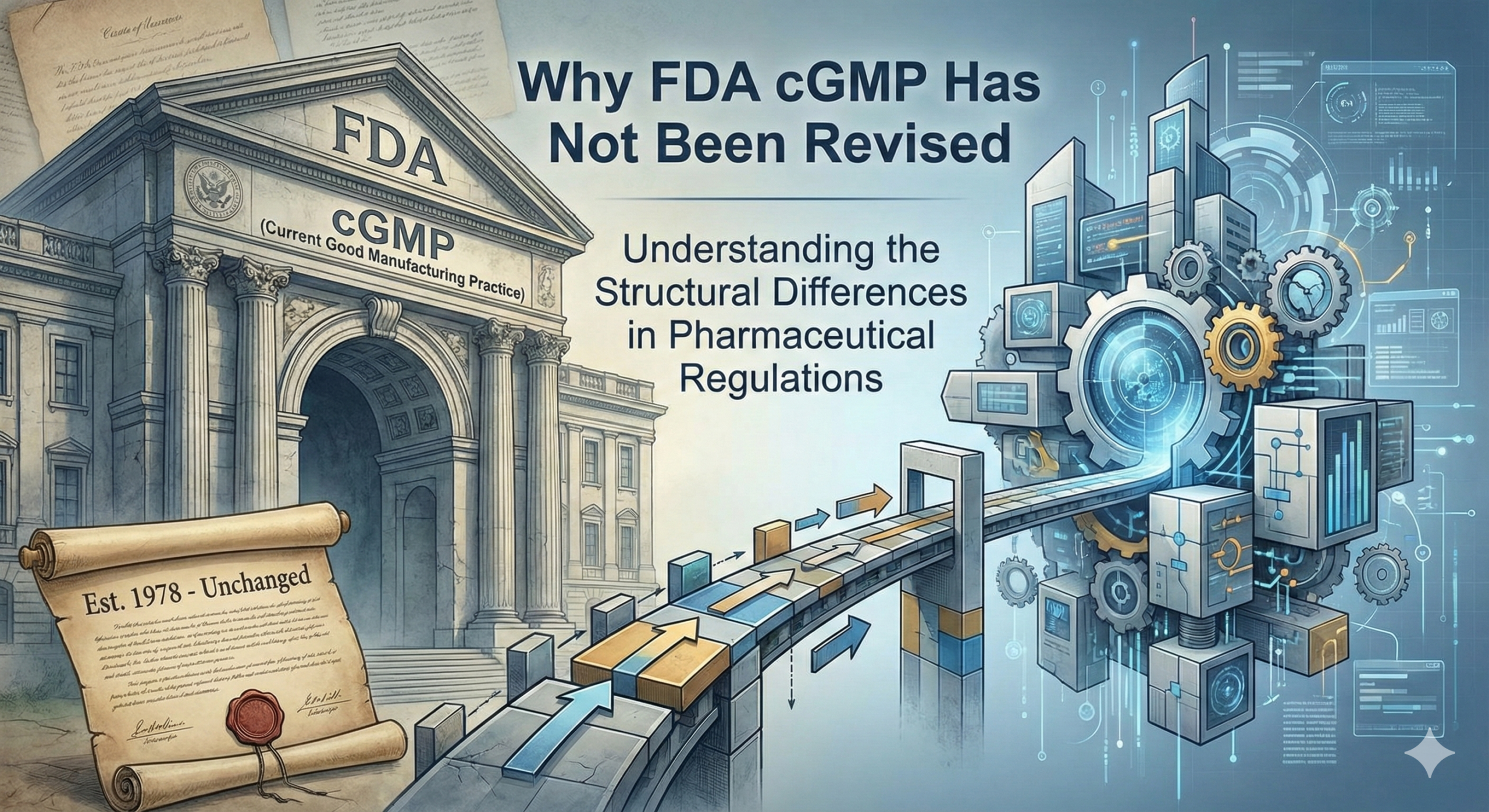
Why FDA cGMP Has Not Been Revised: Understanding the Structural Differences in Pharmaceutical Regulations
The “Static Core with Dynamic Supplements” Model
Fixed Foundation with Flexible Complementation
The core body of FDA cGMP, codified in the Code of Federal Regulations (21 CFR Parts 210 and 211), has undergone minimal fundamental revision since its initial promulgation in 1963. This is not due to regulatory neglect, but rather reflects FDA’s deliberate regulatory approach. The agency maintains a two-tiered structure: basic requirements are preserved as legally binding regulations, while guidance documents provide flexible mechanisms to address emerging scientific knowledge and technological advances.
This approach parallels the relationship between Japan’s GMP Ministerial Ordinance (GMP省令) and Director’s Notices (課長通知). In Japan, the GMP Ministerial Ordinance establishes fundamental requirements, while more detailed operational guidance and interpretations are provided through administrative documents such as Director’s Notices.
The Challenge of Perceiving the Complete Regulatory Picture
A significant challenge inherent in this approach is the difficulty in comprehending “what is legally required” in its entirety. Consider, for example, the case of CAPA (Corrective Action and Preventive Action).
The core FDA cGMP regulations contain no explicit CAPA requirements. This absence reflects the fact that when the regulations were established in the 1960s, modern quality system concepts had not yet fully matured. However, as the pharmaceutical industry evolved and the importance of quality systems became increasingly recognized, FDA issued the “Guidance for Industry: Quality Systems Approach to Pharmaceutical CGMP Regulations” in 2006. This guidance interprets cGMP through the lens of modern quality systems and introduces quality management system elements, including CAPA.
Thus, numerous requirements exist that, while not explicitly stated in the legally binding regulation itself, are effectively mandated through guidance documents. Pharmaceutical companies must not only understand the core regulations but also identify and integrate all relevant guidance documents to achieve comprehensive compliance.
PIC/S GMP: The “Integrated” Model
A Unified Regulatory Framework
In contrast, EU GMP and PIC/S GMP employ a relatively streamlined structure. These systems comprise a main body and annexes, with regulatory requirements integrated within a single documentary framework.
The primary advantage of this integrated approach is the enhanced visibility of the complete regulatory landscape. For instance, quality system requirements are clearly articulated in Part I, Chapter 1, and CAPA requirements are explicitly included. The annexes hold equivalent status to the main body and define additional requirements for specific areas or activities.
This structure provides EU GMP and PIC/S GMP with greater regulatory transparency compared to FDA cGMP, making it easier for pharmaceutical companies to identify compliance obligations.
Structural Comparison of Major GMP Systems
| Regulatory System | Core Structure | Supplementary Documents | CAPA Requirements | Revision Approach |
| FDA cGMP (21 CFR 210/211) | Static regulations (since 1963) | Extensive guidance documents | Addressed in guidance (2006) | Regulations rarely revised; guidance frequently updated |
| EU GMP / PIC/S GMP | Main body + Annexes | Limited additional guidance | Explicitly stated in Part I, Chapter 1 | Periodic comprehensive revisions of entire system |
| Japan GMP | Ministerial Ordinance | Director’s Notices and notifications | Explicitly stated (post-2014 PIC/S alignment) | Hybrid approach: ordinance + administrative guidance |
PIC/S GMP Structure
Main Body (Part I): Establishes fundamental quality management principles, including pharmaceutical quality system requirements, personnel qualifications, premises and equipment standards, documentation requirements, production controls, and quality control.
Annexes: Provide specialized requirements for specific dosage forms, manufacturing processes, and technologies. Examples include sterile medicinal products (Annex 1, revised 2022), biological medicinal products (Annex 2), radiopharmaceuticals (Annex 3), advanced therapy medicinal products (ATMPs), computerized systems, and qualification and validation.
International Harmonization Challenges Created by Different Regulatory Approaches
The structural differences between FDA cGMP and EU GMP significantly impact international regulatory harmonization efforts. Despite harmonization initiatives through PIC/S (Pharmaceutical Inspection Co-operation Scheme), fundamental differences in regulatory approach continue to impede complete alignment.
Japan joined PIC/S in 2014, and its GMP Ministerial Ordinance was subsequently revised to align with PIC/S GMP. This brought Japanese GMP regulation closer to the EU-style integrated model, though differences with FDA cGMP persist.
Current State of International Harmonization (2025)
As of early 2025, international regulatory harmonization efforts continue through multiple channels. The ICH (International Council for Harmonisation of Technical Requirements for Pharmaceuticals for Human Use) has made progress in harmonizing certain quality guidelines, particularly through the ICH Q-series guidelines covering quality systems (Q10), pharmaceutical development (Q8), quality risk management (Q9), and pharmaceutical quality systems (Q12).
However, the fundamental structural differences between regulatory frameworks remain. FDA continues its approach of maintaining the core cGMP regulations while issuing new guidance documents to address emerging technologies and quality concepts. Recent FDA guidance documents have addressed topics such as continuous manufacturing, process validation (revised guidance), data integrity, and advanced manufacturing technologies.
Practical Implications for Pharmaceutical Companies
Understanding these regulatory structural differences is critical for pharmaceutical companies operating globally. The following considerations merit particular attention:
Manufacturing for the US Market: FDA cGMP compliance requires comprehensive understanding and integrated application not only of the Code of Federal Regulations but also of all relevant guidance documents. Companies must establish systems to monitor FDA’s guidance landscape, as new guidances are issued and existing ones updated with considerable frequency. The FDA’s guidance agenda and draft guidances provide insight into emerging regulatory expectations.
Manufacturing for the EU Market: Companies must understand and apply requirements from both the EU GMP main body and its annexes. Recent significant updates include the comprehensive revision of Annex 1 (Sterile Medicinal Products) effective August 2023, which substantially enhanced requirements for contamination control strategy, quality risk management, and contamination control strategy documentation.
Constructing Global Quality Systems: The most efficient approach involves building a global quality system that satisfies the most stringent requirements across all regions while accounting for regional regulatory differences. This “highest common denominator” approach, while demanding initially, reduces the complexity of maintaining separate systems for different markets. Companies should map requirements across FDA cGMP, EU GMP/PIC/S GMP, and other applicable regulations to identify areas of convergence and divergence.
Continuous Regulatory Intelligence: Particularly for FDA, continuous monitoring is essential as new guidance documents are issued and existing ones revised frequently. Companies should establish formal processes for regulatory intelligence gathering, impact assessment, and implementation of new requirements. For EU/PIC/S, monitoring should include not only formal revisions but also Q&A documents and inspection trends reported through PIC/S information sharing mechanisms.
Emerging Technologies and Quality Paradigms: Both FDA and EU/PIC/S regulatory authorities are increasingly focused on advanced manufacturing technologies (continuous manufacturing, 3D printing, artificial intelligence/machine learning applications), enhanced data integrity expectations, supply chain integrity, and pharmaceutical quality systems throughout the product lifecycle. Companies should anticipate that regulatory expectations in these areas will continue to evolve through both guidance documents and regulatory practice.
Conclusion
The structural differences between FDA cGMP and EU/PIC/S GMP reflect fundamentally different regulatory philosophies: FDA’s approach emphasizes stability in core regulations with dynamic guidance, while the EU/PIC/S model favors periodic comprehensive updates to an integrated framework. Neither approach is inherently superior; each presents distinct advantages and challenges.
For pharmaceutical companies, success in the global regulatory environment requires not merely compliance with individual regulations but deep understanding of these structural differences and their practical implications. As international trade in pharmaceuticals continues to expand and manufacturing networks become increasingly global, the ability to navigate these different regulatory architectures effectively becomes a core organizational competency.
While complete harmonization remains elusive, ongoing efforts through ICH, PIC/S, and bilateral regulatory cooperation continue to reduce unnecessary divergence. Companies that invest in robust regulatory intelligence systems and flexible quality management frameworks position themselves to adapt efficiently to evolving regulatory landscapes across all major markets.

Comment