
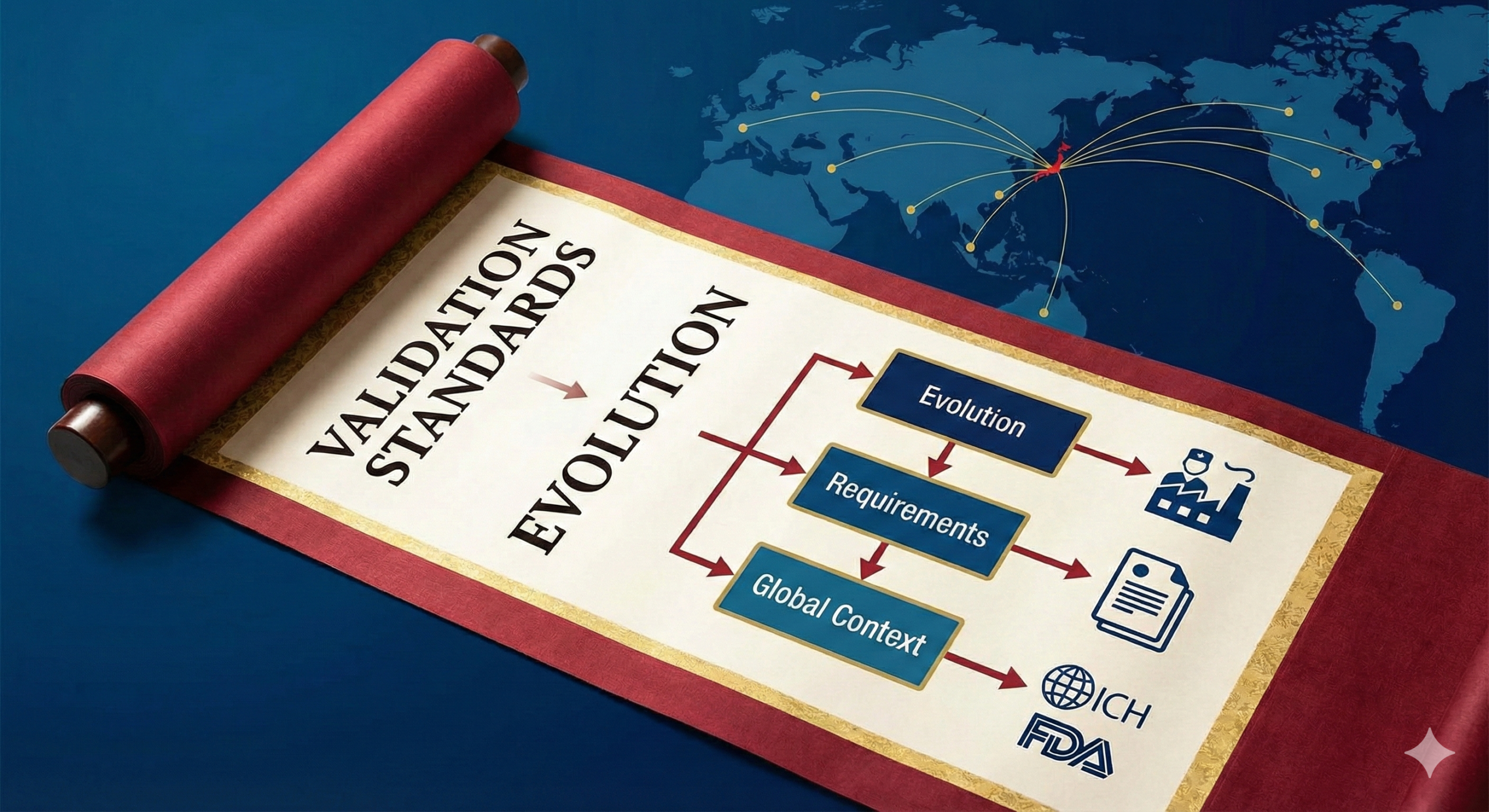
Understanding Japan’s Validation Guideline: Evolution, Requirements, and Global Context
Introduction to the Validation Guideline
With the recent revision of Japan’s GMP (Good Manufacturing Practice) Ministerial Ordinance, the Validation Standard (バリデーション基準) was abolished and replaced with the Validation Guideline (バリデーション指針).
The Validation Guideline is described in Section 4 of “Notification Concerning Partial Amendment of the Ministerial Ordinance on Standards for Manufacturing Control and Quality Control for Drugs and Quasi-drugs” (Notification No. 0428-2, April 28, 2021, issued by the Pharmaceutical Safety and Environmental Health Bureau, Ministry of Health, Labour and Welfare).
This Validation Guideline replaces the “Section 4: Validation Standard” in the notification dated August 30, 2013 (Notification No. 0830-1, Pharmaceutical Safety and Environmental Health Bureau).
Structure of the Validation Guideline
The Validation Guideline is organized according to the following table of contents:
| Section | Content |
| (1) | Purpose of Validation |
| (2) | Items to be Verified Through Validation |
| (3) | Validation Protocol |
| (4) | Responsibilities of Validation Manager |
| (5) | Types of Validation |
| – Qualification (DQ, IQ, OQ, PQ) | |
| – Process Validation (PV) | |
| – Cleaning Validation | |
| – Revalidation | |
| – Change Control Validation | |
| (6) | Validation Report |
| (7) | Other Matters |
Notable changes from the previous Validation Standard include the removal of “Definitions of Terms” and “Retrospective Validation,” aligning with international trends that no longer accept retrospective validation as a valid approach.
Rationale for Revising the Validation Standard
The primary reason for revising the Validation Standard was to achieve harmonization with international standards. The Validation Guideline’s preamble contains the following statement:
“When conducting validation as stipulated in Article 13 or Article 41 of the GMP Ministerial Ordinance, considering the impact on product quality of the pharmaceutical or quasi-pharmaceutical product, it is required to refer to either the Validation Guideline described in Section 2 below or overseas guidelines that are equivalent or superior.”
This statement indicates that strict adherence to the Japanese Validation Guideline is not mandatory. Companies may alternatively refer to overseas guidelines such as PIC/S GMP Annex 15 “Qualification and Validation.” However, this approach raises some questions from a regulatory philosophy perspective.
PIC/S (Pharmaceutical Inspection Co-operation Scheme) is fundamentally an organization of regulatory authorities, established to harmonize regulatory requirements and inspection standards among member countries. It was not created as an organization or guidance system for pharmaceutical companies. The appropriate approach would be for member regulatory authorities to establish regulatory requirements based on PIC/S requirements and then require companies to comply with these domestically established standards.
Key modern GMP concepts such as “Pharmaceutical Quality System,” “Quality Risk Management,” “Risk-Based Approach,” and “Data Integrity”—not limited to validation—were initially proposed by regulatory authorities such as the FDA and other international bodies in the 21st century. It is unfortunate that Japan, as one of the three major pharmaceutical markets and a founding member of the ICH (International Council for Harmonisation), has not been able to propose globally applicable new regulatory concepts. Furthermore, Japan has been following overseas developments (the revised GMP Ministerial Ordinance represents the first major revision in 16 years), and then directing companies to refer to overseas guidelines or PIC/S standards, which is difficult to comprehend from a regulatory development perspective.
Validation Master Plan (VMP)
The Validation Guideline requires the creation of a Validation Master Plan (VMP: procedures related to validation). However, there has been a persistent misunderstanding regarding the nature of the VMP.
A Validation Master Plan is not a standard operating procedure (SOP) but rather a planning document. In its proper definition, a VMP is a high-level document that presents a comprehensive validation plan for an entire project, serving as guidance for the project team regarding resource allocation and technical planning.
However, neither the Japanese Validation Guideline nor PIC/S GMP Annex 15 provides a clear definition of what constitutes a VMP. This lack of definitional clarity has contributed to confusion in the industry regarding the purpose and scope of these documents.
Items Subject to Validation
According to the Validation Guideline, the following items must be validated:
- Manufacturing Equipment and Facilities: Manufacturing equipment, environmental control equipment for work areas, closed-system equipment for aseptic operations, and similar equipment
- Manufacturing Support Systems and Utilities: Systems or equipment that supply water for manufacturing (including water for cleaning manufacturing equipment, apparatus, and containers), air conditioning systems for work areas, and other manufacturing support systems or equipment (including measuring instruments)
- Manufacturing Processes: Manufacturing processes (including storage)
- Cleaning Operations: Cleaning operations for manufacturing equipment
- Test Methods: Test and inspection methods for raw materials, materials, and products (including intermediate products), including systems or equipment used for such testing and inspection
Detailed Requirements for Each Category
Qualification of Facilities and Equipment: Qualification (DQ, IQ, OQ, PQ, etc.) of facilities and equipment is required. Qualification activities must be completed prior to conducting process validation. The qualification stages include:
- Design Qualification (DQ): Verification that the design complies with GMP requirements
- Installation Qualification (IQ): Verification that equipment is installed according to specifications
- Operational Qualification (OQ): Verification that equipment operates within specified limits
- Performance Qualification (PQ): Verification that equipment consistently performs as intended under actual production conditions
Utilities and Supporting Systems: “Manufacturing support equipment” refers to utilities such as purified water supply systems and HVAC (heating, ventilation, and air conditioning) systems. Qualification of utilities is also required, as these systems directly impact product quality and manufacturing environment.
Process Validation: Validation of manufacturing processes refers to process validation, which demonstrates that the manufacturing process consistently produces product meeting predetermined specifications and quality attributes.
Cleaning Validation: Cleaning validation is necessary for cleaning operations of manufacturing equipment to prevent cross-contamination and ensure product quality.
Analytical Method Validation: Validation of test and inspection methods requires analytical method validation, demonstrating that analytical methods are suitable for their intended purpose and provide reliable, accurate results.
Comparison with PIC/S GMP Annex 15
There are several important differences between the Japanese Validation Guideline and PIC/S GMP Annex 15 (revised in 2015, effective October 1, 2015):
Terminology Differences
PIC/S GMP Annex 15 does not use the term “revalidation” but instead refers to “re-qualification” (Chapter 4). This distinction reflects a more lifecycle-oriented approach to maintaining validated states.
Continuous Process Verification
PIC/S GMP Annex 15 has been harmonized with ICH Q8 (Pharmaceutical Development) to enable continuous process verification for products developed through Quality by Design (QbD) methodologies. The guideline recognizes that for products developed with enhanced understanding through QbD principles:
- Traditional process validation approaches may be supplemented or replaced by continuous process verification (CPV)
- CPV involves ongoing monitoring and evaluation of process performance throughout the commercial lifecycle
- Real-time or near-real-time data collection and analysis can provide more comprehensive process understanding than periodic validation studies
However, the Japanese Validation Guideline requires only the traditional process validation approach and does not explicitly address continuous process verification or QbD-based validation strategies. This represents a significant gap between Japanese requirements and international best practices.
Transportation and Packaging Validation
Topics such as GDP (Good Distribution Practice) transportation verification and packaging validation are omitted from the Japanese Validation Guideline, although Japan has issued GDP guidelines separately. PIC/S GMP Annex 15 includes guidance on transportation validation as part of the comprehensive validation lifecycle.
The Three-Batch Requirement
The most significant point of concern relates to the number of batches required for process validation. The Japanese Validation Guideline states: “Process validation shall, in principle, be performed based on results from repeated manufacturing of three lots at commercial production scale, or by an equivalent or superior method.”
However, FDA guidance and PIC/S GMP do not specify a fixed requirement of three batches. Rather, they require that the appropriate sample size (N) be determined based on statistical considerations and the level of process understanding. The guidance emphasizes that:
- The number of validation batches should be scientifically justified
- Statistical tools should be used to determine adequate sample sizes
- Enhanced process understanding from development may reduce the number of PPQ (Process Performance Qualification) batches required
- Previous credible experience with sufficiently similar products and processes can be considered
Historical Context of the Three-Batch Requirement
The traditional requirement for three batches originated from a statistical perspective: with only two batches, plotting results will always produce a straight line, making it impossible to assess whether the process exhibits linearity. However, with three or more batches, deviations from linearity become detectable. Thus, the minimum three-batch requirement was historically established to verify process linearity and consistency.
The FDA’s 2011 Process Validation Guidance moved away from prescriptive batch numbers, stating that the answer to “how many batches?” is “it depends.” The guidance emphasizes:
- Process validation is a scientific endeavor requiring statistically justified approaches
- The number of batches must provide sufficient data to support an appropriate level of statistical confidence
- Manufacturing data and process knowledge from development studies should inform PPQ requirements
- A lifecycle approach encompasses Stage 1 (Process Design), Stage 2 (Process Qualification), and Stage 3 (Continued Process Verification)
Modern Approach to Batch Number Determination
When conducting process validation, it is desirable to determine the appropriate number of lots based on:
- Process complexity and variability
- Level of process understanding achieved during development
- Risk assessment outcomes
- Statistical confidence requirements for critical quality attributes
- Regulatory expectations in the target markets
For well-understood processes developed using QbD principles with defined design spaces, fewer PPQ batches may be justifiable. Conversely, for complex or poorly understood processes, more extensive validation studies may be necessary to demonstrate adequate process control.
Integration with ICH Quality Guidelines
Modern validation practices increasingly integrate with the ICH quality trilogy:
ICH Q8 (R2) – Pharmaceutical Development: Emphasizes building quality into products through enhanced understanding of how formulation and process variables affect product quality. This includes:
- Identification of Critical Quality Attributes (CQAs)
- Determination of Critical Process Parameters (CPPs)
- Establishment of design space
- Development of control strategies
ICH Q9 – Quality Risk Management: Provides systematic approaches to risk assessment, control, communication, and review throughout the product lifecycle. Risk management principles should be applied to:
- Determine validation scope and strategy
- Prioritize validation activities
- Establish acceptance criteria
- Plan ongoing verification activities
ICH Q10 – Pharmaceutical Quality System: Describes a comprehensive model for an effective pharmaceutical quality system that is based on quality management system concepts and incorporates applicable GMP regulations. Q10 emphasizes:
- Knowledge management throughout the product lifecycle
- Continuous improvement
- Corrective and preventive actions (CAPA)
- Management review of system effectiveness
Practical Recommendations for Implementation
Based on the current regulatory landscape, pharmaceutical companies operating in Japan should consider the following approaches:
- Understand Regulatory Flexibility: While the Japanese Validation Guideline provides a framework, companies may reference international guidelines such as PIC/S Annex 15 where appropriate and scientifically justified.
- Adopt Risk-Based Approaches: Implement quality risk management principles (ICH Q9) to determine validation scope, strategies, and acceptance criteria. Not all processes and parameters require equal attention.
- Leverage Process Understanding: For products developed using QbD principles, work with regulatory authorities to potentially implement continuous process verification alongside or instead of traditional batch-based validation.
- Document Scientific Rationale: Whether following traditional three-batch validation or implementing alternative approaches, maintain comprehensive documentation of the scientific and statistical rationale supporting validation decisions.
- Maintain Lifecycle Perspective: Validation is not a one-time event but an ongoing activity throughout the product lifecycle. Implement robust ongoing process verification programs as described in FDA’s Stage 3 guidance.
- Harmonize Global Strategies: For companies with global operations, develop validation strategies that satisfy requirements across all markets while maintaining scientific consistency and efficiency.
- Engage with Regulators: When planning to implement innovative validation approaches or deviations from traditional methods, early dialogue with regulatory authorities (PMDA in Japan) is advisable to ensure alignment and acceptance.
Japan’s Position in the Global Regulatory Landscape
Since August 2014, Japan has been a member of PIC/S, and the Pharmaceuticals and Medical Devices Agency (PMDA) conducts GMP inspections aligned with international standards. Japan’s GMP system references:
- ICH guidelines (Q7 for APIs, Q8/Q9/Q10 for pharmaceutical quality)
- PIC/S GMP guide and annexes
- Domestic regulations and supplementary notifications
PMDA inspections evaluate pharmaceutical quality systems (PQS), validation lifecycle management, data integrity, and ongoing process control. Inspection types include:
- Pre-approval inspections (PAIs) for new drug applications
- Periodic inspections every five years
- Product category-based inspections (certificate valid for three years)
- For-cause inspections triggered by quality concerns
Foreign manufacturers must demonstrate GMP compliance through PMDA inspections or recognized certificates to supply the Japanese market.
Conclusions and Future Outlook
The revision of Japan’s Validation Standard to a Validation Guideline represents progress toward international harmonization, though some gaps remain. The guideline’s allowance for reference to international standards provides flexibility, but clearer regulatory direction would benefit the industry.
Key considerations for the future include:
- Further Harmonization: Continued alignment with ICH guidelines and PIC/S standards, particularly regarding continuous process verification and QbD-based validation strategies
- Data Integrity Emphasis: Increased focus on data integrity throughout validation activities, consistent with global regulatory trends
- Digital Transformation: Adoption of advanced technologies such as process analytical technology (PAT), real-time release testing, and electronic quality systems
- Knowledge Management: Enhanced systems for capturing, maintaining, and utilizing process and product knowledge throughout the lifecycle
- Risk-Based Regulation: Evolution toward more flexible, science-based regulatory approaches that reward enhanced process understanding with reduced regulatory burden
As Japan continues to refine its regulatory framework and pharmaceutical companies advance their validation capabilities, the ultimate goal remains consistent: ensuring that validated processes reliably and consistently produce products that meet all quality, safety, and efficacy requirements for patient protection.
References
For detailed information on validation requirements and related guidelines, pharmaceutical professionals should consult:
- Japan GMP Ministerial Ordinance (Ordinance No. 179, 2004, as amended)
- Validation Guideline (Notification No. 0428-2, April 28, 2021)
- PIC/S GMP Guide PE 009-17 and Annex 15 (Qualification and Validation)
- FDA Guidance: Process Validation: General Principles and Practices (January 2011)
- ICH Q8(R2) Pharmaceutical Development
- ICH Q9 Quality Risk Management
- ICH Q10 Pharmaceutical Quality System
- ICH Q8, Q9, Q10 Questions and Answers
- PMDA website (www.pmda.go.jp) for current inspection guidance and requirements

Comment