
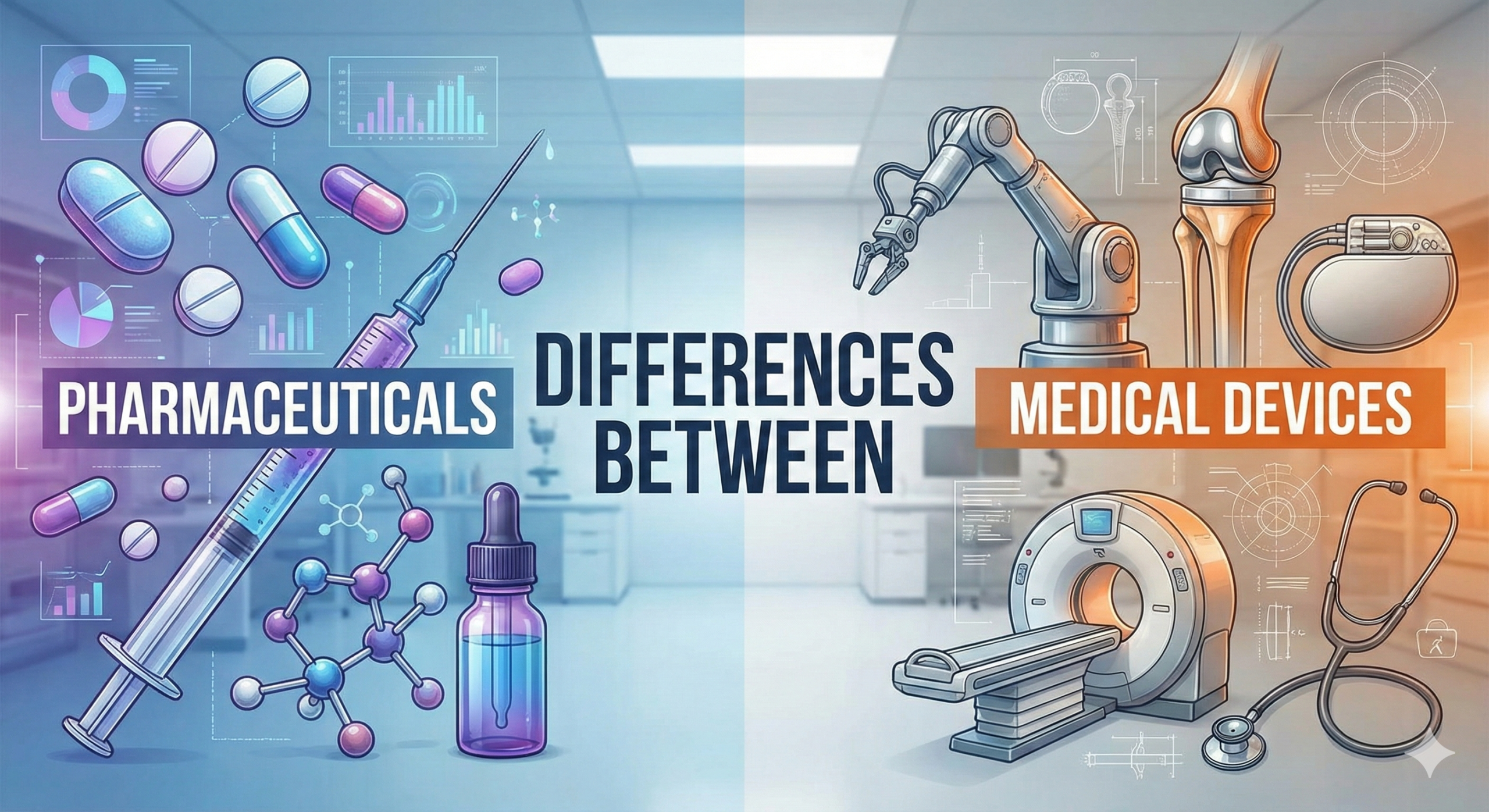
Differences Between Pharmaceuticals and Medical Devices
Introduction
In my consulting work, I often encounter situations where the differences between pharmaceutical and medical device regulations become critical factors. For instance, concepts such as process validation and risk management, while using the same terminology, are implemented quite differently by pharmaceutical companies and medical device companies. This article aims to clarify the distinctions between pharmaceutical and medical device regulatory approaches and promote proper understanding of their respective regulatory requirements.
1. Quality Assurance Scope and Philosophy
The scope and philosophy of quality assurance differ fundamentally between pharmaceuticals and medical devices.
Pharmaceuticals must ensure quality until they are administered to patients. This quality assurance primarily focuses on the product itself – its identity, strength, purity, and quality must be maintained throughout its shelf life. Once dispensed and properly stored according to labeled conditions, the pharmaceutical product’s quality is generally assured until administration.
In contrast, medical devices must ensure quality not only up to delivery to patients or healthcare providers but also during actual use. Medical device failures or misuse during operation can directly impact patient safety. Therefore, quality assurance for medical devices extends throughout the entire lifecycle, including installation, use, maintenance, and even disposal. This requires consideration of human factors engineering, user interface design, and real-world use conditions.
For example, an infusion pump must not only be manufactured correctly but must also function properly throughout its service life in clinical settings, accounting for various user skill levels, environmental conditions, and maintenance practices.
2. Risk Management vs. Quality Risk Management
The approach to risk management fundamentally differs between medical devices and pharmaceuticals due to the directness of risk to patients.
Medical Device Risk Management (ISO 14971:2019)
Medical device malfunctions directly impact patients or users. ISO 14971:2019, “Medical devices — Application of risk management to medical devices,” provides the international standard for medical device risk management. This comprehensive approach addresses risks throughout the entire product lifecycle, from design through post-market surveillance.
Medical device risk management focuses on:
- Hazards associated with the device itself
- Hazardous situations arising from device use or misuse
- Direct harm to patients, operators, or third parties
- Risks related to property and environmental damage
The risk management process for medical devices includes establishing risk acceptability criteria, identifying hazards and hazardous situations, estimating and evaluating risks, implementing risk control measures, and conducting residual risk evaluation. Importantly, this extends to post-market surveillance to identify emerging risks during actual clinical use.
Pharmaceutical Quality Risk Management (ICH Q9(R1))
For pharmaceuticals, the situation is more indirect. Equipment failures, process deviations, or quality control issues can introduce defects that remain latent in the product. These defects only cause harm when patients consume the defective medicine. Therefore, the pharmaceutical industry implements “Quality Risk Management” (QRM) as defined in ICH Q9(R1).
ICH Q9 was originally issued in 2005 and underwent revision, with ICH Q9(R1) published in August 2023. The revision emphasizes several key principles:
- Risk-based decision making in quality management
- Appropriate formality in risk management activities (matching effort to risk level)
- Management and minimization of subjectivity in risk assessments
- Integration with the pharmaceutical quality system (ICH Q10)
Quality Risk Management in pharmaceuticals addresses:
- Risks to product quality arising from materials, equipment, processes, and facilities
- Risks to drug substance and drug product quality attributes
- Indirect risks to patient safety through product quality degradation
The key distinction is that medical device risk management deals with direct risks (device failures directly harming patients), while pharmaceutical quality risk management addresses indirect risks (manufacturing process or facility issues affecting product quality, which subsequently impacts patient safety).
3. Critical Importance of Design in Medical Devices
Pharmaceuticals: Manufacturing-Focused Quality Issues
Most pharmaceutical quality problems originate from manufacturing operations. Common issues include:
- Contamination with foreign matter or impurities
- Labeling errors (wrong labels, missing information)
- Packaging defects (broken blisters, compromised container integrity)
- Cross-contamination between products
- Process deviations during manufacturing
These issues typically arise during production, packaging, or storage and can be prevented or detected through proper manufacturing controls, in-process testing, and finished product testing.
Medical Devices: Design-Driven Quality and Safety
For medical devices, even perfect manufacturing cannot compensate for poor design. The design phase is paramount for several critical reasons:
Design Determines Inherent Safety: A medical device’s fundamental safety characteristics are established during design. For example:
- An improperly designed defibrillator might deliver incorrect energy levels regardless of manufacturing quality
- A surgical instrument with poor ergonomic design increases the risk of user error during procedures
- Software defects in a diagnostic device cannot be eliminated by manufacturing excellence
User Requirements May Be Incorrect: Even when design is executed correctly, the underlying user requirements might be flawed. This can result from:
- Incomplete understanding of clinical workflow
- Inadequate consideration of diverse user populations (skill levels, physical abilities)
- Failure to account for reasonably foreseeable misuse
- Insufficient analysis of the use environment
Design Verification and Validation Are Critical:
- Design verification confirms that design outputs meet design inputs
- Design validation ensures the device meets user needs and intended uses
- Both must be completed before manufacturing begins
Therefore, medical device regulations (such as ISO 13485:2016 and FDA QSR 21 CFR Part 820) place heavy emphasis on design controls, including:
- Design and development planning
- Design input requirements
- Design output specifications
- Design review processes
- Design verification and validation
- Design transfer to manufacturing
- Design changes and change control
This contrasts with pharmaceuticals, where the formulation is typically well-established, and quality focus centers on manufacturing consistency and control.
4. Inspection and Testing Method Differences
Pharmaceutical Testing: Destructive Testing and Sampling
Pharmaceutical testing predominantly involves destructive testing methods. To determine content uniformity, dissolution characteristics, or sterility, samples must be destroyed during analysis. This necessitates:
Sampling-Based Quality Control:
- Representative samples are drawn from each batch
- Testing is performed on these samples
- Statistical methods ensure sample representativeness
- The entire batch’s quality is inferred from sample results
Consequences of OOS (Out of Specification): When OOS results occur, investigation is required per FDA and other regulatory guidance. If confirmed as a true batch failure (not due to laboratory error), the typical consequence is:
- The entire batch must be rejected or destroyed
- Cannot selectively remove defective units
- Significant financial and supply impact
- Extensive investigation and documentation requirements
This approach is necessary because once a tablet or capsule is tested destructively, that unit cannot be released. Testing can only provide evidence about the sampled units and statistical confidence about the untested remainder of the batch.
Medical Device Testing: Non-Destructive Testing Capability
Many medical devices can undergo non-destructive testing, allowing:
100% Inspection Possibility:
- Visual inspection of all units for surface defects
- Electrical testing using oscilloscopes without damaging devices
- Measurement using multimeters, power meters, and other instruments
- Functional testing that doesn’t compromise device integrity
- Automated optical inspection (AOI) systems
Selective Rejection and Rework: When defects are identified:
- Only non-conforming units are rejected
- Defective units can potentially be reworked and retested
- Successfully reworked units can be released for distribution
- This minimizes waste and economic impact
Exception – Special Processes: However, certain medical device processes cannot be adequately verified by subsequent inspection or testing. These “special processes” include:
- Sterilization processes (cannot verify sterility of each unit without compromising packaging)
- Welding and soldering (internal joint quality cannot be inspected without destruction)
- Adhesive bonding (bond strength cannot be tested without destruction)
- Crimping operations (internal mechanical integrity not fully verifiable)
These special processes require process validation, similar to pharmaceutical manufacturing, because post-production verification is insufficient.
5. Process Validation Requirements
Pharmaceutical Process Validation: Comprehensive Approach
According to current regulatory expectations, including Japan’s GMP省令 (GMP Ordinance), EU GMP, and FDA guidance, pharmaceutical process validation follows a lifecycle approach:
Stage 1: Process Design
- Based on development studies and manufacturing experience
- Establishes the commercial manufacturing process
- Identifies critical quality attributes (CQAs) and critical process parameters (CPPs)
- Applies Quality by Design (QbD) principles where appropriate
Stage 2: Process Qualification
- Facility and equipment qualification (IQ, OQ)
- Process Performance Qualification (PPQ)
- Traditionally requires successful manufacture of three consecutive commercial-scale batches
- Demonstrates the process consistently produces product meeting all quality attributes
Stage 3: Continued Process Verification
- Ongoing assurance that the process remains in a state of control
- Statistical monitoring of process and product quality
- Periodic review and improvement
This comprehensive approach is necessary because pharmaceutical products generally cannot undergo complete quality verification through finished product testing alone due to destructive test methods.
Medical Device Process Validation: Risk-Based Approach
Medical device process validation, as required by ISO 13485:2016, FDA QSR (21 CFR 820.75), and other regulations, takes a more focused approach:
Validation Required For Special Processes Only: Special processes are those where:
- Results cannot be fully verified by subsequent inspection and testing
- Process output verification requires destructive testing
- Critical quality attributes cannot be assured without process validation
Examples of special processes requiring validation:
- Sterilization: Sterility cannot be verified without compromising sterile packaging
- Welding/Soldering: Internal weld or solder joint quality requires destructive testing to verify
- Adhesive bonding: Bond strength cannot be tested without destroying the bond
- Crimping: Internal crimp quality cannot be fully verified non-destructively
- Molding/Forming: Internal structure and material properties may not be fully verifiable
- Heat treatment: Material property changes may require destructive testing to verify
- Coating processes: Coating adhesion and uniformity may require destructive testing
Processes Not Requiring Validation: When subsequent inspection and testing can adequately verify the process output:
- Visual inspection for cosmetic defects (scratches, discoloration)
- Dimensional measurements (calipers, micrometers, coordinate measuring machines)
- Electrical performance testing (functional testing, safety testing)
- Mechanical performance testing (torque, force, displacement measurements)
These processes require verification (demonstrating the process meets requirements under specified conditions) but not formal validation.
Validation Protocol Similar to Pharmaceuticals: When validation is required, the approach includes:
- Installation Qualification (IQ)
- Operational Qualification (OQ)
- Performance Qualification (PQ)
- Documented evidence of consistent output
- Revalidation after significant changes
The key difference is that pharmaceutical process validation applies broadly across manufacturing operations, while medical device validation focuses specifically on special processes where post-production verification is inadequate.
Summary Comparison Table
| Aspect | Pharmaceuticals | Medical Devices |
| Quality Assurance Scope | Until administration to patient; focus on product stability and integrity | Throughout lifecycle including use, maintenance, and disposal |
| Risk Management Standard | ICH Q9(R1) Quality Risk Management (2023) | ISO 14971:2019 Risk Management |
| Risk Type | Indirect – manufacturing issues → product defects → patient harm | Direct – device failure or misuse → immediate patient harm |
| Design Criticality | Less critical; formulation established, focus on manufacturing | Paramount; inherent safety and performance determined at design stage |
| Testing Methods | Primarily destructive testing requiring sampling | Often non-destructive allowing 100% inspection |
| Non-conformance Handling | Entire batch typically rejected for confirmed failures | Individual units rejected or potentially reworked |
| Process Validation Scope | Broad application across manufacturing processes for critical quality attributes | Focused on special processes where verification is inadequate |
| Validation Drivers | Destructive testing limitations necessitate process assurance | Inability to verify output of certain processes (sterilization, welding, etc.) |
| Regulatory Focus | Manufacturing consistency and GMP compliance | Design controls and risk management throughout lifecycle |
Conclusion
Understanding these fundamental differences between pharmaceutical and medical device regulations is essential for companies operating in either or both sectors. While some concepts share terminology (validation, risk management, quality systems), their implementation must reflect the distinct nature of each product type.
Pharmaceutical manufacturers must focus on robust manufacturing processes and quality control systems to ensure product quality, as direct verification of all quality attributes is not feasible. Medical device manufacturers must emphasize design excellence and lifecycle risk management, as inherent product safety is largely determined during development, with selective process validation for operations that cannot be adequately verified.
Both industries share the ultimate goal of ensuring patient safety and product quality, but the paths to achieving this goal reflect the fundamental differences between chemical/biological products and mechanical/electronic devices.
Modern regulatory frameworks, including ICH Q9(R1), ISO 14971:2019, ISO 13485:2016, and evolving GMP requirements, continue to refine these approaches, emphasizing risk-based, science-based decision making. Companies must stay current with these developments while maintaining the fundamental understanding of how pharmaceutical and medical device quality assurance appropriately differ.

Comment