
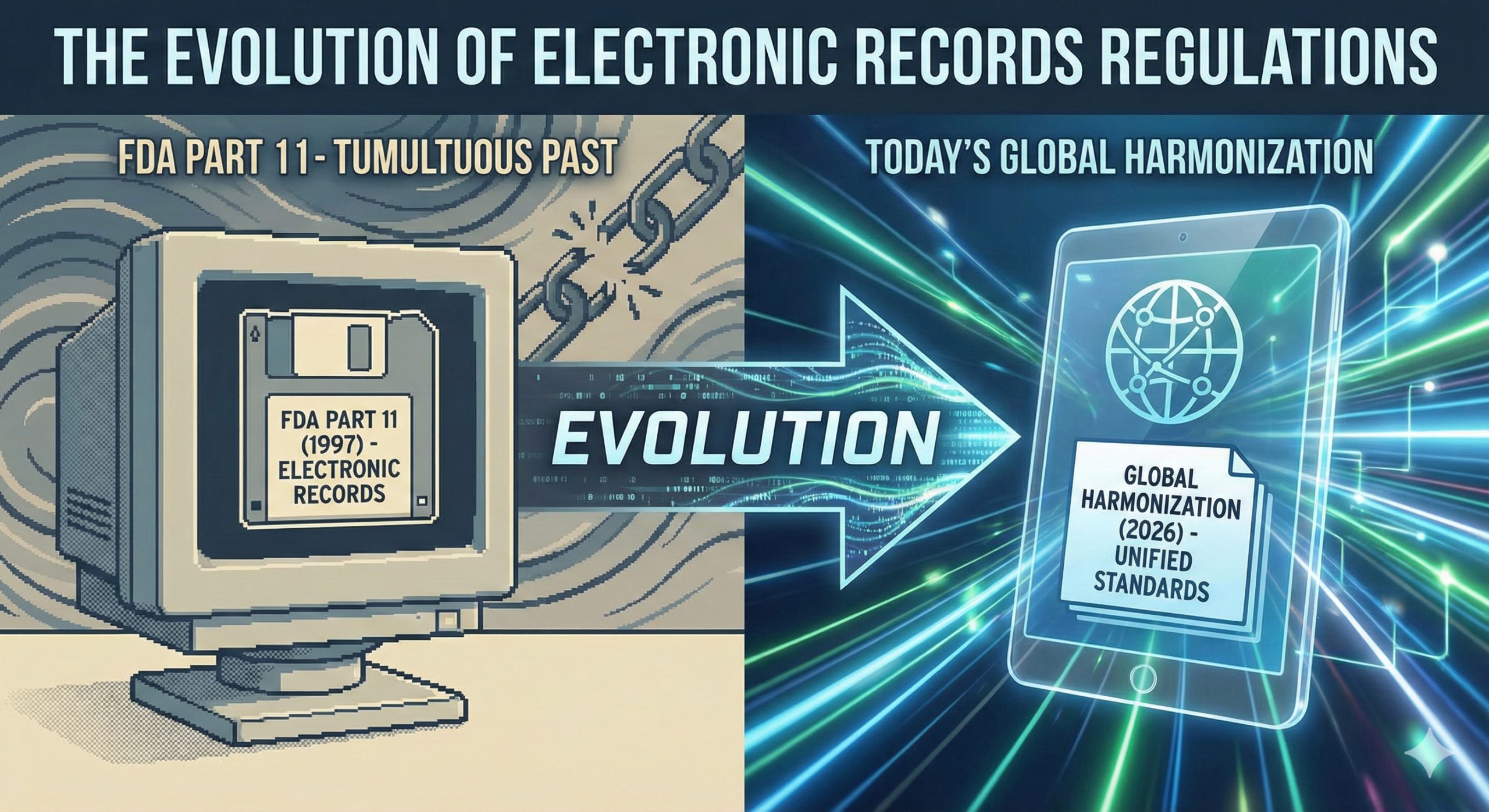
The Evolution of Electronic Records Regulations: From FDA Part 11’s Tumultuous Past to Today’s Global Harmonization
Historical Context: The 2004 Crisis
The Cancelled Public Meeting
As announced on our company website, the FDA Part 11 Public Meeting scheduled for June 11, 2004, was cancelled. Officially, the cancellation was attributed to the temporary closure of government agencies for the state funeral of former President Ronald Reagan, who passed away on June 5, 2004. The funeral service was held on June 11, 2004, which was declared a National Day of Mourning by President George W. Bush. However, the fact that no rescheduling was planned suggested deeper issues beyond the immediate circumstances.
The reality was that convening the meeting would likely have created more confusion rather than clarity. The FDA’s intention to revise and fully implement Part 11 stood in stark opposition to industry demands for its complete abolition. With such fundamentally divergent positions, it was evident that a public forum would not achieve productive outcomes. The FDA’s objectives and the ultimate goal of the Public Meeting remained unclear to stakeholders.
The Japanese Parallel: Delayed but Determined
Meanwhile, Japan’s equivalent to Part 11—the “Guidelines for the Use of Electronic Records and Electronic Signatures in Applications for Approval or Permission of Pharmaceuticals”—faced its own delays. Given the turbulent state of the original FDA Part 11, it was understandable that Japanese regulators hesitated to issue their guidelines. However, with the Electronic Common Technical Document (eCTD) acceptance scheduled to begin in Japan in April 2005, the Japanese version of Part 11 needed to be published beforehand to provide the necessary regulatory foundation.
This created a challenging situation where both the United States and Japan faced uncertainty about the future direction of electronic record regulations.
The Regulatory Evolution (2003-2026)
FDA’s Strategic Shift: The 2003 Guidance
The confusion surrounding Part 11 that characterized 2004 was actually part of a significant regulatory transition. In February 2003, the FDA had already begun addressing industry concerns by revoking its previous Compliance Policy Guide (CPG 7153.17) and related guidance documents. This was followed in September 2003 by the publication of the landmark guidance document “Part 11, Electronic Records; Electronic Signatures—Scope and Application.”
This 2003 guidance document represented a fundamental shift in the FDA’s approach. The key changes included:
Narrowed Scope of Enforcement: The FDA announced it would exercise “enforcement discretion” regarding certain Part 11 requirements. This meant the agency would focus on predicate rule compliance and overall data integrity rather than treating Part 11 as a rigid checklist of technical requirements.
Legacy System Accommodation: Systems implemented before 1997 (when Part 11 was finalized) were granted enforcement discretion, provided they remained fit for their intended purpose and maintained data trustworthiness.
Risk-Based Approach: The emphasis shifted from universal technical compliance to a risk-based evaluation of whether electronic records met the fundamental principles of being attributable, legible, contemporaneous, original, and accurate (ALCOA).
Focus on Data Integrity: Rather than penalizing minor technical deviations from Part 11, the FDA prioritized ensuring that electronic records maintained their integrity and could be trusted for regulatory decision-making.
This strategic recalibration helped stabilize the regulatory environment and provided industry with clearer expectations. Subsequent guidance documents continued this trajectory, including the 2004 draft guidance on “Computerized Systems Used in Clinical Investigations” and the 2007 final guidance on the same topic.
Japan’s ER/ES Guidelines: Successful Implementation
Despite the uncertainties of 2004, Japan successfully published its electronic records and electronic signatures guidelines on April 1, 2005. The official title was “Guidelines for the Use of Electronic Records and Electronic Signatures in Applications for Approval or Permission of Pharmaceuticals” (commonly referred to as the “ER/ES Guidelines”), issued through notification Yakushokuhatsu No. 0401022 by the Director of the Pharmaceutical and Food Safety Bureau, Ministry of Health, Labour and Welfare.
The timing was deliberate and strategic. The guidelines were released in conjunction with the implementation of Japan’s e-Document Law (Law Concerning the Use of Information and Communications Technology in Connection with Preservation of Documents by Private Businesses), which came into effect on April 1, 2005. This law provided the legal foundation for businesses to maintain electronic records in place of paper documents across various sectors, including pharmaceuticals.
The Japanese guidelines were developed with careful consideration of FDA’s Part 11 while incorporating Japan-specific requirements and cultural considerations. Key features included:
Alignment with International Standards: The ER/ES Guidelines were designed to be substantially harmonized with FDA’s Part 11, facilitating international drug development and regulatory submissions.
Three Core Principles: Like Part 11, the Japanese guidelines emphasized three fundamental principles for electronic records:
- Authenticity (Shinsesei): Ensuring that electronic records are genuine and can be trusted as originating from their purported source
- Readability (Kendokusei): Maintaining the ability to review and read electronic records throughout their retention period
- Preservation (Hozonsei): Ensuring long-term retention and protection against loss, alteration, or deterioration
Distinction Between Closed and Open Systems: The guidelines differentiated between closed systems (where access is controlled by persons responsible for the content) and open systems (where access is not so controlled), with additional security requirements for open systems, including the use of digital signatures.
Electronic Signature Requirements: For electronic signatures, the guidelines mandated that they must uniquely identify individuals, be linked to the signed electronic record in a manner that prevents tampering, and include information about the signer’s identity, the date and time of signing, and the meaning of the signature.
eCTD Implementation in Japan
The eCTD system was formally introduced in Japan through a notification from the Ministry of Health, Labour and Welfare on May 27, 2004 (Yakushokushinsa-hatsu Notification No. 0527004), followed by a Pharmaceuticals and Medical Devices Agency (PMDA) notification on June 29, 2005 (Yakuki-hatsu No. 0629005).
The implementation proceeded in phases:
2005: Official acceptance of eCTD submissions began, though submission volumes remained modest initially.
2009: The implementation of eCTD v3.2.2 marked a turning point, with a dramatic increase in electronic submissions. The enhanced specifications and clearer guidance gave companies greater confidence in adopting the electronic format.
2015: By this time, the majority of new drug applications in Japan were being submitted in eCTD format, demonstrating the success of the electronic submission program.
2021-2022: Japan conducted technical pilots for eCTD v4.0, positioning itself alongside other ICH regions in adopting the next-generation standard.
2026: Japan is moving toward mandatory implementation of eCTD v4.0, following successful pilot programs and the issuance of comprehensive implementation guides.
Current Global Landscape (2025-2026)
eCTD v4.0: The Next Generation
The pharmaceutical regulatory world is currently transitioning to eCTD v4.0, which represents a fundamental redesign rather than an incremental update. This new version addresses many limitations of eCTD v3.2.2 and incorporates lessons learned from two decades of electronic submissions.
Key Innovations in eCTD v4.0:
Single Submission-Unit Architecture: Unlike v3.2.2, which required separate XML files for different modules, v4.0 uses a single XML exchange message that encapsulates all modules (1-5) in one cohesive package. This unified structure significantly reduces transmission errors and simplifies validation.
Enhanced Document Reuse: Documents can now be submitted once and referenced by their unique identifier in subsequent submissions if validly retained by the regulatory authority. This dramatically reduces redundancy and file sizes for lifecycle management.
Improved Metadata and Context-of-Use: eCTD v4.0 introduces sophisticated metadata structures and context-of-use keywords that provide richer information about document content and purpose. This enables more precise searching, filtering, and review workflows for regulatory agencies.
Flexible Lifecycle Operations: The new version supports one-to-one, one-to-many, and many-to-one lifecycle operations, providing unprecedented flexibility in managing complex submission scenarios such as line extensions or multiple products in a single submission.
Controlled Vocabularies: Standardized vocabularies ensure consistency in metadata across submissions and between sponsors and regulatory agencies. These vocabularies are maintained centrally and regularly updated to reflect new product categories, study types, and document types.
Regional Implementation Timelines:
Different regulatory regions are implementing eCTD v4.0 on varied timelines, reflecting their unique regulatory environments and readiness:
| Region | Agency | Pilot Phase | Voluntary Phase | Mandatory Phase |
| Japan | PMDA | Q2 2021 | 2022-2026 | April 2026 |
| European Union | EMA | 2025 | 2025-2027 | To be determined |
| United States | FDA | 2023-2024 | 2024-2028 | To be determined |
| Canada | Health Canada | 2023 | 2026-2028 | 2028 |
Modern Data Integrity Expectations
While the technical specifications have evolved, the fundamental principles governing electronic records have remained remarkably consistent since Part 11’s inception in 1997. However, regulatory agencies worldwide have refined and expanded their expectations around data integrity.
The ALCOA+ framework (Attributable, Legible, Contemporaneous, Original, Accurate, plus Complete, Consistent, Enduring, and Available) has become the global standard for evaluating electronic record systems. Regulatory agencies now focus enforcement efforts on data integrity violations rather than technical non-compliance with specific regulations.
Contemporary Enforcement Priorities:
Audit Trail Completeness: Regulatory agencies expect comprehensive audit trails that capture all data changes, including who made the change, when it occurred, and why. The inability to demonstrate data lineage is a frequent citation in warning letters.
System Validation: The FDA’s 2022 guidance on Computer Software Assurance (CSA) represents a shift toward risk-based validation that focuses testing resources on high-risk areas while reducing burden on low-risk systems. This approach maintains quality while eliminating non-value-added documentation activities.
Preventing Data Manipulation: Recent warning letters have highlighted cases where companies lacked adequate controls to prevent selective reporting, data deletion, or results manipulation. Modern systems must incorporate technical and procedural controls to maintain data integrity throughout the lifecycle.
Hybrid System Management: Many organizations operate hybrid environments combining paper and electronic records, or multiple electronic systems. Regulatory agencies expect clear procedures for managing data transfers between systems while maintaining the integrity of electronic signatures and audit trails.
Lessons Learned and Best Practices
The Importance of Regulatory Pragmatism
The Part 11 crisis of 2004 taught both regulators and industry valuable lessons about regulatory pragmatism. The FDA’s initial approach to Part 11 was criticized for being overly prescriptive and potentially inhibiting technological innovation. The 2003 guidance’s shift to enforcement discretion and focus on risk-based compliance demonstrated that regulations must balance public health protection with practical implementation feasibility.
This principle has influenced subsequent regulatory initiatives, including:
Pharmaceutical Quality for the 21st Century (2002): This initiative emphasized risk-based approaches and quality by design, concepts that later influenced how Part 11 was interpreted and enforced.
Process Validation Guidance (2011): Rather than prescribing specific validation protocols, this guidance established principles and left implementation details to companies’ judgment based on their specific processes and risks.
Computer Software Assurance (2022): This represents the latest evolution in risk-based thinking, explicitly encouraging companies to focus validation efforts where they provide the most value.
Industry Collaboration and Standardization
The eCTD story demonstrates the power of international collaboration in regulatory harmonization. The International Council for Harmonisation (ICH) brought together regulatory authorities and industry representatives from multiple regions to develop common standards that reduce duplicative work while maintaining high-quality submissions.
Key success factors included:
Stakeholder Engagement: Regular workshops, public comment periods, and pilot programs ensured that standards were practical and addressed real-world needs.
Phased Implementation: Allowing voluntary adoption before mandating use gave companies time to develop capabilities and provided regulators with feedback to refine requirements.
Technical Support Infrastructure: Investments in validation tools, controlled vocabularies, and comprehensive implementation guides reduced barriers to adoption.
Mutual Recognition: As more regions adopted eCTD, companies could increasingly leverage the same submission packages across multiple markets, realizing significant efficiency gains.
Technology Evolution and Regulatory Adaptation
The past two decades have seen dramatic technological changes that impact electronic record systems:
Cloud Computing: Modern pharmaceutical companies increasingly rely on cloud-based systems for data storage, processing, and collaboration. Regulatory agencies have adapted by issuing guidance on cloud validation and data security expectations.
Mobile Devices and Digital Health Technologies: Clinical trials now frequently incorporate mobile apps, wearable sensors, and other digital health technologies that generate electronic source data. The 2023 FDA draft guidance on “Use of Electronic Systems and Electronic Records in Clinical Investigations” addresses these contemporary technologies.
Artificial Intelligence and Machine Learning: AI/ML systems present new challenges for validation and regulatory compliance. Agencies are developing frameworks to evaluate these technologies while preserving their potential benefits.
Blockchain and Distributed Ledgers: Emerging technologies like blockchain offer new approaches to ensuring data integrity and creating tamper-evident audit trails. While not yet widely adopted in regulated environments, regulatory thinking is evolving to accommodate these innovations.
Future Outlook
Continued Harmonization Efforts
The success of ICH’s eCTD initiative has inspired similar harmonization efforts across other aspects of pharmaceutical regulation. Looking ahead, we can expect:
Expanded Geographic Participation: More countries are joining ICH or adopting ICH standards, expanding the reach of harmonized approaches to electronic records and submissions.
Deeper Technical Integration: Future eCTD versions may incorporate even more sophisticated features, such as machine-readable content, automated quality checks, and enhanced reviewer tools.
Cross-Industry Learning: Principles and technologies developed for pharmaceutical electronic records are being adopted in other highly regulated sectors, including medical devices, biologics, and combination products.
Emerging Regulatory Focus Areas
Several themes are likely to shape the future of electronic records regulation:
Data Integrity by Design: Rather than treating data integrity as a compliance checklist, regulators are encouraging companies to build integrity controls into system architecture and business processes from the outset.
Real-World Evidence: As regulatory agencies increasingly consider real-world evidence in decision-making, expectations for electronic health records, claims databases, and patient registries are evolving.
Patient-Centric Data: Patient-reported outcomes, patient preference studies, and other patient-generated data are becoming more important in regulatory submissions, creating new requirements for electronic capture and management.
Cybersecurity: With increasing connectivity comes increased vulnerability to cyber threats. Regulatory expectations for cybersecurity controls in systems managing electronic records continue to evolve.
Conclusion: From Crisis to Maturity
The journey from the tumultuous days of 2004 to today’s relatively stable regulatory environment demonstrates the pharmaceutical industry’s resilience and adaptability. What began as a crisis—characterized by regulatory uncertainty, conflicting stakeholder positions, and implementation challenges—has evolved into a mature, globally harmonized framework for electronic records management.
The cancelled FDA Public Meeting of June 11, 2004, now appears as a pivotal moment when regulators recognized that rigid enforcement of prescriptive rules would not serve public health as effectively as flexible, risk-based approaches focused on fundamental data integrity principles. The subsequent refinement of Part 11 guidance, the successful implementation of Japan’s ER/ES Guidelines, and the global adoption of eCTD standards all reflect this learning.
For pharmaceutical professionals today, electronic records and electronic signatures are not novel concepts requiring careful navigation of uncertain regulations—they are standard tools supported by clear expectations and proven best practices. The regulatory framework continues to evolve, but always in dialogue with industry stakeholders and always with the goal of protecting public health while enabling innovation.
As we look to the future with eCTD v4.0 implementation, cloud-based systems, artificial intelligence, and other technological advances, the lessons of the past two decades remain relevant: successful regulation requires pragmatism, stakeholder engagement, international harmonization, and a willingness to adapt to changing technology while preserving core principles of data quality and integrity.
The path from those uncertain days of 2004 to today’s harmonized global framework was neither quick nor easy, but it has created a foundation that will serve public health and pharmaceutical innovation for years to come.
Glossary of Key Terms
21 CFR Part 11: FDA regulation establishing requirements for electronic records and electronic signatures in pharmaceutical development and manufacturing.
ER/ES Guidelines: Japan’s Guidelines for the Use of Electronic Records and Electronic Signatures, functionally equivalent to FDA’s Part 11.
eCTD: Electronic Common Technical Document, the international standard format for regulatory submissions developed by ICH.
ICH: International Council for Harmonisation of Technical Requirements for Pharmaceuticals for Human Use, which develops globally harmonized standards.
ALCOA/ALCOA+: Principles for data integrity—Attributable, Legible, Contemporaneous, Original, Accurate, plus Complete, Consistent, Enduring, and Available.
PMDA: Pharmaceuticals and Medical Devices Agency, Japan’s regulatory authority responsible for reviewing pharmaceutical applications.
Predicate Rules: The underlying regulations (e.g., GMP, GLP, GCP) that require records to be maintained; Part 11 applies when these records are maintained electronically.
Enforcement Discretion: FDA’s policy of not routinely citing certain technical Part 11 violations if fundamental data integrity requirements are met.
CSV: Computer System Validation, the documented process of ensuring a computerized system does what it is designed to do in a consistent and reproducible manner.
Data Integrity: The degree to which data are complete, consistent, accurate, trustworthy, and reliable throughout the data lifecycle.

Comment