
Understanding CFR: The Foundation of U.S. Regulatory Framework
What is CFR: Official Name and Function
For those working in the pharmaceutical industry or life sciences field, the term “21 CFR Part 11” is likely familiar. This regulation, known for its requirements regarding electronic records and electronic signatures, is widely recognized. However, surprisingly few people accurately understand what “CFR” means and where “Part 11” fits within this broader regulatory framework. This article provides a comprehensive explanation of CFR, from its overall structure to the positioning of 21 CFR Part 11, in a manner accessible to beginners while maintaining professional depth.
Understanding CFR
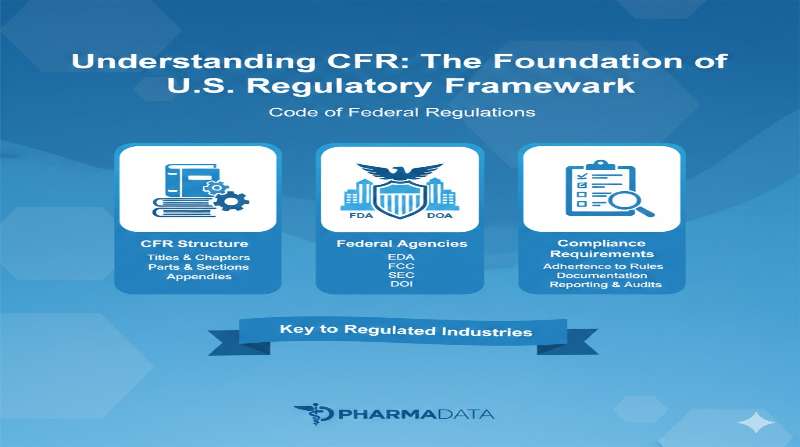
CFR stands for “Code of Federal Regulations.” It is an official compilation that systematically organizes regulations established by U.S. federal government administrative agencies and forms the foundation of administrative law in the United States.
The U.S. legal system has a hierarchical structure. At the top is the Constitution, below which are laws (Statutes) enacted by Congress. Based on these laws, various administrative agencies establish specific operational regulations. These regulations established by administrative agencies are compiled into the CFR.
Structure of CFR: Classification by 50 Titles
The CFR is organized into 50 Titles, each covering a specific administrative area and consolidating related regulations. Major Titles include:
- Title 7: Agricultural regulations administered by the Department of Agriculture
- Title 21: Food and drug regulations administered by the Food and Drug Administration (FDA)
- Title 40: Environmental protection regulations administered by the Environmental Protection Agency (EPA)
- Title 49: Transportation regulations administered by the Department of Transportation
As demonstrated, each Title is closely linked to its responsible administrative agency. For those involved in the pharmaceutical, medical device, and food industries, the most important is Title 21, administered by the FDA.
Structure of Title 21: The Food and Drug Regulatory Framework
Scope of Title 21
Title 21, as its name “Food and Drugs” suggests, covers a broad range of areas under FDA jurisdiction. Specifically, it includes regulations for pharmaceuticals, medical devices, biological products, food, cosmetics, and electronic products that emit radiation.
Subdivision into Parts
Title 21 is further divided into “Parts” (chapters). Each Part consolidates regulations related to specific topics or product categories. Representative Parts include:
- Part 11: Regulations for electronic records and electronic signatures
- Parts 210 and 211: Current Good Manufacturing Practice (cGMP) regulations for pharmaceuticals
- Part 312: Regulations for Investigational New Drug (IND) applications
- Part 314: Regulations for New Drug Applications (NDA)
- Part 820: Quality System Regulation (QSR) for medical devices
Note: Part 820 is transitioning to the Quality Management System Regulation (QMSR) effective February 2, 2026, incorporating ISO 13485:2016 by reference.
This structure, where each Part handles a specific regulatory domain, organizes vast regulations into a coherent framework.
Positioning of 21 CFR Part 11
Background of Part 11’s Creation
21 CFR Part 11, established by the FDA in 1997, is a regulation concerning the use of electronic records and electronic signatures. For many years, the pharmaceutical industry relied on paper-based records and handwritten signatures as the standard. However, with advances in computer technology, the transition to electronic systems was progressing. The challenge was how to ensure the reliability of electronic records, which are more easily altered than paper records.
To address this challenge, the FDA established requirements for electronic records and electronic signatures to have the same reliability and legal effectiveness as paper records and handwritten signatures. This became Part 11.
Part 11 was published as a final rule on March 20, 1997, and became effective on August 20, 1997.
Scope of Application of Part 11
Part 11 applies to records submitted to the FDA and records that the FDA reviews during inspections. In other words, when records required by other Parts of Title 21 are created or maintained electronically, they must meet Part 11 requirements.
For example, if manufacturing records required by Part 211 for pharmaceutical manufacturing are managed in an electronic system, that system must comply with Part 11 requirements. Thus, Part 11 functions as a cross-cutting regulation that works in conjunction with other Parts.
Key Requirements of Part 11
Part 11 consists of three Subparts:
Subpart A: General Provisions This section establishes the scope and definitions of electronic records, and conditions under which electronic records and electronic signatures are considered equivalent to paper records and handwritten signatures.
Subpart B: Electronic Records This section defines technical requirements such as system validation, audit trails, the ability to create accurate copies of records, and record protection.
Subpart C: Electronic Signatures This section independently establishes requirements specific to electronic signatures, including uniqueness of electronic signatures, identity verification of signers, biometric authentication or password management, and clarification of signature meaning.
Evolution of Part 11 Guidance
Following initial implementation challenges and industry feedback, the FDA issued guidance in 2003 titled “Guidance for Industry: Part 11, Electronic Records; Electronic Signatures — Scope and Application.” This guidance adopted a risk-based approach and clarified that the FDA would exercise enforcement discretion on certain provisions. The guidance narrowed the scope by focusing on records that are required to be maintained under predicate rules and that are maintained in electronic format in place of paper format.
Additionally, the FDA has issued several other related guidance documents, including:
- “Guidance for Industry: Computerized Systems Used in Clinical Investigations” (May 2007)
- “Data Integrity and Compliance with Drug CGMP: Guidance for Industry” (December 2018)
These documents provide practical implementation guidance and reflect the FDA’s current thinking on electronic records and data integrity.
Practical Significance of Understanding the CFR Framework
Grasping Regulatory Relationships
Understanding the structure of CFR clarifies the context in which individual regulations are positioned. For example, when understanding Part 11, it becomes clear that it does not exist in isolation but is closely related to regulations concerning manufacturing and clinical trials, such as Parts 210, 211, and 312.
This understanding of relationships is extremely important for compliance. When implementing electronic systems that comply with Part 11, it is necessary to clearly identify which regulations (e.g., cGMP) the system will ultimately manage records for.
Tracking Regulatory Trends
The CFR is updated annually on a staggered basis according to the following schedule:
| Title Range | Update Date |
| Titles 1-16 | January 1 |
| Titles 17-27 | April 1 |
| Titles 28-41 | July 1 |
| Titles 42-50 | October 1 |
New regulations are added and existing regulations are revised, so understanding the CFR structure is essential for staying current with regulatory trends. By tracking which Parts of Title 21 have been revised, one can quickly assess the impact on one’s own operations.
Harmonization with Global Regulations
Currently, many countries and regions have introduced their own regulations based on FDA regulations. For example, Europe’s EudraLex Volume 4 Annex 11 and Japan’s ER/ES Guidance (issued in April 2005) were both developed with reference to 21 CFR Part 11. Understanding the structure of CFR serves as the first step in understanding the global regulatory environment.
Key Global Equivalents:
| Region | Regulation/Guidance | Year Issued | Basis |
| United States | 21 CFR Part 11 | 1997 | Original regulation |
| European Union | EudraLex Vol. 4 Annex 11 | 2011 (revised) | Based on Part 11 principles |
| Japan | ER/ES Guidance | 2005 | Based on Part 11 |
The European Annex 11, titled “Computerised Systems,” provides comprehensive requirements for computerized systems in GMP environments and shares many principles with Part 11, though with some differences in approach and emphasis.
Recent Regulatory Developments
QMSR Implementation (2026)
A significant regulatory development affecting Title 21 is the transition from Part 820 (Quality System Regulation) to the Quality Management System Regulation (QMSR), effective February 2, 2026. This transformation represents a historic update that harmonizes 21 CFR Part 820 with ISO 13485:2016.
Key aspects of QMSR:
- Incorporates ISO 13485:2016 by reference, making compliance with the international standard a legal requirement
- Reduces written content significantly: from 15 sub-parts (A-O) in the QSR to just 2 sub-parts (A-B) in the QMSR
- Maintains FDA’s inspection authority; ISO 13485 certification does not exempt manufacturers from FDA inspections
- Introduces new terminology, including replacement of Device Master Record (DMR), Device History Record (DHR), and Design History File (DHF) with the unified Medical Device File (MDF)
- Two-year transition period allows manufacturers to update their quality management systems
This modernization aligns U.S. requirements with international standards while reducing regulatory burden for global manufacturers.
Data Integrity Focus
In recent years, the FDA and other regulatory authorities have placed increased emphasis on data integrity. The concept of ALCOA+ (Attributable, Legible, Contemporaneous, Original, Accurate, plus Complete, Consistent, Enduring, and Available) has become a critical framework for evaluating electronic records and systems.
The FDA’s 2018 guidance on “Data Integrity and Compliance with Drug CGMP” provides important clarifications on expectations for data integrity in pharmaceutical manufacturing. This guidance applies across all GxP environments and affects how Part 11 requirements are interpreted and implemented.
Practical Approaches to Utilizing CFR
Utilizing Official Resources
The complete text of CFR is freely accessible on the website operated by the U.S. Government Publishing Office (GPO) at ecfr.gov. This site allows access not only to the latest version but also to past versions, enabling tracking of regulatory evolution.
Additionally, the FDA’s official website publishes guidance documents for each regulation. For Part 11 specifically, the guidance “Guidance for Industry: Part 11, Electronic Records; Electronic Signatures — Scope and Application,” issued in 2003, is important for understanding practical interpretations.
Key Official Resources:
| Resource | URL | Purpose |
| Electronic CFR (eCFR) | ecfr.gov | Daily updated unofficial version |
| Annual CFR | govinfo.gov | Official annual edition |
| FDA Guidance Documents | fda.gov/regulatory-information | Implementation guidance |
| Federal Register | federalregister.gov | Proposed and final rules |
Internal Knowledge Sharing
Systematic understanding of CFR is required not only in quality assurance departments but also in various departments such as manufacturing, research and development, and IT. It is advisable to conduct regular internal training to ensure that relevant departments understand the basic structure of CFR and regulations related to their own departments.
Particularly when introducing new electronic systems, having system development personnel accurately understand Part 11 requirements is key to success.
Implementation Best Practices
When implementing Part 11 compliance:
- Conduct Risk Assessment: Identify which systems and processes fall under Part 11 scope using a risk-based approach
- Perform Gap Analysis: Compare current state against Part 11 requirements and related guidance
- Establish Documentation: Create and maintain Standard Operating Procedures (SOPs) for electronic record and signature management
- Implement Technical Controls: Ensure systems have appropriate validation, audit trails, access controls, and security features
- Provide Training: Ensure all users understand their responsibilities regarding electronic records and signatures
- Plan for Maintenance: Establish ongoing monitoring and periodic review processes
- Consider Data Integrity: Apply ALCOA+ principles throughout system design and operation
Summary
CFR is a systematically organized compilation of U.S. administrative regulations, classified into 50 Titles. Among these, Title 21 covers the food and drug field and is further subdivided into multiple Parts. 21 CFR Part 11 is positioned as Chapter 11 of Title 21, addressing regulations for electronic records and electronic signatures.
To understand Part 11, it is necessary to recognize that it does not exist in isolation but is closely related to other Parts concerning pharmaceutical manufacturing and clinical trials. By grasping the overall structure of CFR, the meaning and scope of individual regulations become clearer, enabling effective compliance.
The regulatory environment is constantly evolving. Understanding the structure of CFR and continuously tracking the latest information is a fundamental skill required of all professionals working in the pharmaceutical and medical device industries. As technology evolves, regulations evolve as well, and understanding CFR, which forms the foundation, will continue to increase in importance.
The upcoming QMSR implementation in February 2026 exemplifies this evolution, demonstrating how U.S. regulations adapt to align with international standards while maintaining stringent quality and safety requirements. Similarly, the ongoing emphasis on data integrity reflects the regulatory community’s response to technological advances and emerging risks in pharmaceutical manufacturing and development.
For organizations operating in regulated industries, maintaining awareness of CFR structure, staying current with regulatory updates through official channels, and implementing robust compliance programs are essential for success in an increasingly complex global regulatory landscape.
Related Articles
- Why Software Category Classification is Necessary
- The Birth of 21 CFR Part 11: A Historical Perspective
- The Four Unsolvable Challenges of Part 11
- Understanding the “Typewriter Excuse” in FDA 21 CFR Part 11 Compliance
- Why Printouts Cannot Be Trusted: Understanding the Vulnerability of Paper-Based Document Management
Related FDA QMSR Templates
Streamline your FDA QMSR compliance with our professionally crafted templates: