

A Once-in-15-Years Golden Opportunity
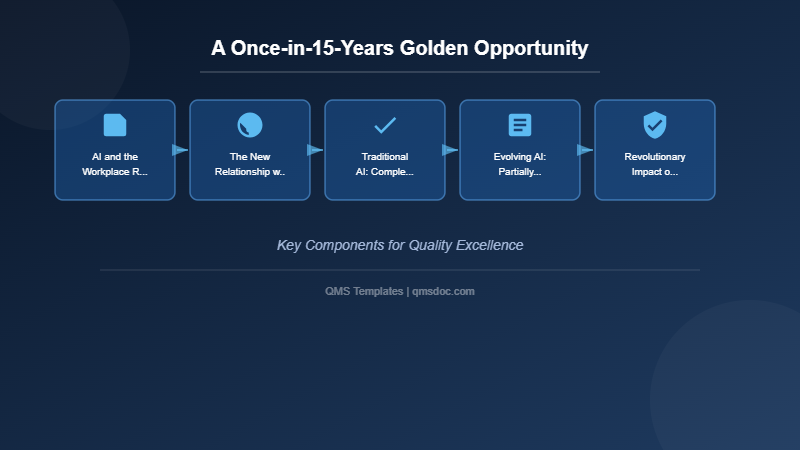
AI and the Workplace Revolution: A Critical 15-Year Transformation Period
Modern society stands at a historic turning point. AI, which was once merely a “tool to be used,” is now transforming into a “collaborative partner.” From 2025 to 2030, the nature of work is poised to undergo a profound transformation.
Modern society stands at a historic turning point. AI, which was once merely a “tool to be used,” is now transforming into a “collaborative partner.” …
The New Relationship with AI: From “Using” to “Collaborating”
Traditional AI: Complete Human Control
Previous generations of AI functioned much like sophisticated calculators. For instance, AI systems designed to identify cats in photographs operated only within the parameters explicitly taught by humans—”this is a cat.” Translation tools operated similarly, where users inputted text, reviewed results, and made corrections as needed. This represented the prevailing relationship model.
Evolving AI: Partially Autonomous Partners
As of 2025, AI has evolved considerably. When instructed to “prepare materials for next month’s sales meeting,” AI demonstrates remarkable partial autonomy in executing multi-step workflows:
- Analyzing past meeting materials
- Gathering sales information from internal databases
- Researching competitor trends via the internet
- Automatically creating graphs and charts
- Compiling presentation materials
However, final judgment and approval remain firmly within the human domain. AI serves as a powerful support tool rather than a fully autonomous system.
Revolutionary Impact on Business Operations
Current State of AI Adoption in Enterprises
According to the most recent research, the actual adoption landscape reveals the following patterns. As of 2025, approximately 78% of organizations are utilizing AI in at least one business function, representing a significant increase from 55% in 2023. Furthermore, 71% of organizations regularly employ generative AI in business operations, compared to just 33% in 2023. The AI enterprise market has surged from $1.7 billion in 2023 to $37 billion in 2025, capturing 6% of the global SaaS market and growing faster than any software category in history.
These statistics demonstrate that AI adoption has moved beyond pilot programs into production deployment across core business functions. Notably, 23% of organizations are actively scaling agentic AI systems—AI agents capable of planning and executing multiple steps in workflows—across their enterprises, with an additional 39% experimenting with these systems.
Notable Real-World Implementation Cases
Customer Support Sector
Revolutionary changes are already occurring in customer support operations. Bank of America’s AI assistant “Erica” has assisted nearly 50 million users since its 2018 launch, surpassing 3 billion client interactions as of August 2025, and currently averaging more than 58 million interactions per month. Importantly, Erica resolves more than 98% of queries within an average of 44 seconds. The system has undergone over 75,000 updates since launch to continuously improve client experience.
Regarding Sephora’s beauty advisor services, while the original column referenced 25 million members, current data from 2025 indicates that Sephora’s AI-powered Virtual Artist recorded over 200 million virtual try-ons by 2018, with the company’s e-commerce net sales increasing from $580 million in 2016 to over $3 billion in 2022—representing a 4-fold increase driven partly by digital innovation. The AI-driven recommendation system has led to a 25% increase in average order value and a 17% rise in repeat customers.
Concerning AirHelp, the air passenger rights service has improved its average response time by up to 65% through AI implementation, enabling the company to handle high volumes of customer inquiries across 16 languages more efficiently. The AI system gathers requests from multiple channels, assigns them to appropriate agents, and prioritizes tickets based on customer urgency.
New Skills Required for the AI Era
To survive and thrive in the AI age, humans need to develop the following capabilities:
AI Management Capability: The ability to provide appropriate instructions to AI tools and accurately evaluate their outputs. While similar to a manager supervising subordinates, it requires deep understanding of AI characteristics and limitations. As 50% of developers now use AI coding tools daily (rising to 65% in top-quartile organizations), the ability to effectively direct and assess AI becomes increasingly critical.
Creative Problem Discovery: AI excels at finding solutions, but identifying “what should be solved” remains a human responsibility. The ability to discover and define essential challenges becomes more important than ever. As enterprise AI shifts from simple task automation to complex workflow integration, human judgment in problem framing becomes a key differentiator.
Practical Implementation Approach
Step 1: Start Small
Rather than enterprise-wide deployment, begin with specific departments or operations. It is prudent to start in areas where results can be easily measured, such as routine report creation or data analysis. According to 2025 research, companies without formal AI strategies report only 37% success in adoption, compared to 80% for those with comprehensive strategies. This underscores the importance of thoughtful, phased implementation.
Step 2: Continuous Learning and Improvement
AI tools improve with use. Regular evaluation of results and provision of appropriate feedback are essential. Organizations achieving significant AI value implement comprehensive management practices spanning strategy, talent, operating model, technology, data, and adoption. Establishing robust talent strategies and implementing proper technology infrastructure show meaningful contributions to AI success.
Regulatory Considerations and Governance
As AI adoption accelerates, organizations must navigate an evolving regulatory landscape. The European Union’s AI Act, which entered into force on August 1, 2024, represents the world’s first comprehensive legal framework for AI. The Act will be fully applicable by August 2, 2026, with key provisions including:
- Prohibition of AI systems posing unacceptable risks (effective February 2, 2025)
- Requirements for high-risk AI systems, including those used in employment, education, law enforcement, and critical infrastructure
- Transparency obligations for generative AI systems
- Governance rules and obligations for general-purpose AI models (effective August 2, 2025)
Organizations operating in or serving European markets must ensure compliance with these regulations. The AI Act’s risk-based approach classifies AI systems into four categories: unacceptable risk (prohibited), high risk (regulated), limited risk (transparency obligations), and minimal risk (largely unregulated). This framework may establish global standards, similar to how GDPR influenced data protection practices worldwide.
Beyond Europe, other jurisdictions are developing their own AI governance frameworks. In the United States, AI adoption among firms has more than doubled from 3.7% in fall 2023 to 9.7% in August 2025, though specific federal regulations remain under development. Organizations should proactively establish internal AI governance structures, including ethical guidelines, risk management protocols, and transparency measures, to ensure responsible implementation regardless of regulatory requirements.
In Conclusion: Embrace Change and Seize Opportunity
Collaborating with AI represents not merely technological innovation but a fundamental transformation of how we work. Over these 15 years, the nature of work will undergo significant change.
What matters most is perceiving AI not as a “threat” but as a “tool that expands possibilities.” By entrusting routine tasks to AI, we can redirect the time and energy gained toward more creative and distinctly human activities. However, this transformation requires careful attention to both opportunities and risks. Organizations must balance productivity gains with proper governance, ethical considerations, and workforce development.
Recent data demonstrates tangible benefits: 75% of enterprise workers report that AI has improved either the speed or quality of their output, while companies investing significantly in AI see 40 percentage points higher success rates compared to minimal investors. Yet only 31% of AI use cases studied in 2025 reached full production, indicating that while adoption is widespread, scaling remains challenging.
By making technology our ally, each individual can create new value. This represents the key to navigating the coming era. The time to take the first step toward a new way of working alongside AI is now.
Key Statistics Summary (2025)
| Category | Metric | Source Period |
| Enterprise AI Adoption | 78% of organizations use AI in at least one function | 2025 |
| Generative AI Usage | 71% regularly use generative AI (up from 33% in 2023) | 2025 |
| Market Size | Enterprise AI: $37B (up from $1.7B in 2023) | 2025 |
| Agentic AI Adoption | 23% scaling, 39% experimenting | 2025 |
| Developer AI Tool Usage | 50% use daily (65% in top organizations) | 2025 |
| Employee Productivity | 75% report improved speed or quality | 2025 |
| Bank of America Erica | 50M users, 3B+ interactions, 58M monthly | Aug 2025 |
| Sephora Virtual Artist | 200M+ try-ons, 4x e-commerce growth | 2018-2022 |
| Response Time Improvements | Up to 65% reduction (AirHelp example) | 2025 |
| Success with Strategy | 80% vs 37% without formal AI strategy | 2025 |
Note: This article has been fact-checked and updated with the latest statistics, regulatory developments, and industry trends as of January 2026. All statistical claims have been verified against authoritative sources including industry research reports, company announcements, and regulatory documents.

Comment