
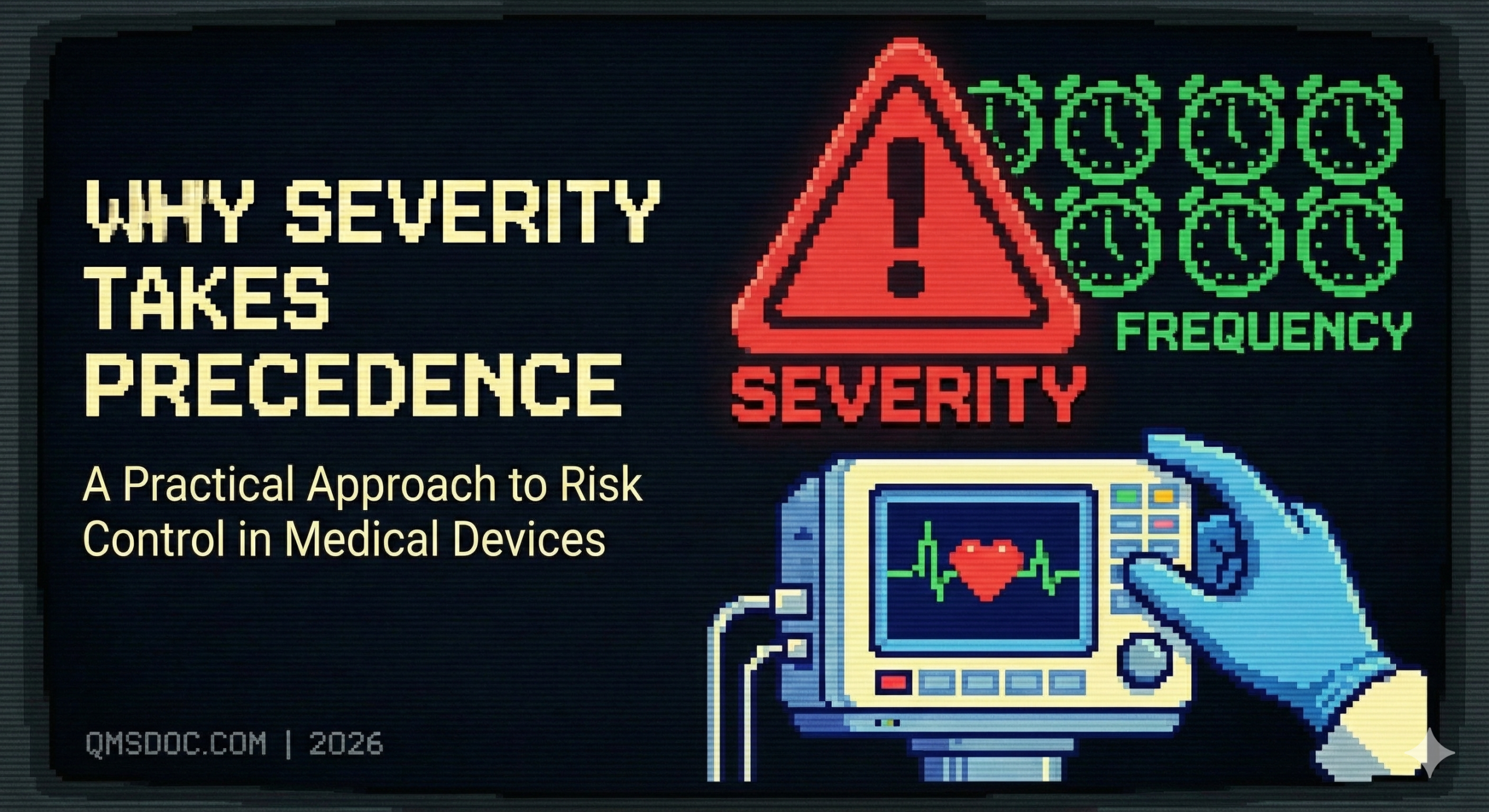
Why Severity Takes Precedence Over Frequency: A Practical Approach to Risk Control in Medical Devices
Introduction
In risk control for medical devices, the relationship between occurrence frequency and severity of harm presents a fundamental challenge for regulatory compliance. This article examines how to effectively balance these two critical dimensions of risk management in accordance with ISO 14971 and ICH Q9 guidance, while addressing the practical realities of implementation.
In risk control for medical devices, the relationship between occurrence frequency and severity of harm presents a fundamental challenge for regulator…
Fundamental Principles of Risk Management
Both ISO 14971:2019 “Medical devices—Application of risk management to medical devices” and ICH Q9(R1) “Guideline for Quality Risk Management” establish a clear mathematical framework for understanding risk:
Risk = Occurrence Probability × Severity of Harm
These international standards explicitly require that risk assessment consider both dimensions simultaneously. The risk matrix, commonly referred to as R-MAP (Risk-Matrix Approach), places occurrence probability on one axis and severity of harm on the other, creating a two-dimensional assessment tool where both elements combine to determine overall risk level.
Importantly, ISO 14971:2019 explicitly states: “Risk control measures shall be capable of reducing the severity of harm, the probability of occurrence of harm, or both.” This language fundamentally contradicts any approach that considers only one dimension while neglecting the other. Effective risk management demands comprehensive consideration of both factors.
The Predictability Challenge: Why Estimating Human Error Frequency Is So Difficult
While both dimensions merit equal theoretical consideration, practical implementation reveals a critical asymmetry. Predicting the occurrence probability of human error presents substantial challenges that deserve detailed examination.
Human behavior is influenced by countless variables that defy precise quantification. These include temporal factors, environmental conditions, individual competency levels, stress responses, fatigue, emotional state, organizational culture, training quality, system design flaws, and numerous other contextual elements. This multifactorial nature makes accurate prediction extraordinarily difficult.
Consider a real-world example: A large organization underwent comprehensive organizational restructuring in 2025. New systems, processes, and operational procedures were introduced across multiple departments. During the transition period, human error incidents increased significantly as employees familiarized themselves with novel workflows and interfaces. However, the error occurrence probability estimates calculated before reorganization failed entirely to predict this increase. This scenario illustrates a fundamental limitation: certain disruptions and changes create unpredictable spikes in human error rates that standard risk models struggle to capture prospectively.
This predictability challenge extends beyond organizational change. Equipment malfunction, system failures, natural disasters, economic pressures, competitive dynamics, and regulatory modifications all create conditions that elevate human error risk in ways that retrospective analysis may illuminate but prospective prediction often misses. For medical device manufacturers, this reality demands a defensive posture toward human error prevention, even when historical data suggests low occurrence probabilities.
Why Risk Control Emphasizes Probability Reduction
In practical medical device risk management, risk control strategies typically prioritize reduction of occurrence probability over reduction of severity. This emphasis reflects a crucial reality about the nature of harm mitigation.
The Fundamental Difficulty of Reducing Severity
A widely held assumption—and one generally validated by regulatory practice—holds that “risk control measures leave the severity of harm unchanged.” In other words, once harm occurs, reducing its severity becomes extremely difficult or impossible through typical design and procedural controls.
The aviation industry provides an instructive example. Aircraft manufacturers cannot redesign airframes to ensure that catastrophic impact causes minimal injury or death. The physics of a high-speed collision with terrain creates inherent consequences. However, through superior design, redundant systems, predictive maintenance, crew training, and procedural protocols, manufacturers can dramatically reduce the probability that such impact occurs in the first place. A crash-resistant fuselage cannot prevent death in a catastrophic crash; instead, the solution lies in preventing crashes.
The same principle applies across medical devices. A surgical instrument cannot eliminate severe tissue damage if misused during critical procedures; however, ergonomic design, clear labeling, intuitive interfaces, clinical training protocols, and procedural safeguards can substantially reduce the probability of misuse itself. A medication delivery device cannot prevent the severe health consequences of an incorrect dose once delivered; but multiple verification checkpoints, automated dose calculations, and user interface design can significantly reduce the probability of dose errors occurring.
Practical Mechanisms for Reducing Occurrence Probability
Manufacturers and healthcare organizations possess numerous evidence-based strategies for reducing the probability of human error and other harmful events:
Inherently safe design involves engineering devices in ways that make errors unlikely or impossible through design constraints rather than reliance on human vigilance. Examples include mechanical interlocks preventing incorrect assembly, graduated dose selectors that make overdose mechanically impossible, and color-coding or shape-coding schemes that prevent misidentification.
Protection measures detect errors or hazardous conditions before they result in harm, creating safety barriers between the error and the adverse outcome. Examples include automated alarms detecting temperature deviations, verification systems checking dosage calculations, and containment systems preventing contamination spread.
User education and information provision ensures that individuals operating medical devices understand proper use procedures, recognize warning signs, and follow critical safety protocols. Effective labeling, pictorial instructions, training documentation, and clinical education substantially reduce the probability of misuse arising from knowledge gaps.
Process standardization establishes clear, simplified, and transparent procedures that reduce cognitive burden and opportunity for variation. Standardized checklists, defined decision points, and simplified workflows make correct operation the path of least resistance.
Dual verification mechanisms create redundancy in critical steps, allowing human reviewers to detect and correct errors before they propagate. Independent verification of critical measurements, cross-checks of patient identification, and reviewer confirmations of complex decisions provide error-catching opportunities.
Environmental and organizational factors including workspace design, fatigue management, stress reduction, adequate resource allocation, and supportive organizational culture all influence error probability. While individual medical device manufacturers have limited control over some of these factors, their influence on error reduction is substantial.
The Essential Balance: Both Dimensions Matter in Risk Assessment
The emphasis on probability reduction should not create the false impression that severity can be ignored. During the risk assessment phase, both dimensions must receive thorough, rigorous evaluation. Risk decisions must be based on the complete risk picture, not a single dimension.
A high-severity risk demands special attention. Consider a scenario where human error or system malfunction results in unauthorized access to patient data. The direct health impact might be low, but the reputational damage to a manufacturer or healthcare provider is severe: loss of patient trust, regulatory sanctions, litigation costs, loss of business, market withdrawal, and long-term competitive disadvantage. For such high-severity risks, even a low calculated occurrence probability warrants additional risk reduction measures. The potential consequences justify enhanced prevention efforts.
Risk prioritization must account for risk level as a combined metric. Risks that are simultaneously high in both probability and severity demand urgent intervention. Risks with high severity but seemingly low probability deserve careful scrutiny and substantial control measures. Even risks with moderate probability and severity warrant thoughtful control strategies. Only truly low-risk combinations—low probability and low severity—warrant acceptance with monitoring rather than active control.
Practical Application in Medical Device Risk Management
Implementing these principles requires a structured approach that honors both theoretical completeness and practical feasibility:
Risk Assessment Phase demands evaluation of both occurrence probability and severity of harm for all identified hazards. Risk assessment teams must systematically consider both dimensions using evidence-based methods such as failure mode and effects analysis (FMEA) and fault tree analysis. The resulting risk matrix should clearly illustrate the two-dimensional nature of risk.
Risk Prioritization must account for risk level as a composite metric. Organizations should sequence risk control interventions starting with high-risk items—those combining high probability, high severity, or both. However, high-severity items warrant priority attention even with modest occurrence probabilities.
Risk Control Strategy Development acknowledges practical reality: because severity reduction is inherently difficult, effective strategies emphasize probability reduction. However, organizations should pursue both strategies when feasible. For instance, a surgical procedure might combine improved instrument design (reducing misuse probability), clearer labeling (reducing confusion probability), enhanced surgical training (reducing error probability), and better adverse outcome monitoring (detecting complications earlier to reduce severity through rapid intervention).
Regulatory and Compliance Considerations recognize that current regulatory guidance, while theoretically requiring both dimensions, practically acknowledges the emphasis on probability reduction. However, regulators increasingly expect explicit documentation showing that severity reduction opportunities were considered, even if subsequently rejected as infeasible.
Ongoing Monitoring and Reassessment remain essential. As discussed earlier, actual error probabilities may diverge significantly from predicted values due to unforeseen organizational changes, market disruptions, or operational factors. Post-market surveillance data, complaint analysis, and field experience must inform periodic reassessment of occurrence probability estimates, potentially triggering enhanced risk controls when actual experience exceeds predictions.
Emerging Considerations in Modern Risk Management
Contemporary risk management must account for evolving regulatory and technological landscapes:
Artificial Intelligence and Machine Learning Medical Devices introduce novel failure modes where traditional probability prediction becomes especially challenging. The dynamic, adaptive nature of AI systems means that error probabilities can shift during product lifecycle in ways that static pre-market analysis cannot fully capture. Enhanced post-market monitoring and dynamic risk reassessment become particularly important.
Cybersecurity Risk Integration recognizes that digital connectivity creates hazard pathways—unauthorized access, system compromise, and data manipulation—that directly impact both probability and severity calculations. Standards such as IEC 62304:2024 and the IEC 62443 series increasingly demand explicit cybersecurity risk treatment within the medical device risk framework.
Lifecycle Perspective acknowledges that risk requirements evolve across design, manufacturing, installation, operation, maintenance, and end-of-life phases. Risk reduction strategies must account for this temporal dimension, recognizing that some controls prove most effective at specific lifecycle stages.
Post-Market Risk Management has gained increasing emphasis in recent regulatory guidance. Early post-market surveillance—systematic collection and analysis of real-world performance data—often reveals that actual error probabilities diverge substantially from pre-market predictions. This finding supports a dynamic risk management approach where post-market evidence informs periodic reassessment and enhancement of risk controls.
Summary and Key Takeaways
Risk management for medical devices rests fundamentally on ISO 14971 and ICH Q9 requirements that both occurrence probability and severity of harm receive thorough evaluation. This theoretical foundation remains inviolable: incomplete risk assessment fails regulatory standards and good engineering practice alike.
However, practical implementation strategy reflects asymmetry between the two dimensions. Because harm severity proves difficult or impossible to reduce through typical risk control measures, effective strategies emphasize probability reduction. This emphasis reflects neither theoretical preference nor regulatory bias; rather, it reflects the practical reality that engineering controls more readily reduce the likelihood of errors occurring than the consequences of errors that do occur.
Understanding this nuance—the theoretical equality of both dimensions combined with practical emphasis on probability reduction—enables professionals to apply risk management principles effectively within regulatory constraints. Risk assessment must remain comprehensive; risk control strategy must remain practical.
Furthermore, contemporary risk management must remain dynamic. Market disruptions, organizational changes, technological innovations, and post-market experience regularly challenge pre-market risk predictions. Sustained vigilance, ongoing data collection, periodic reassessment, and willingness to enhance controls based on emerging evidence represent hallmarks of mature risk management practice.
Professionals who internalize this sophisticated understanding—comprehensive in assessment, pragmatic in strategy, and dynamic in execution—will achieve the dual goals of effective medical device safety and regulatory compliance.
Reference Standards
- ISO 14971:2019 Medical devices—Application of risk management to medical devices
- JIS T 14971:2020 Medical devices—Application of risk management to medical devices
- ICH Q9(R1) Guideline for Quality Risk Management
- IEC 62304:2024 Medical device software lifecycle processes
- IEC 62366-1:2015 Medical devices—Part 1: Guidance on usability
- ISO 14644 Cleanrooms and associated controlled environments
Related FDA QMSR Templates
Streamline your FDA QMSR compliance with our professionally crafted templates:

Related Articles
- The Importance of Design Control in Medical Devices
- Understanding Risk in Pharmaceuticals and Medical Devices
- Severity Remains: ISO 14971’s Precise Framework for Understanding Risk Control and Residual Risk Assessment
- Public Comments Solicitation on the Proposed Ordinance Amending the Ordinance Regarding Standards for Manufacture Control and Quality Control of Medical Devices and In Vitro Diagnostic Devices
- Evolution of Risk Management in Medical Devices: The Significance of ISO 14971 Revision
- Understanding the Difference Between “Design” and “Design Control” in Medical Devices
