
Understanding Medical Device Families
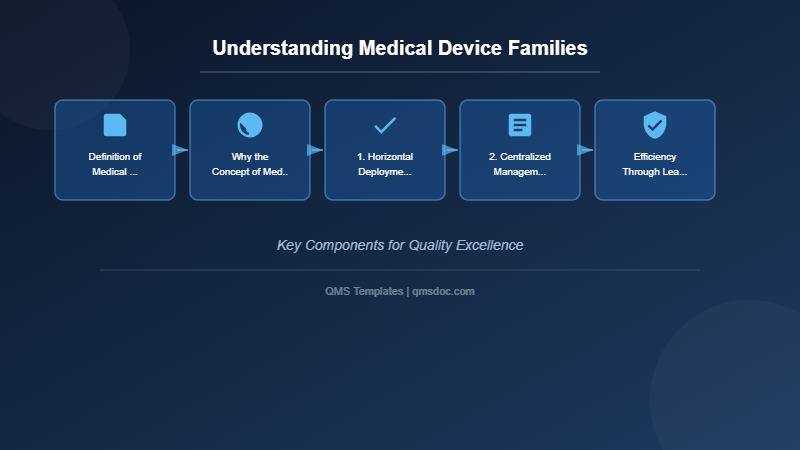
In the development and manufacturing of medical devices, the concept of “medical device family” plays an extremely important role from both safety assurance and operational efficiency perspectives. This article explains the essence of this concept and its practical application.
In the development and manufacturing of medical devices, the concept of “medical device family” plays an extremely important role from both safety ass…
Definition of Medical Device Family
A medical device family refers to a group of medical devices that share the same fundamental design and performance characteristics. While these devices have a common technical foundation, they may differ slightly in specifications such as size, capacity, and output.
For example, blood pressure monitors that operate on the same principle may exist in different models such as upper arm, wrist, and pediatric versions. These constitute a single medical device family. Each model shares the measurement principle and basic structure but differs in aspects such as cuff size and display dimensions.
According to ISO 13485:2016, a medical device family is defined as a “group of medical devices manufactured by or for the same organization and having the same basic design and performance characteristics related to safety, intended use, and function.” This internationally recognized definition provides a foundation for consistent interpretation across different regulatory jurisdictions.
Why the Concept of Medical Device Family is Necessary
1. Horizontal Deployment of Safety Information
The most significant importance of medical device families lies in ensuring safety. Information about malfunctions or incidents that occur with one model can be rapidly deployed to other models within the same family.
For example, suppose a malfunction related to flow control is discovered in a particular infusion pump. If the cause of this malfunction originates in the basic design, there is a high probability that similar risks exist in other infusion pump models belonging to the same family. By managing devices as a medical device family, safety information obtained from one model can be promptly applied to all related products, enabling preventive measures to be taken.
This approach aligns with the post-market surveillance requirements under the EU Medical Device Regulation (MDR) and the FDA‘s Quality System Regulation (QSR), both of which emphasize the importance of systematic safety information management across device portfolios.
2. Centralized Management of Technical Documentation
The development and manufacturing of medical devices require extensive technical documentation. Documents that must be submitted to regulatory authorities include design verification reports, risk management files, and clinical evaluation reports, among many others.
By adopting the concept of medical device family, these technical documents can be consolidated, with device-specific portions managed as differences. This approach not only significantly improves document management efficiency but also prevents oversight in managing critical safety information.
Under the EU MDR, manufacturers may create common technical documentation for devices sharing the same Basic UDI-DI (Unique Device Identification – Device Identifier), which represents a practical implementation of the medical device family concept within the European regulatory framework.
Efficiency Through Leading Device
In the operation of medical device families, the concept of “leading device” is particularly effective. A leading device refers to the most representative or highest-risk model within the family.
Efficiency in Post-Market Clinical Follow-up
Conducting individual post-market clinical follow-up for all medical devices places a significant burden in terms of both time and cost. By designating a leading device, clinical data obtained from this device can be extrapolated to other family members.
However, when adopting this approach, it is necessary to clearly establish the rationale for selecting the leading device and demonstrate scientific validity for the extrapolation of data. This methodology is recognized in various regulatory frameworks, including the EU MDR’s clinical evaluation requirements and FDA guidance on the use of clinical data.
Practical Considerations
1. Setting the Scope of Families
Setting the appropriate scope of a medical device family is extremely important. If the scope is too broad, there is a risk of treating devices with inherently different characteristics as identical. Conversely, if it is too narrow, the benefits of family grouping cannot be fully realized.
It is necessary to comprehensively evaluate design principles, intended use, and risk profiles, and define family boundaries based on scientific evidence. The following table summarizes key considerations for family grouping across different regulatory frameworks:
| Regulatory Framework | Grouping Criteria | Key Requirements |
| ISO 13485:2016 | Same basic design and performance characteristics related to safety, intended use, and function | Medical device family concept allows consolidated documentation |
| EU MDR | Same Basic UDI-DI: same intended purpose and risk class | Common technical documentation permitted for devices with identical Basic UDI-DI |
| FDA | Substantial equivalence in intended use, technological characteristics | Device grouping for 510(k) submissions based on predicate device comparison |
| Health Canada | Same manufacturer, design, manufacturing process, and intended use; differ only in style, color, flavor, or size | Allows medical device family licensing for qualifying products |
2. Importance of Change Management
When making design changes to one model within a family, the impact of those changes on other family members must be carefully evaluated. Changes to common components may affect all models, making it essential to consider the entire family in the change management process.
The FDA’s Quality Management System Regulation (QMSR), which harmonizes with ISO 13485:2016 and became enforceable in February 2026, emphasizes the need for robust change control procedures that account for potential impacts across device families. Manufacturers transitioning from the legacy Quality System Regulation (QSR) to the QMSR must ensure their change management processes adequately address family-wide implications.
3. Responding to Regulatory Requirements
While regulatory authorities recognize the concept of medical device families, they may have different requirements regarding specific operational methods. The EU MDR (Medical Device Regulation), US FDA, and Japan’s Pharmaceuticals and Medical Devices Act each have distinct requirements that must be accurately understood and appropriately addressed.
For instance, the December 2025 proposal by the European Commission to simplify the MDR and In Vitro Diagnostic Medical Devices Regulation (IVDR) includes provisions that may affect how device families are managed, particularly regarding certificate validity periods and the introduction of breakthrough device designations. These proposed changes aim to streamline regulatory processes while maintaining high safety standards, potentially offering new opportunities for efficient family-based device management.
Additionally, the gradual implementation of EUDAMED (European Database on Medical Devices), with the first four modules becoming mandatory from May 2026, will require manufacturers to register family-related information in a structured digital format, further emphasizing the importance of clear family definitions and documentation.
Summary
Medical device family is not merely a product classification method but a strategic approach to achieving both medical device safety assurance and operational efficiency. When properly implemented, it offers numerous benefits including reliable deployment of safety information, efficient technical document management, and optimization of post-market surveillance activities.
However, its operation requires specialized knowledge and careful judgment. Making decisions based on scientific evidence at each stage—including family scope setting, leading device selection, and change management—is the key to effectively utilizing this concept.
For organizations involved in medical device development and manufacturing, correctly understanding the concept of medical device family and establishing optimal operational methods tailored to their product characteristics will become a source of competitive advantage. As regulatory frameworks continue to evolve globally—with initiatives such as the FDA’s adoption of ISO 13485-based QMSR, the EU’s ongoing MDR/IVDR implementation and proposed simplifications, and increasing international harmonization through bodies like the International Medical Device Regulators Forum (IMDRF)—maintaining a robust and well-defined device family structure will be increasingly critical for efficient market access and compliance across multiple jurisdictions.
Furthermore, as medical devices become more complex, particularly with the integration of artificial intelligence and software as a medical device (SaMD), the device family concept must evolve to accommodate these technological advances while maintaining its fundamental purpose of ensuring safety through systematic management and efficient regulatory compliance.
Related Articles
- Understanding Part 11 in FDA Inspections: Key Considerations for Pharmaceutical and Medical Device Companies
- Preventive Action as Risk Management: Understanding CAPA in Pharmaceutical and Medical Device Industries
- Understanding FMEA in Pharmaceutical and Medical Device Industries
- Understanding Quality Systems in Pharmaceutical and Medical Device Industries
- Understanding Risk in Pharmaceuticals and Medical Devices
- Understanding STED in Medical Device Applications
