
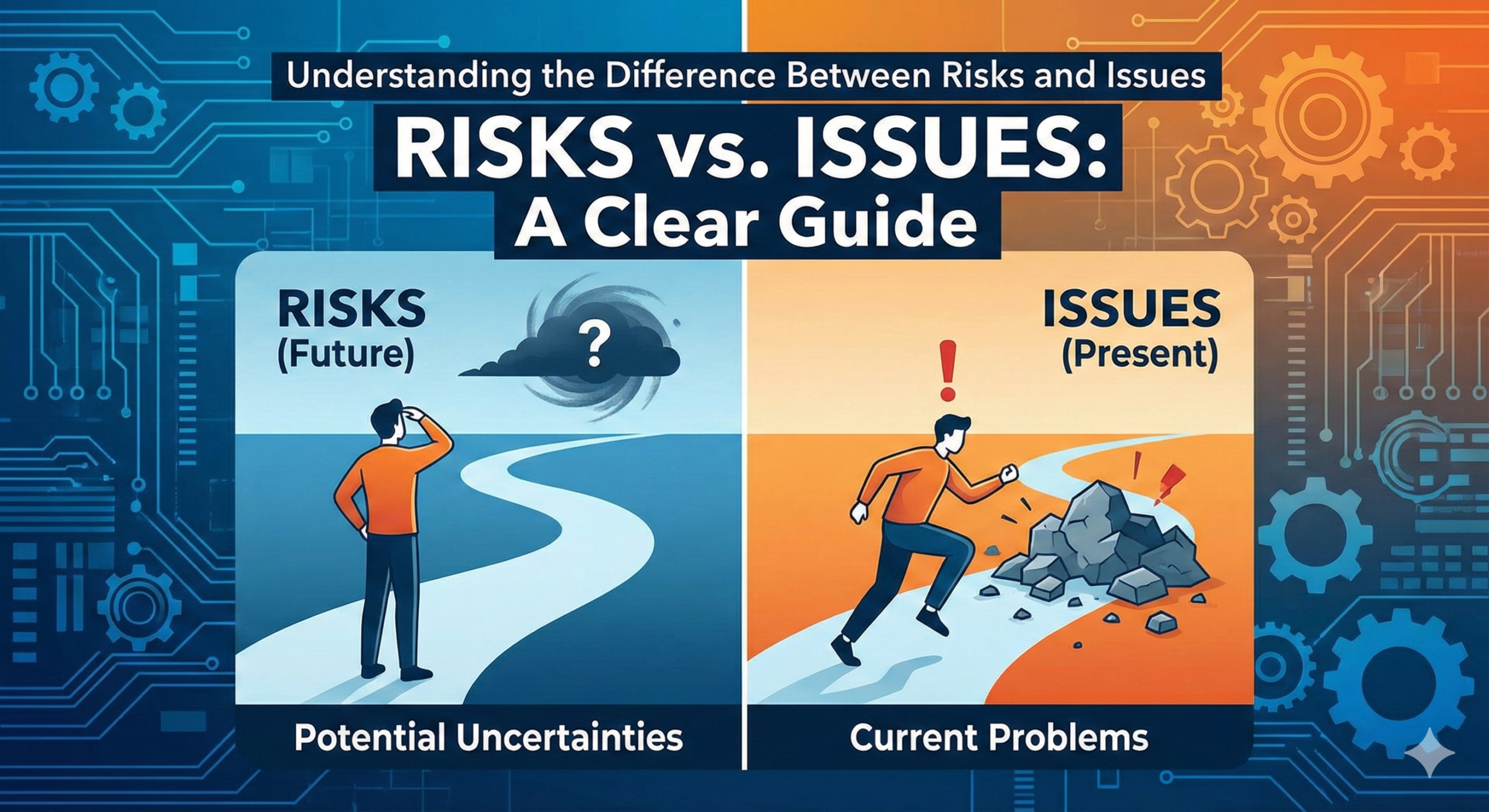
Understanding the Difference Between Risks and Issues
In business and daily life, the terms “risk” and “issue” are frequently used. However, it is not uncommon to see these terms used interchangeably. In reality, there is a clear distinction between risks and issues, and understanding this difference enables you to select more appropriate response strategies. This article explains the essential differences between risks and issues based on international standards such as ISO 31000, ISO 9001, and PMBOK, and discusses appropriate approaches for addressing each.
In business and daily life, the terms “risk” and “issue” are frequently used. However, it is not uncommon to see these terms used interchangeably. In …
In Simple Terms: The Difference in Time Axis
Let us first establish the most important point.
Risk = A problem that has not yet occurred (future possibility)
Issue = A problem that has already occurred (present reality)
This difference in time axis is the starting point for all other differences.
What is a Risk?
Definition in International Standards
Risk is defined in ISO 31000 (the international standard for risk management) as “the effect of uncertainty on objectives.” In simpler terms, it is “an undesirable event that may occur in the future.”
Understanding Through Concrete Examples
For example, the following are risks:
- “The launch of the new product next month may be delayed”
- “An important employee may resign”
- “We may suffer a cyberattack”
- “The factory may be damaged by a typhoon”
Note that all of these include the uncertainty of “may occur.”
Three Characteristics of Risk
Potential (not yet manifested): Risk is like the underwater portion of an iceberg. It is invisible, but it certainly exists.
Probabilistic (does not necessarily occur): Not all risks become reality. A risk with a 10% probability of occurrence means it happens only once in ten times.
Has impact (magnitude when it occurs): Even for the same “delay risk,” a one-day delay and a one-month delay have completely different magnitudes of impact.
What is an Issue?
Definition in Practice
An issue (referred to as “issue” or “problem” in English) is “an event that has already occurred and requires resolution.” It refers to a challenge that requires attention in the present progressive tense.
Understanding Through Concrete Examples
The following are issues:
- “The launch of the new product is delayed by two weeks”
- “Key person Mr./Ms. A resigned last month”
- “There was unauthorized access to the internal system yesterday”
- “The factory roof was damaged by the typhoon”
The key point is that all are confirmed facts of what “happened” or “is happening,” not “may happen.”
Three Characteristics of Issues
Manifested (already visible): An issue is the above-water portion of an iceberg. It is clearly visible to everyone.
Definite (100% occurred): No discussion of probability is necessary. It has already happened.
Requires immediate response: “We’ll deal with it someday” is not sufficient. Action must be taken right now.
Why This Difference is Important
Evaluation Methods Are Completely Different
Risk Evaluation: Thinking on Two Axes
Risks are evaluated by “probability of occurrence” × “impact.” This is called a risk matrix.
| Impact | Low Probability | Medium Probability | High Probability |
| High | Caution Required | Top Priority Response | Top Priority Response |
| Medium | Monitor | Caution Required | Caution Required |
| Low | Acceptable | Monitor | Caution Required |
Example: “Risk of Losing an Important Customer”
- Probability of occurrence: Low (approximately 1% per year based on past performance)
- Impact: High (accounts for 30% of sales)
- → Treated as a cautionary risk, implement regular relationship strengthening measures
Issue Evaluation: Thinking on Three Perspectives
Issues are evaluated from the following perspectives:
- Scope of impact: How many people or departments are affected?
- Urgency: By when must it be resolved?
- Difficulty of resolution: How many resources are required?
Example: “Production Line is Stopped”
- Scope of impact: Large (affects production of all products)
- Urgency: Maximum (losses expand every hour)
- Difficulty of resolution: Medium (can be addressed with parts replacement)
- → Form a response team with top priority
Difference in Response Methods: Four Strategies vs. CAPA
Risk Response: Four Strategies (ISO 31000, PMBOK Compliant)
Avoid: Stop the activity that causes the risk.
Example: Cancel a business trip to a dangerous area
Mitigate: Reduce the probability or impact of the risk.
Example: Introduce a backup system
Transfer: Move the risk to another party.
Example: Purchase insurance, outsource work
Accept: Consciously do nothing while recognizing the risk.
Example: Accept risks with extremely low probability of occurrence and small impact
Issue Response: CAPA (Corrective Action and Preventive Action)
CAPA is the standard problem-solving approach required by ISO 9001 and other standards.
Step 1: Root Cause Analysis
Why did the problem occur? Find the root cause through methods such as “5 Whys Analysis.”
Step 2: Corrective Action
Resolve the current problem. This is a firefighting response.
Step 3: Preventive Action
Ensure the same problem does not occur again. Improve systems and processes.
Step 4: Effectiveness Verification
Confirm whether the measures are truly effective.
Practical Example: Project Schedule Delay
Treating as Risk (not yet delayed):
“At this rate, there is a risk of not meeting next month’s deadline”
→ Response: Prepare to increase personnel (mitigation), prepare for deadline extension negotiations (mitigation)
Treating as Issue (already delayed):
“With only one week until the deadline, progress is only 70%”
→ Response: Form an emergency team (corrective action), improve future estimation methods (preventive action)
Common Mistakes and Correct Usage
Mistake 1: Treating a Risk as an Issue
Panicking and responding to the risk that “sales may decline” as if it has already happened leads to overreaction.
Mistake 2: Treating an Issue as a Risk
Taking a leisurely approach to the issue of “the system is down” as if it were a risk allows damage to expand.
Tips for Correct Usage
Ask yourself: “Has this already happened? Or is it something that may happen in the future?”
Practice in Organizations: The Two-Wheel Approach
Separate Risk Management Meetings from Problem-Solving Meetings
Many successful organizations clearly separate these two types of meetings.
Risk Management Meeting (monthly, etc.):
- Identify new risks
- Review status of existing risks
- Review countermeasures
Problem-Solving Meeting (as needed or weekly):
- Share occurred problems
- Confirm response status
- Examine recurrence prevention measures
Clear Distinction in ISO Standards
ISO 9001:2015 (Quality Management System) specifies:
- Clause 6.1: Actions to address risks and opportunities (future-oriented)
- Clause 10.2: Nonconformity and corrective action (addressing current problems)
as separate requirement items.
Summary: Both Prevention and Treatment Are Important
The difference between risks and issues is easy to understand when compared to medicine.
Risk management = Preventive medicine (measures to avoid getting sick)
Problem-solving = Therapeutic medicine (treatment to cure illness)
Both are necessary to maintain health. Similarly, both risk management and problem-solving are essential for the sound operation of organizations and projects.
What you should remember last is that “today’s risk can become tomorrow’s issue.” Prevent problems from occurring through appropriate risk management, and if problems do occur despite this, resolve them quickly. Acquiring this way of thinking leads to success in all situations.
Supplement: Risk is Not Necessarily Just “Bad Things”
In the definition of ISO 31000, risk includes “opportunities (favorable impacts)” as well. For example, “it may sell better than expected” is also a risk. However, in practice, “threats (negative impacts)” are primarily dealt with, so this article has explained from that perspective.
Related Articles
- Understanding the Difference Between Validation and Verification
- Understanding the Differences Between Correction, Corrective Action, and Preventive Action
- Understanding the Difference Between Computerized Systems and Computer Systems
- Understanding the Differences Between FDA Form 483 and Warning Letters: Issuance Processes and Corporate Impact
- Understanding the Difference Between “Design” and “Design Control” in Medical Devices
- Understanding the Difference Between Formative and Summative Assessment
