
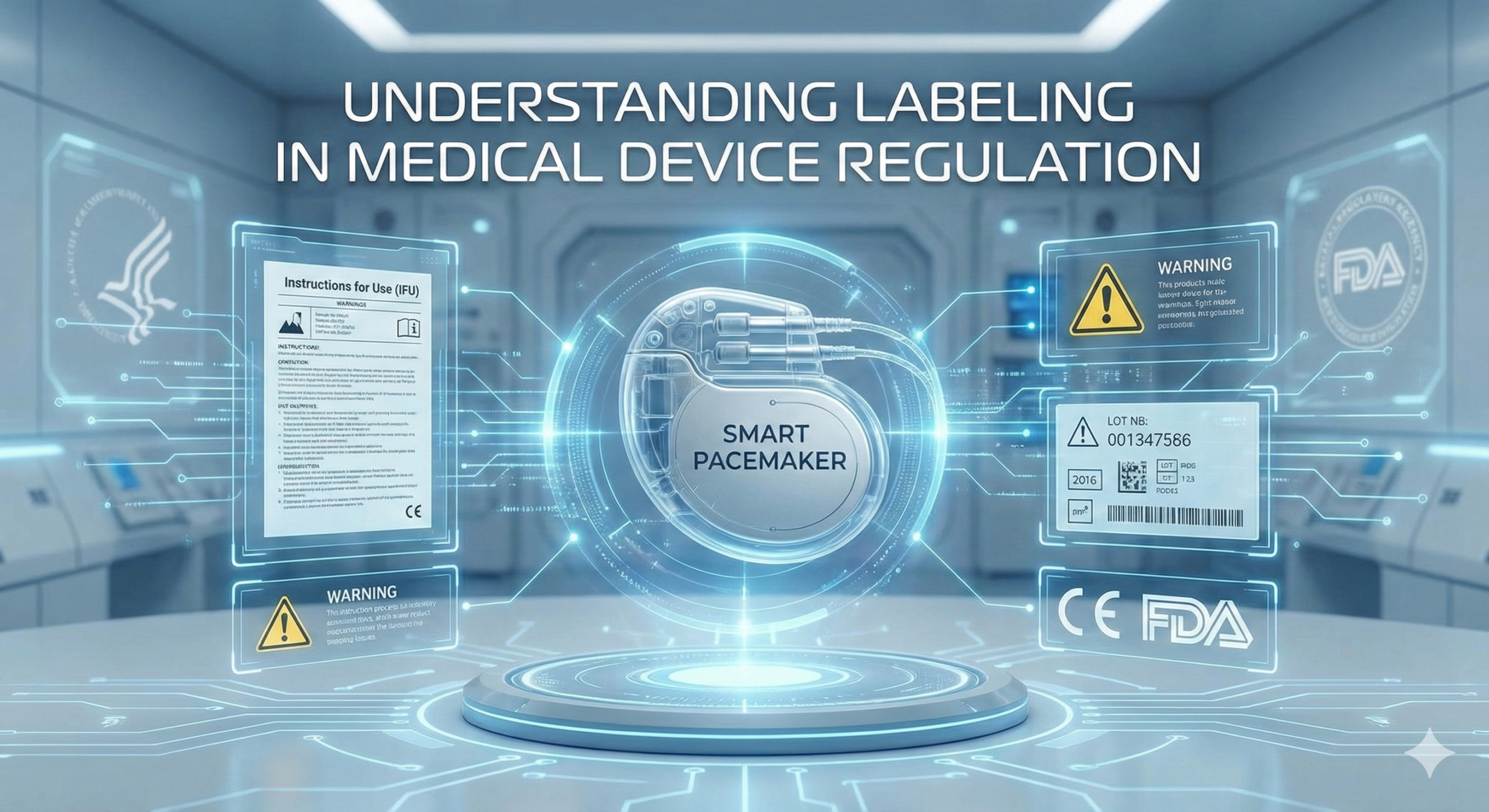
Understanding Labeling in Medical Device Regulation
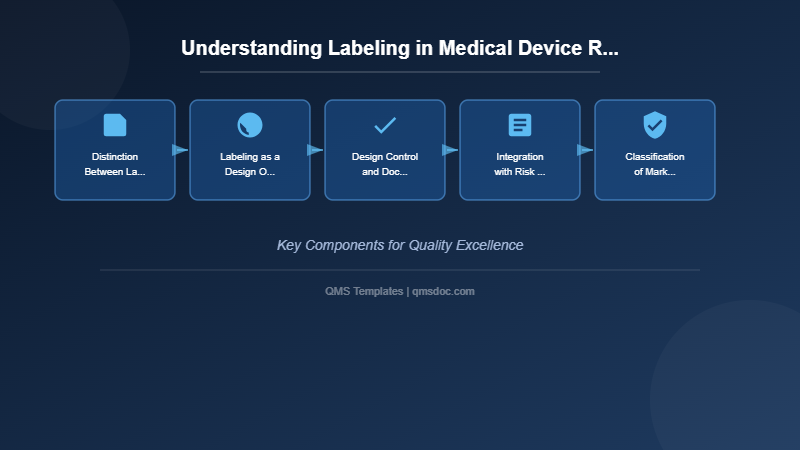
Distinction Between Label and Labeling
Label and labeling are distinct concepts, though a label is a component of labeling. Understanding this distinction is fundamental to medical device regulatory compliance.
Label and labeling are distinct concepts, though a label is a component of labeling. Understanding this distinction is fundamental to medical device r…
A label refers to the physical identification information affixed or printed directly on a medical device. Specifically, this includes the device designation (brand name, model name, serial number) and UDI (Unique Device Identifier) data carriers. Labels are typically affixed or printed on primary packaging or commercial packaging (secondary packaging).
Labeling, by contrast, encompasses all printed materials and written information that comes into contact with patients or users. The scope of labeling is far broader than physical labels alone and includes instructions for use (IFU), package inserts, text printed on packaging, user training materials, product catalogs, websites, instructional videos, and any other information accessible to users. This comprehensive definition reflects the understanding that all such materials can influence how patients and users employ the medical device.
Critically, inaccuracies or inappropriate statements in catalogs or website content pose the same risks as errors in instructions for use or package inserts. A misstatement regarding device performance, intended use, or operational procedures may cause patient harm regardless of the medium through which the information is conveyed. Consequently, all such information falls within the regulatory scope of labeling.
Labeling as a Design Output
Design Control and Documentation Requirements
Labeling must be treated as a formal output of the design development process and must undergo appropriate design review before being archived in the Design History File (DHF). This requirement derives from FDA 21 CFR Part 11 design control provisions, ISO 13485:2016 section 4.2.3 (design and development file requirements), and the technical documentation requirements specified in EC MDR (Medical Device Regulation) and IVDR (In Vitro Diagnostic Regulation).
Many organizations make the critical error of composing labeling content outside the formal design process, allowing marketing or sales departments to author materials independently. This practice fails to satisfy regulatory requirements and results in insufficient verification of safety and effectiveness claims. Effective labeling development requires active collaboration between the design function and all other departments involved in product description, with formal design review and approval being mandatory.
Integration with Risk Management
Labeling, particularly safety information, warnings, and precautions, must be based on the outputs of the risk management process as specified in ISO 14971. Labeling should reflect the results of risk analysis and risk evaluation, ensuring that users are aware of known hazards and can use the device appropriately. The relationship between risk management and labeling is bidirectional: risk analysis informs labeling requirements, while labeling effectiveness directly impacts risk mitigation.
Classification of Marketing and Promotional Content
One of the most challenging aspects of labeling compliance involves determining the boundary between advertising (promotional material) and regulatory labeling when content appears in catalogs or on websites.
As a general principle, content limited to product name, price, or general business information typically qualifies as advertising rather than labeling. However, when information regarding effectiveness, clinical benefits, diagnostic capabilities, operating instructions, performance characteristics, or clinical outcomes is included, the content likely constitutes labeling subject to regulatory requirements.
The digital transformation of commerce has particularly complicated this landscape. Product information presented on company websites, social media platforms, and online marketplaces is increasingly recognized as accessible labeling material subject to regulatory oversight. Both EU MDR and IVDR explicitly identify online-provided product information as labeling for regulatory purposes. Regulators expect manufacturers to maintain consistent, accurate, and compliant product information across all channels through which users may access such information, whether physical or digital.
Abbreviated User Manuals and Simplified Labeling
Abbreviated user manuals or simplified guides derived from comprehensive instructions for use constitute labeling. Such materials are provided to support user competency in the device’s initial operational stages and are accessible to users. They therefore satisfy the definition of labeling and must be managed accordingly.
Simplified manuals must be treated as design outputs and subject to formal design review before archive in the DHF. In practice, organizations sometimes permit their marketing or sales functions to independently author abbreviated manuals without design review and approval. This approach is non-compliant with regulatory expectations. Abbreviated manuals must be reviewed by the design function to verify accuracy, completeness, and appropriateness. Vague language, omission of critical information, or statements that may cause user misunderstanding directly contribute to use errors and can result in serious adverse events.
Usability Engineering and Design Validation
Comprehensive instructions for use, abbreviated manuals, and other materials related to the user interface may require design validation or, alternatively, summative evaluation as specified in IEC 62366-1:2015 (Application of usability engineering to medical devices). Such evaluation is particularly important when risk analysis identifies that ambiguous or incomplete labeling poses significant risk or when the user population demonstrates high diversity in terms of age, language ability, health literacy, or technical capability.
Summative evaluation with representative users confirms that labeling achieves its intended purpose across the full range of anticipated use conditions, user capabilities, and foreseeable misuses. This validation process ensures that labeling content supports patient and user safety across the realistic spectrum of device deployment and use.
Information Not Constituting Labeling
Not all printed material encountered by patients or users constitutes labeling. For example, shipping documents, packing lists, or delivery documentation do not constitute labeling because they do not provide information supporting safe and appropriate device use. The defining characteristic of labeling is whether the information functionally supports patient and user safety and effectiveness with the device.
Regulatory Landscape and Emerging Considerations
Recent regulatory guidance, particularly from the FDA, PMDA, and European regulatory authorities, increasingly emphasizes the comprehensive nature of labeling and its role within the broader quality management system. Regulatory expectations include that labeling be:
- Technically and clinically accurate based on available evidence
- Appropriately comprehensive, addressing known risks and required use conditions
- Accessible and intelligible to the intended user population
- Consistent across all channels and geographic regions in which the device is marketed
- Maintained under a document control system that ensures traceability and current regulatory compliance
Conclusion
Labeling represents a critical regulatory element supporting medical device safety and effectiveness. As a design output, labeling must be managed within the formal design control process, subjected to design review, and archived appropriately within the design history file. Effective labeling must be integrated with risk management and usability engineering processes to ensure that patients and users receive accurate, complete, and usable information supporting safe and effective device use. Given the increasing digitalization of product information and regulatory scrutiny of labeling consistency across channels, manufacturers must recognize that catalogs, websites, social media, and other digital platforms constitute regulatory labeling subject to the same control and documentation requirements as traditional physical labeling.
Related Articles
- Understanding Labels and Labeling: Regulatory Requirements for Medical Devices
- Understanding Part 11 in FDA Inspections: Key Considerations for Pharmaceutical and Medical Device Companies
- Preventive Action as Risk Management: Understanding CAPA in Pharmaceutical and Medical Device Industries
- Understanding FMEA in Pharmaceutical and Medical Device Industries
- Understanding Quality Systems in Pharmaceutical and Medical Device Industries
- Understanding Risk in Pharmaceuticals and Medical Devices
