
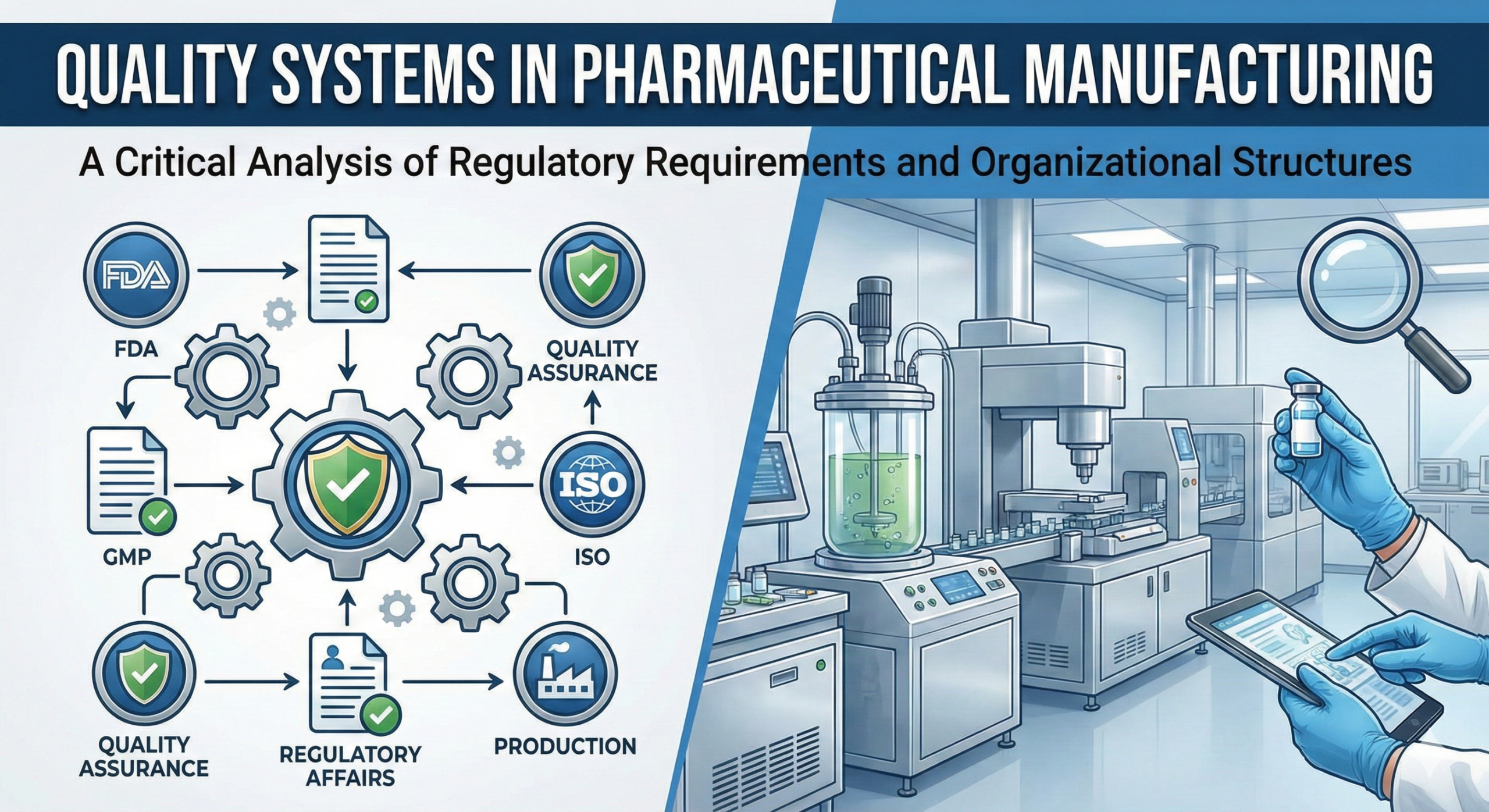
Quality Systems in Pharmaceutical Manufacturing: A Critical Analysis of Regulatory Requirements and Organizational Structures
Introduction
The revised Good Manufacturing Practice (GMP) Ministerial Ordinance in Japan requires pharmaceutical manufacturing sites to establish quality systems. However, the fundamental question arises: should quality systems truly be constructed on a per-manufacturing-site basis? This article examines the current regulatory landscape, international standards, and explores more optimal approaches to quality system implementation.
Key Takeaway: This article provides a comprehensive analysis of quality systems in pharmaceutical manufacturing: a critical analysis of regulatory requirements and organizational structures, covering essential requirements, best practices, and implementation strategies for pharmaceutical and medical device quality professionals.
The Manufacturing Authorization Holder (MAH) as the Core of Quality Systems
The Fundamental Principle
Quality systems should not be constructed solely at the manufacturing site level. Rather, the Manufacturing Authorization Holder (MAH) must establish comprehensive quality systems that encompass all manufacturing operations. This approach aligns with international best practices and regulatory expectations.
In Japan, the regulatory distinction between Manufacturing Authorization Holders (製造販売業者) and manufacturers (製造業者) creates unique challenges that are not present in other major pharmaceutical markets. This separation can lead to structural inefficiencies and unclear lines of responsibility within the quality management framework.
Lessons from Medical Device Regulations
The medical device sector in Japan provides an instructive example of regulatory evolution. Following the 2014 revision of the Quality Management System (QMS) Ministerial Ordinance for medical devices, MAHs became responsible for monitoring and supervising manufacturers. This revision brought several significant changes:
- Regulatory Status: Medical device manufacturers transitioned from a licensing system to a registration system, reflecting their changed role within the quality management hierarchy.
- Scope Expansion: The QMS Ministerial Ordinance, originally known as medical device GMP, was expanded to apply to MAHs as well as manufacturers, creating a more integrated quality management approach.
- Supervisory Framework: MAHs assumed direct responsibility for overseeing manufacturer compliance with quality requirements.
This integrated approach does not exist in the pharmaceutical sector, where GMP requirements primarily focus on manufacturing sites, and Good Quality Practice (GQP) requirements govern MAH quality management activities separately.
Organizational Challenges in Quality System Implementation
The Problem of Dual Corporate Structures
When the MAH and manufacturer are separate legal entities, or when they exist as divisions within the same corporation, significant organizational challenges emerge:
Management Authority Issues
In cases where manufacturing sites lack independent executive management, several critical problems arise:
- Quality Manual Development: Without senior management authority at the manufacturing site level, developing comprehensive quality manuals that align with corporate strategy becomes problematic.
- Quality Policy Establishment: Plant managers, who typically are not executive officers, may lack the authority to establish quality policies that truly reflect organizational commitment and strategic direction.
- Quality Objectives: Setting meaningful quality objectives requires understanding of business strategy and resource allocation authority that plant-level management may not possess.
- Management Review: The implementation of effective management reviews requires executive authority to make resource allocation decisions and strategic changes, which plant managers typically do not have.
Structural Comparison with Global Practices
| Aspect | Japan (Current Structure) | International Best Practice |
| Quality System Scope | Manufacturing site-focused | Enterprise-wide, MAH-centered |
| Management Authority | Often limited at site level | Clear executive oversight |
| Complaint Handling | MAH (GQP) separate from manufacturing | Integrated within quality system |
| Quality Policy | May be established at site level | Established by executive management |
| Management Review | Challenged by authority gaps | Conducted with full executive authority |
Complaint Handling: A Critical Divergence
Japanese Regulatory Framework
In Japan’s current system, complaint collection is primarily the responsibility of the MAH under GQP requirements. The manufacturer receives only “quality information” (品質情報) from the MAH as part of the information flow system. This creates a disconnect between:
- Direct market feedback (received by MAH)
- Manufacturing process knowledge (held by manufacturer)
- Root cause analysis and corrective action (requiring both perspectives)
Similarly, product recall activities are managed by the MAH under GQP provisions, with manufacturers playing a supporting rather than integrated role.
FDA Requirements: An Integrated Approach
The U.S. Food and Drug Administration (FDA) takes a fundamentally different approach through 21 CFR Part 211 §211.198 “Complaint Files.” This regulation requires:
Key Requirements of 21 CFR 211.198:
- Written Procedures: Establishments must have written procedures for handling all written and oral complaints regarding drug products.
- Quality Control Unit Review: Complaints involving possible failure to meet specifications must be reviewed by the quality control unit.
- Investigation Determination: The quality control unit must determine whether investigation under §211.192 is necessary.
- Adverse Event Screening: Procedures must include provisions to identify complaints representing serious and unexpected adverse drug experiences requiring FDA reporting.
- Record Maintenance: Complaint files must be maintained at the manufacturing establishment (or at another facility with readily available access).
- Record Content: Written records must include the drug product name and strength, lot number, complainant name, complaint nature, and reply to complainant.
- Investigation Records: When investigations are conducted, findings and follow-up must be documented and maintained.
- Retention Period: Records must be retained for at least one year after the product expiration date or one year after complaint receipt, whichever is longer.
Critical Differences and Implications
The structural differences between Japanese and U.S. regulatory frameworks have significant practical implications:
| Aspect | Japan (GQP/GMP) | United States (21 CFR 211) |
| Primary Responsibility | MAH (GQP Province) | Manufacturing Establishment |
| Manufacturer Role | Receives “quality information” | Direct complaint handling |
| Integration | Separate GQP and GMP systems | Integrated within cGMP |
| Investigation Authority | Divided between MAH and manufacturer | Manufacturing site authority |
| Procedure Location | Primarily in GQP manual | Part of cGMP requirements |
These differences require careful attention when developing procedures for companies operating in both jurisdictions. A company cannot simply translate Japanese GQP procedures into English and expect FDA compliance, nor can U.S. procedures be directly adopted in Japan without considering GQP requirements.
ICH Q10: The Comprehensive Quality System Vision
Scope Beyond Traditional GMP
The ICH Q10 “Pharmaceutical Quality System” guideline presents a holistic vision that extends beyond conventional GMP boundaries. ICH Q10 explicitly includes:
- Pharmaceutical Development: Integration of quality-by-design principles from early development stages
- Technology Transfer: Systematic approaches to transferring manufacturing processes between sites or from development to commercial production
- Commercial Manufacturing: Traditional GMP operations
- Product Discontinuation: End-of-lifecycle considerations
This comprehensive scope aligns with Good Distribution Practice (GDP) and overlaps significantly with GQP requirements in the Japanese system, though the integration approach differs.
The ICH Q10 Quality System Model
ICH Q10 describes a quality system that:
- Provides a framework for managing product quality throughout the product lifecycle
- Emphasizes the importance of senior management leadership and responsibility
- Promotes continual improvement and corrective and preventive actions (CAPA)
- Facilitates innovation and continual improvement
- Strengthens the link between pharmaceutical development and manufacturing activities
The Ideal Quality System Architecture
Comprehensive MAH-Centered Approach
Based on international standards and best practices, the optimal quality system architecture should be:
Manufacturing Authorization Holder (MAH) as the Central Hub
The MAH should establish and maintain an enterprise-wide quality system that encompasses:
- Pharmaceutical Development (Early research through clinical development)
- Quality-by-design principles
- Development risk management
- Control strategy development
- Technology Transfer and Chemistry, Manufacturing, and Controls (CMC)
- Process validation
- Analytical method transfer
- Scale-up activities
- Commercial manufacturing preparation
- Manufacturing Operations (GMP)
- Process control
- In-process monitoring
- Batch release
- Equipment qualification
- Distribution (GDP – Good Distribution Practice)
- Storage conditions maintenance
- Transportation controls
- Chain of custody
- Temperature monitoring
- Market Quality Monitoring (GQP in Japanese system)
- Complaint handling and investigation
- Trend analysis
- Market surveillance
- Customer feedback integration
- Post-Market Safety Surveillance (GVP – Good Vigilance Practice)
- Adverse event monitoring
- Safety signal detection
- Risk-benefit assessment
- Regulatory reporting
Organizational Structure Requirements
To effectively implement this comprehensive quality system, organizations need:
Executive Management Engagement
- Quality Policy: Established by executive leadership, reflecting organizational values and strategic objectives
- Resource Allocation: Senior management commitment to providing adequate resources
- Management Review: Regular executive-level review of quality system performance and effectiveness
- Authority: Clear delegation of authority with accountability
Integrated Quality Organization
Rather than separate GQP and GMP functions, organizations should consider:
- Unified quality leadership reporting to executive management
- Matrix management for site-specific and enterprise-wide quality functions
- Clear interfaces between development, manufacturing, and commercial operations
- Integrated data systems enabling enterprise-wide quality trending and analysis
Information Flow Architecture
An effective quality system requires seamless information flow:
Market/Customers → Complaint Management → Investigation → Root Cause Analysis → CAPA → Monitoring
↓ ↓ ↓ ↓ ↓ ↓
GVP/Safety GQP/Quality Manufacturing Development Management Effectiveness
Surveillance Assurance Quality Input Review Verification
Recommendations for Implementation
For Organizations with Separated MAH and Manufacturing Functions
- Establish Clear Governance: Create formal governance structures with defined authorities and responsibilities across the MAH-manufacturer interface
- Integrate Quality Systems: While maintaining regulatory compliance with separate GQP and GMP requirements, develop integrated quality system documentation and procedures
- Unified Quality Leadership: Consider matrix organizational structures where quality personnel have dual reporting relationships
- Information Systems Integration: Implement quality management information systems that provide seamless visibility across MAH and manufacturing operations
- Joint Management Review: Conduct integrated management reviews that evaluate the entire quality system, not just site-specific GMP compliance
For Global Organizations
- Risk-Based Harmonization: Develop procedures that meet the most stringent requirements (often FDA) while maintaining Japanese regulatory compliance
- Complaint Handling: Implement complaint handling systems that satisfy both 21 CFR 211.198 requirements and Japanese GQP requirements
- Documentation Strategy: Maintain master procedures at the enterprise level with site-specific implementation procedures
- Training and Competency: Ensure personnel understand both GQP and GMP requirements and how they interact
For Regulatory Authorities and Industry Associations
- Regulatory Modernization: Consider whether the Japanese regulatory separation of MAH (GQP) and manufacturer (GMP) requirements continues to serve patient safety and product quality optimally
- Industry Guidance: Develop detailed guidance on implementing integrated quality systems that comply with current Japanese regulations while preparing for potential future regulatory convergence
- International Harmonization: Continue efforts to harmonize Japanese requirements with ICH guidelines, PIC/S standards, and FDA regulations
Conclusion
While the revised Japanese GMP Ministerial Ordinance requires manufacturing sites to establish quality systems, this site-centric approach has inherent limitations. The optimal architecture for pharmaceutical quality systems places the Manufacturing Authorization Holder at the center of an integrated quality system that encompasses the entire product lifecycle—from development through post-market surveillance.
The medical device regulatory model in Japan, where MAHs assume supervisory responsibility over manufacturers, demonstrates a more integrated approach. Similarly, FDA’s requirements under 21 CFR Part 211 §211.198 for complaint handling at manufacturing establishments reflect an integrated quality system philosophy.
ICH Q10 provides the conceptual framework for comprehensive quality systems that extend beyond traditional GMP to include development, technology transfer, distribution, and market quality monitoring. This vision aligns with the principle that quality systems should be comprehensive, MAH-centered, and fully integrated across all aspects of the pharmaceutical product lifecycle.
Organizations should strive to implement quality systems that, while complying with current regulatory requirements, embody these principles of integration, executive management oversight, and comprehensive lifecycle coverage. Such systems not only ensure regulatory compliance but also deliver superior product quality and patient safety outcomes.
Key Takeaways
- Quality systems should be MAH-centered, not limited to manufacturing site level
- The separation of MAH and manufacturer creates unique challenges in Japan’s regulatory framework
- Medical device regulations in Japan provide a model for MAH supervisory responsibility
- FDA requirements for complaint handling differ fundamentally from Japanese GQP requirements
- ICH Q10 envisions comprehensive quality systems spanning the entire product lifecycle
- Organizations should implement integrated quality systems that encompass development, manufacturing, distribution, and market surveillance
- Effective quality systems require executive management engagement, not just plant-level management
- Global companies must navigate different regulatory frameworks while maintaining integrated quality approaches
Related Articles
- The Nature and Approach of Regulatory Requirements in Pharmaceutical Manufacturing
- Understanding Self-Inspection in Pharmaceutical Quality Management: A Comparative Analysis of Global Regulatory Approaches
- Issuance of Administrative Notice on Manufacturing and Quality Management Systems for Pharmaceutical Manufacturers
- Proper Japanese Translation of “Review” in Medical Device Regulatory Requirements: Clarifying Terminology in Quality Management Systems
- Data Analysis in Medical Device and Pharmaceutical Quality Management Systems
- Manufacturing and Quality Control Systems at Pharmaceutical Manufacturers
Related FDA QMSR Templates
Streamline your FDA QMSR compliance with our professionally crafted templates:

Comment