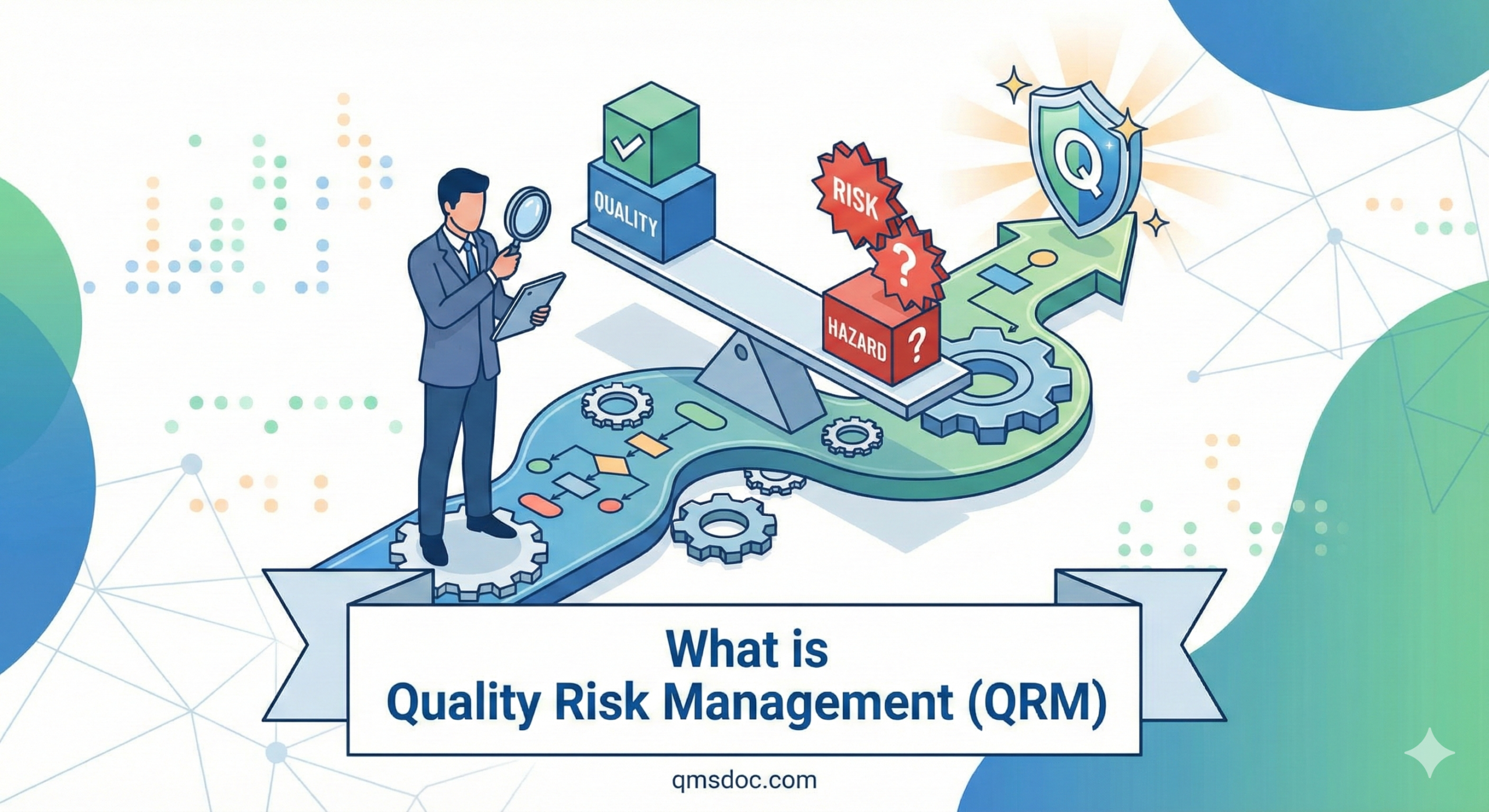
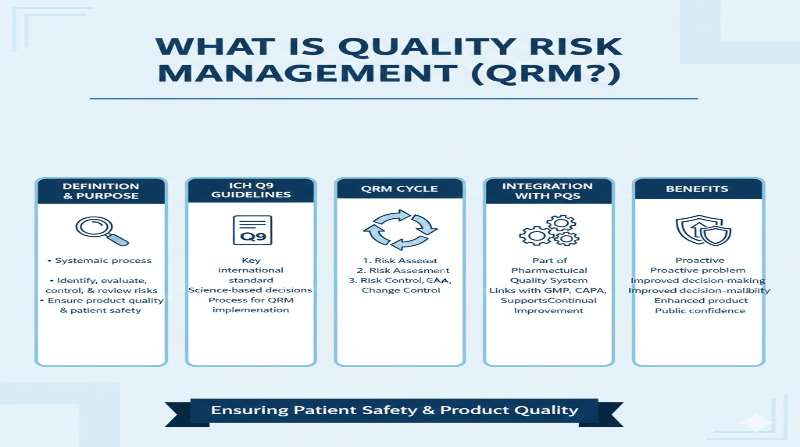
What is Quality Risk Management (QRM)?
Basic Concepts of Risk Management and Differences Between Pharmaceuticals and Medical Devices
Risk management approaches in healthcare differ fundamentally between pharmaceuticals and medical devices. Understanding this distinction is crucial for establishing an appropriate quality assurance framework.
Risk management for medical devices is implemented based on ISO 14971:2019 “Medical devices—Application of risk management to medical devices.” This international standard aims to directly assess and manage health risks to patients, healthcare professionals, and others throughout the medical device lifecycle. Since medical devices directly affect patients or users, it is possible to identify hazards caused by device failures or malfunctions and quantify risks by evaluating their probability of occurrence and severity. This process is relatively direct, making it easier to predict health hazards resulting from device use.
In contrast, “Quality Risk Management” (QRM) is applied to pharmaceuticals. This is based on ICH Q9(R1) “Quality Risk Management Guideline” (revised August 31, 2023), which establishes a systematic process implemented throughout the pharmaceutical product lifecycle. The fundamental difference between pharmaceutical QRM and medical device risk management is that the pharmaceutical approach is indirect.
Characteristics of QRM in Pharmaceuticals: Indirect Risk Assessment
In pharmaceutical QRM, when product quality defects arise due to equipment failures, deviations, or human errors in the manufacturing process, it is necessary to estimate what health hazards might occur to patients through these quality defects. In other words, indirect risk assessment is required through multiple stages: “manufacturing process problems” → “product quality defects” → “patient health hazards.”
For example, consider a case where foreign matter contaminates the manufacturing process. The health hazards this contamination might cause to patients depend on numerous factors: the nature of the foreign matter (metal fragments, glass particles, microorganisms, etc.), size, contamination amount, product administration route (oral, injection, etc.), and patient condition. Foreign matter contamination can result in various degrees of health hazards, from minor discomfort to gastrointestinal damage, infections, and in the worst cases, death. This assessment requires not only pharmaceutical and medical expertise but also a deep understanding of the manufacturing process.
Similarly, when temperature control deviations in the manufacturing process cause degradation of active ingredients, complex evaluations are required to determine how the degree of degradation affects patient therapeutic efficacy and whether degradation products may be toxic. A 10% content reduction may lead to insufficient therapeutic effects and symptom deterioration, while a 50% reduction may render the product nearly ineffective, potentially causing serious health hazards.
Thus, risk estimation in pharmaceutical QRM is extremely complex and difficult. A crucial point is that pharmaceutical risks cannot actually be tested. Ethically, it is not permissible to intentionally contaminate products with foreign matter or administer degraded pharmaceuticals to patients to verify health hazards. Therefore, it is necessary to infer risks by comprehensively evaluating all available information, including scientific evidence, literature information, past cases, and in vitro test data.
The Essence of QRM: A Knowledge Management Approach
Due to this characteristic, quality risk management inherently possesses aspects of knowledge management. ICH Q9(R1) defines quality risk management as “the continuous identification, assessment, and management of events that may adversely affect quality and their probability of occurrence (quality risks) for pharmaceutical products.” Importantly, this assessment must be conducted continuously from before commercial production begins until commercial production ends.
To effectively implement QRM, it is necessary to systematically collect and utilize diverse scientific evidence, including:
- Data on relationships between quality characteristics and clinical efficacy obtained during product development
- Past manufacturing trouble cases and their impact assessments
- Quality problem reports for similar products in scientific literature
- Regulatory authority guidance documents and warning letters
- Knowledge and best practices shared by industry associations
- Manufacturing process validation data
- Stability study data and information on temporal changes in product quality
- Post-market product quality monitoring data
- Health hazard reports and quality defect information for similar products
By systematically aggregating this information and sharing it within the organization, risk assessment based on sufficient scientific evidence becomes possible.
ICH Q9(R1) Revision and Latest Regulatory Trends
ICH Q9 was first established in 2006 but reached Step 4 of the ICH Process in January 2023, and the revised version was issued in Japan on August 31, 2023 (Notification No. Yakuseiyakushin-hatsu 0831 No. 1 / Yakuseikanma-hatsu 0831 No. 2 dated August 31, 2023). This revised version (R1) addresses four major topics that had been challenging:
- Formality in Quality Risk Management: The importance of appropriately adjusting the level of effort, formality, and documentation in the QRM process according to the risk level has been clarified. It is not necessary to conduct excessively detailed analysis for all risks; a rational approach commensurate with the magnitude of risk is recommended.
- Risk-based Decision Making: The concept of making better, scientifically-based decisions based on information obtained through QRM has been strengthened. Rather than merely conducting risk assessments, utilizing the results in actual decision-making is emphasized.
- Managing and Minimizing Subjectivity: Methodologies for recognizing and minimizing the impact of subjectivity (bias) in risk assessment have been added. Evaluation by multiple experts, establishment of clear evaluation criteria, and consideration of different stakeholder opinions are recommended.
- Addressing Product Supply Risks: The role of QRM in addressing product supply risks arising from quality and manufacturing issues has been newly emphasized. The importance of risk management in supply chain management, supplier assessment, and manufacturing capacity evaluation has been clarified.
The revised version also encourages the use of digital tools and predictive analytics, promoting advanced risk monitoring using statistical methods such as CUSUM control charts and weighted moving averages.
GMP Ministerial Ordinance Revision and QRM Legalization
In Japan, the “Ministerial Ordinance on Standards for Manufacturing Control and Quality Control for Drugs and Quasi-drugs” (GMP Ministerial Ordinance) was revised on April 28, 2021 (Ministry of Health, Labour and Welfare Ordinance No. 90 of 2021) and came into force on August 1, 2021. A major objective of this revised GMP Ministerial Ordinance was to harmonize with the PIC/S (Pharmaceutical Inspection Co-operation Scheme) Guidelines and ICH Q10 “Pharmaceutical Quality System Guideline.”
Article 3-4 of the revised GMP Ministerial Ordinance clearly stipulates quality risk management, and the following requirements have been legislated:
“Manufacturing operators must construct a pharmaceutical quality system utilizing quality risk management and conduct manufacturing control and quality control at the manufacturing site for pharmaceutical products.”
This provision makes QRM not merely a recommendation but a legal requirement for compliance. Specifically, manufacturers are required to:
- Designation of Quality Risk Management Responsible Person: It is necessary to designate in advance a staff member familiar with quality risk management as the responsible person and clearly document their responsibilities and authority. This responsible person requires pharmaceutical and medical expertise to infer what health hazards might occur to patients when pharmaceutical quality defects arise due to deviations in manufacturing or testing.
- Incorporation into Procedures: In the various procedures stipulated in Article 8, Paragraph 1 of the GMP Ministerial Ordinance (manufacturing control, quality control, facility and equipment management, hygiene management, etc.), it is necessary to appropriately incorporate the concept of quality risk management. Each procedure must specify anticipated risks and their management methods, and reflect risk assessment concepts in deviation response procedures.
- Construction of Pharmaceutical Quality System: Quality risk management is positioned as the foundation of the Pharmaceutical Quality System (PQS). It is required to utilize QRM principles and methods in each element of the pharmaceutical quality system, including Product Quality Review, Change Control, Deviation Management, Corrective and Preventive Actions (CAPA), and Management Review.
Practical Challenges and Responses
With the implementation of the revised GMP Ministerial Ordinance, many manufacturers face challenges in implementing QRM. Particularly in small and medium-sized manufacturing sites, securing personnel with pharmaceutical and medical expertise can be difficult. In such cases, it is recommended to cooperate closely with the development and quality assurance departments of marketing authorization holders to share necessary knowledge and information.
What is important in implementing QRM is not ending with formal risk assessment but substantively reducing risks and ensuring product quality and patient safety. For this purpose, the following practical approaches are effective:
Risk Assessment Implementation Structure: Establish a team composed of members with diverse expertise from manufacturing, quality control, quality assurance, and development departments to evaluate risks from multiple perspectives. It is important to hold regular risk review meetings and continuously reflect new information and knowledge.
Selection of Risk Assessment Methods: Appendices to ICH Q9(R1) describe various risk assessment tools, including FMEA (Failure Mode and Effects Analysis), FMECA (Failure Mode, Effects, and Criticality Analysis), FTA (Fault Tree Analysis), HACCP (Hazard Analysis and Critical Control Points), and PHA (Preliminary Hazard Analysis). It is recommended to select appropriate methods according to product and process characteristics, available resources, and the nature of risks. There is no need to adhere to a single method; combining multiple methods according to circumstances can also be effective.
Risk Communication: It is important to clearly share risk assessment results and the rationale for decisions based on them among stakeholders. When parties in different positions—manufacturing sites, quality departments, and management—have common understanding, effective risk management becomes possible.
Continuous Improvement: QRM is not completed once implemented but must be conducted continuously throughout the product lifecycle. By periodically reviewing post-market information, manufacturing performance, change control results, and updating risk assessments, more sophisticated risk management can be achieved.
International Regulatory Harmonization and Future Prospects
Quality risk management plays a central role in international harmonization of pharmaceutical regulations. The revised version of ICH Q9 is being sequentially implemented not only in Japan but also in the United States, EU, and other ICH member countries and regions, advancing global regulatory harmonization.
In PIC/S Guidelines, ICH Q10 has been incorporated as Annex 20, further emphasizing the importance of QRM. Japan joined PIC/S in July 2014, requiring the construction of GMP management systems compliant with international standards.
Going forward, with advances in digital technology, development of more sophisticated risk assessment methods utilizing big data analysis, artificial intelligence (AI), and machine learning is also expected. Real-time monitoring and predictive analysis of manufacturing data may enable early detection of risks and preventive measures.
Furthermore, the COVID-19 pandemic has renewed recognition of the importance of ensuring stable pharmaceutical supply. In addition to conventional product quality risks, addressing supply risks, including risk management across the entire supply chain, supplier assessment, and securing alternative supply sources, has become an important challenge.
Conclusion
Quality Risk Management (QRM) is characterized by indirect risk assessment through pharmaceutical quality and requires a knowledge management approach based on scientific evidence. With the revised GMP Ministerial Ordinance implemented in August 2021, QRM has been clearly positioned as a legal requirement, and each manufacturing site is required to appropriately incorporate the concept of quality risk management into procedures and implement substantive risk reduction activities.
The revised ICH Q9(R1) in 2023 has strengthened guidance on practical issues including formality, risk-based decision making, managing subjectivity, and supply risks. Based on these latest international guidelines and Japanese regulatory requirements, establishing an effective quality risk management system based on scientific evidence has become an important responsibility of pharmaceutical companies.
QRM is not merely compliance but a powerful tool for achieving product quality improvement and patient safety. By understanding the importance of QRM throughout the organization and continuously improving it, it becomes possible to provide higher quality and safer pharmaceuticals to patients.
Related Articles
- The Necessity of Risk-Based Approach
- Quality Risk Management: Understanding ICH Q9 and the Revised GMP Regulations
- Quality Risk Management in the Pharmaceutical Industry
- Tips for Risk Management
- Understanding Risk Assessment in Pharmaceutical Quality Management
Related FDA QMSR Templates
Streamline your FDA QMSR compliance with our professionally crafted templates: