Revision of Japan’s GMP Ministerial Ordinance
Background and Overview of the Revision
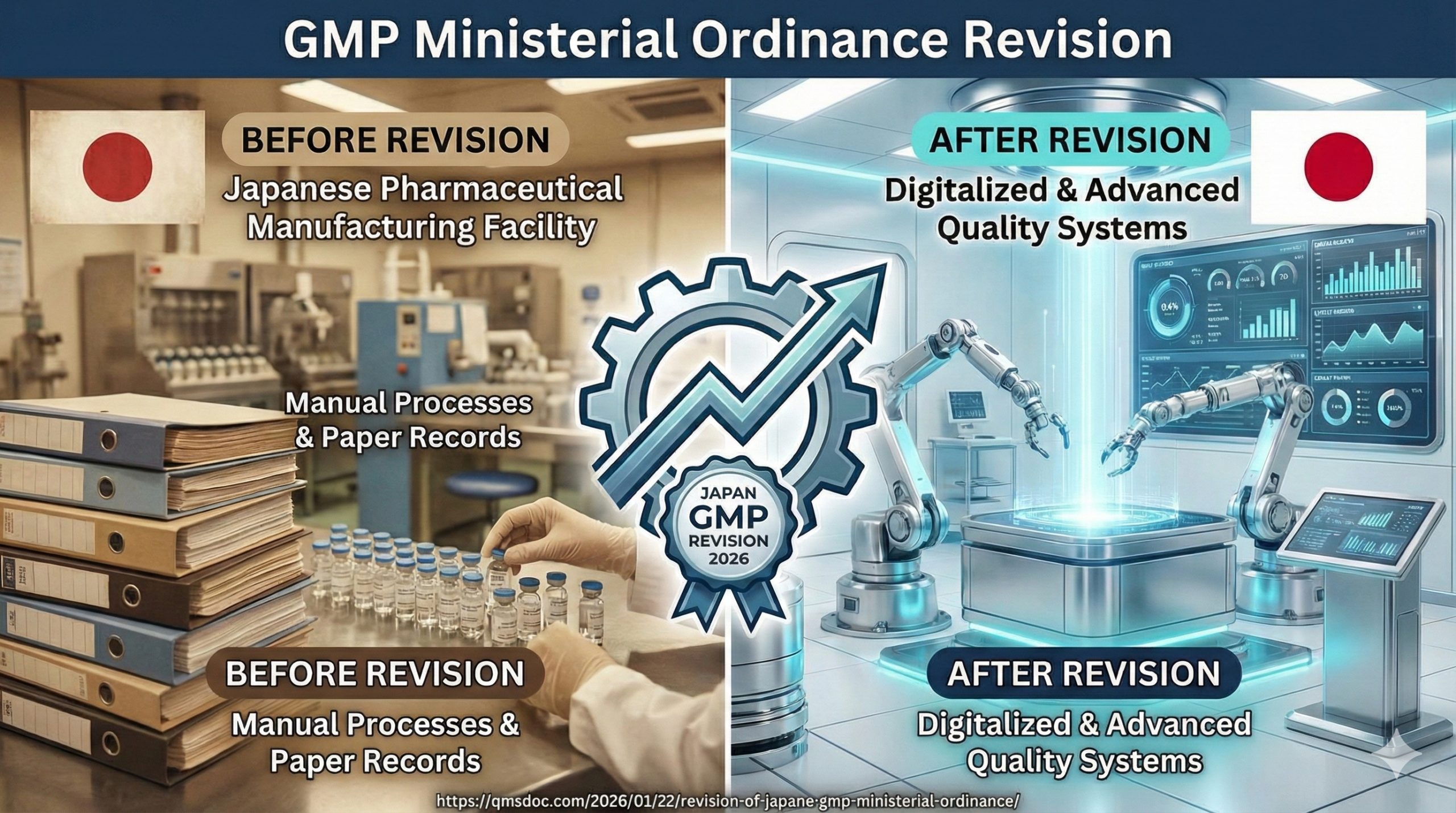
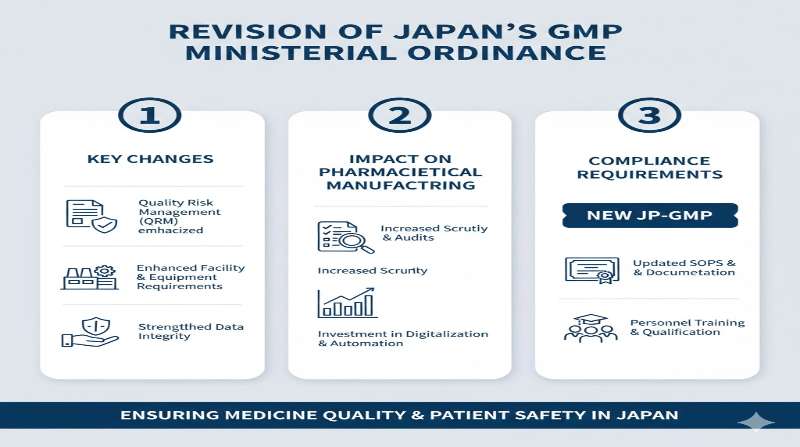
In Japan, the revision of the “Ministerial Ordinance on Standards for Manufacturing Control and Quality Control for Drugs and Quasi-drugs” (GMP Ministerial Ordinance) was promulgated on April 28, 2021, and came into effect on August 1, 2021. This marked the first major revision in 16 years. The primary objectives of this revision were to achieve international harmonization with the GMP Guidelines of the Pharmaceutical Inspection Convention and Pharmaceutical Inspection Co-operation Scheme (PIC/S) and to ensure consistency with the guidelines of the International Council for Harmonisation of Technical Requirements for Pharmaceuticals for Human Use (ICH).
💡 日本のGMP省令改正は、国際整合性の向上とデータインテグリティ要件の強化を目的としています。
Japan joined PIC/S in 2014 and became an official member in July 2015. Consequently, the establishment of manufacturing control and quality control systems compliant with international standards became mandatory. The revised GMP Ministerial Ordinance aims to enhance the international competitiveness of Japan’s pharmaceutical industry while further ensuring the safety and quality of pharmaceuticals for patients as part of the global pharmaceutical quality assurance system.
Key Additional Requirements of the Revised GMP Ministerial Ordinance
The revised GMP Ministerial Ordinance introduced or clarified the following requirements:
| Item | Main Content |
| 1. Pharmaceutical Quality System (PQS) | Establishment of a quality system based on ICH Q10. Clarification of senior management involvement and responsibilities |
| 2. Strict Compliance with Approved Matters | Obligation for manufacturers to understand approved applications and communicate with marketing authorization holders |
| 3. Incorporation of Key PIC/S GMP Guideline Items | Ensuring consistency with international standards |
| 4. Establishment of Quality Assurance (QA) Organization | Clarification of roles and responsibilities of the QA department |
| 5. Quality Risk Management (QRM) | Introduction of risk-based approaches based on ICH Q9 |
| 6. Enhanced Communication and Collaboration with Marketing Authorization Holders | Establishment of information sharing systems regarding GMP compliance |
| 7. Provisions for Shared Equipment | Appropriate management to prevent cross-contamination |
| 8. Data Integrity (DI) | Clarification of requirements for ensuring data reliability |
| 9. Storage Requirements for Reference and Retention Samples | Clarification of storage of reference samples of raw materials/materials and retention samples of products |
| 10. Product Quality Review (PQR) | Implementation of periodic quality reviews |
| 11. Stability Monitoring | Implementation of ongoing stability monitoring programs |
| 12. Supplier Management for Raw Materials | Strengthening of supply chain management |
Definition of Terms and Harmonization with ICH Q10
In the revised ordinance, the definitions of terms have been harmonized with ICH Q10 (Guideline on Pharmaceutical Quality System). Specifically, the following terms have been added to Article 2 (Definitions):
Newly Defined Key Terms:
- Pharmaceutical Quality System (PQS)
- Senior Management
- Corrective Action (CA)
- Preventive Action (PA)
- Quality
These terms promote common understanding in international pharmaceutical regulation and support the establishment of a global quality assurance system.
Understanding the Pharmaceutical Quality System (PQS)
The concept of “Pharmaceutical Quality System” may be an unfamiliar term in traditional Japanese GMP practices. However, it represents a critical framework for pharmaceutical quality assurance.
A Quality System (QS) is referred to as a Quality Management System (QMS) in ISO 9001. The foundation of a quality system is the PDCA cycle (Plan-Do-Check-Act). By continuously executing this cycle—planning (Plan), implementing (Do), evaluating results (Check), and taking improvement measures (Act)—quality is maintained and improved.
Role of Senior Management in the Pharmaceutical Quality System
One of the most important features of the pharmaceutical quality system is that active involvement of senior management (top management) is required. This represents a paradigm shift from the traditional concept of “GMP compliance at the manufacturing site level” to “quality assurance at the entire corporate level.”
Specific Responsibilities Required of Senior Management:
- Establishment and Implementation of the Pharmaceutical Quality System: Senior management is responsible for establishing an organization-wide quality system and ensuring its effectiveness. This includes the allocation of appropriate resources (personnel, facilities, budget).
- Development of Quality Policy: Clarify the organization’s commitment to quality and establish quality objectives.
- Conduct of Management Reviews: Senior management must periodically conduct management reviews to evaluate the suitability, adequacy, and effectiveness of the pharmaceutical quality system. Based on these reviews, system modifications and improvements should be made as necessary.
- Promotion of Continual Improvement: Promote continuous quality improvement throughout the pharmaceutical lifecycle (development, technology transfer, commercial manufacturing, product discontinuation).
Role of the Quality Assurance (QA) Department and CAPA
The Quality Assurance department plays a crucial role in implementing continuous quality improvement through Corrective Action and Preventive Action (CAPA).
Understanding CAPA:
One of the major challenges in responding to the revised GMP Ministerial Ordinance for Japanese companies is the insufficient understanding of the CAPA concept.
- Corrective Action (CA): Measures to eliminate the causes of detected nonconformities or other undesirable events and prevent recurrence. This addresses problems that have already occurred.
- Preventive Action (PA): Measures to eliminate the causes of potential nonconformities or other undesirable potential events and prevent their occurrence. This prevents problems that have not yet occurred but may occur.
CAPA is not merely problem response but should be a systematic process implemented based on data analysis, trend analysis, and risk assessment in conjunction with Quality Risk Management (ICH Q9).
Essence of GMP and Relationship with the ICH Q Trio
Good Manufacturing Practice (GMP) is fundamentally the “Standards for Manufacturing Control and Quality Control for Drugs and Quasi-drugs.” In other words, GMP is merely a “standard.”
The traditional GMP Ministerial Ordinance did not sufficiently include the following three important concepts:
- Systematic approach to Quality Control
- Quality Risk Management
- Comprehensive system of Quality Assurance
To complement these concepts, a series of guidelines known as the ICH Q Trio was developed.
Composition of the ICH Q Trio:
| Guideline | Title | Main Content |
| ICH Q8 | Pharmaceutical Development | Concept of Quality by Design (QbD). Pharmaceutical development based on scientific understanding and risk assessment |
| ICH Q9 | Quality Risk Management | Systematic implementation methods of risk-based approaches |
| ICH Q10 | Pharmaceutical Quality System | Comprehensive quality management system throughout the product lifecycle |
Until now in Japan, the ICH Q Trio has been issued as “Division Director Notifications” rather than ministerial ordinances. Division Director Notifications, unlike legally binding ministerial ordinances, were merely guidance-oriented. With this revision, these concepts have been incorporated into the main body of the GMP Ministerial Ordinance, thus clarifying them as legal requirements.
Challenges Faced by Japanese Companies
Japanese pharmaceutical companies face the following challenges:
- Lack of Familiarity with Quality Management Standards such as ISO 9001: Many companies lack personnel who are well-versed in ISO 9001 requirements and quality management system concepts.
- Lack of Established Quality Manuals: Currently, few companies have established systematic quality manuals compliant with ISO 9001. A quality manual is a top-level document that comprehensively describes senior management’s commitment to quality, quality policy, organizational roles and responsibilities, and key processes.
- Lack of Essential Understanding of Pharmaceutical Quality Systems: In the future, many pharmaceutical company employees and former employees (retirees) will likely offer seminars and publish books on the revised GMP Ministerial Ordinance. However, experts who truly understand the essence of “pharmaceutical quality systems” and can establish effective systems are limited.
Global Trends and ICH Q10
The incorporation of ICH Q10 (Pharmaceutical Quality System) is not a movement unique to Japan but part of a global regulatory harmonization trend. Major pharmaceutical regulatory authorities, including those in Europe and the United States, have already incorporated ICH Q10 concepts into regulatory requirements.
Therefore, under the revised GMP Ministerial Ordinance, not merely formal compliance but true understanding and practice of ICH Q10 are strongly required. This is an essential initiative for Japanese pharmaceutical companies competing not only in the domestic market but also in the global market.
Data Integrity (DI) Requirements
One of the most significant additions to the revised GMP Ministerial Ordinance is requirements related to data integrity. Data integrity is a concept that ensures data is complete, accurate, consistent, and reliable.
Importance of Data Integrity:
In recent years, data falsification and fraud in pharmaceutical manufacturing have become global concerns. In response, regulatory authorities such as MHRA (UK Medicines and Healthcare products Regulatory Agency), FDA (US Food and Drug Administration), PIC/S, and WHO have successively issued guidance on data integrity.
ALCOA+ Principles:
Data integrity requirements are represented by the following nine attributes known as the ALCOA+ principles:
| Principle | English | Description |
| A | Attributable | Data clearly shows who created it and when |
| L | Legible | Data is permanent and readable |
| C | Contemporaneous | Data is recorded simultaneously with the activity |
| O | Original | Data is original or a true copy |
| A | Accurate | Data is accurate and error-free |
| + | (Extended Attributes) | |
| C | Complete | Data is complete with no omissions |
| C | Consistent | Data is consistent with no contradictions |
| E | Enduring | Data is retained throughout the record retention period |
| A | Available | Data can be referenced and used when needed |
Data Integrity Requirements in the Revised GMP Ministerial Ordinance:
Under Articles 8-2 and 20-2 of the revised GMP Ministerial Ordinance, manufacturers must continuously ensure the reliability of procedures and records. Specifically, the following activities must be defined in procedures:
- Activities to ensure that procedures and records to be created and stored are complete
- Activities to ensure that created procedures and records have accurate content
- Activities to ensure consistency with the content of other procedures and records
- Other activities necessary to ensure the reliability of procedures and records
- Creation and storage of records related to the above activities
Practical Implementation:
It is necessary to add data integrity requirements to various SOPs (Standard Operating Procedures). This includes:
- Appointment of a data integrity officer and clarification of duties and authorities
- Recording of timestamps and creators at the time of data creation
- Ensuring audit trails for electronic data
- Recording reasons for data changes
- Establishment of data backup and restoration procedures
- Appropriate management of data access rights
- Ensuring consistency between paper records and electronic records
- Clarification of data review procedures
Conclusion
The revised GMP Ministerial Ordinance demands significant transformation from Japan’s pharmaceutical industry. Rather than formal compliance, it is important to understand the essence of the pharmaceutical quality system and establish an effective framework.
The particularly important points are as follows:
- Establishment of a company-wide quality assurance system through active involvement of senior management
- True understanding and practice of ICH Q8, Q9, and Q10 concepts
- Establishment of an effective CAPA (Corrective and Preventive Action) system
- Implementation of comprehensive quality risk management, including ensuring data integrity
These initiatives go beyond mere regulatory compliance and lead to the cultivation of a corporate quality culture, improvement of product quality, and provision of safe pharmaceuticals to patients. Japanese pharmaceutical companies are expected to take advantage of this opportunity to establish truly effective quality systems compliant with global standards.
Related Articles
- Is Senior Management Responsible for GMP Compliance?
- The Importance of Supplier Management (Revised Edition)
- The Future of Japan’s GDP (Good Distribution Practice)
- Quality Manuals in Pharmaceutical Manufacturing: A Comprehensive Guide
- The Importance of Supplier Management
📌 関連テンプレート: GMP手順書テンプレート
Related FDA QMSR Templates
Streamline your FDA QMSR compliance with our professionally crafted templates: