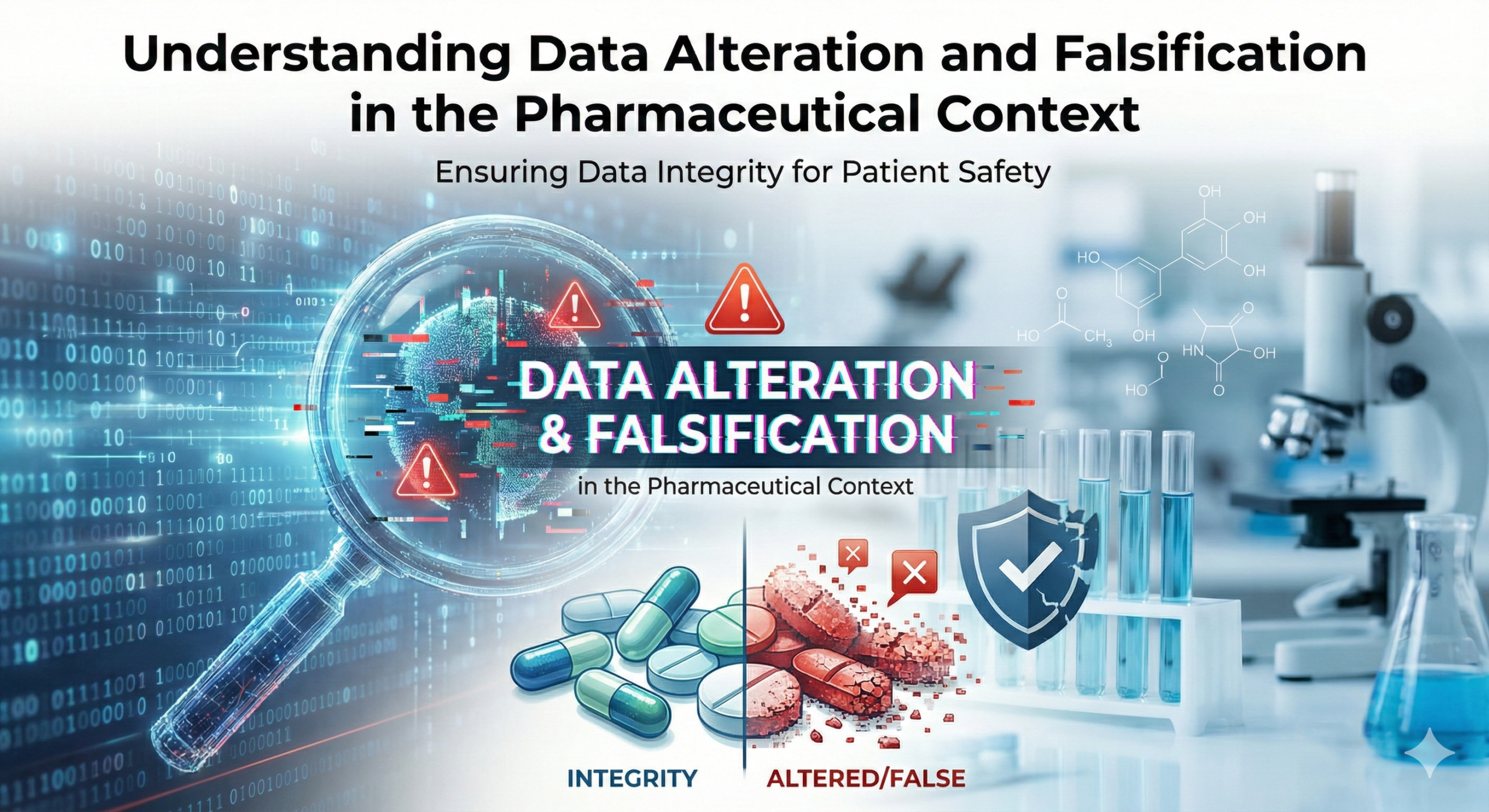
Understanding Data Alteration and Falsification in the Pharmaceutical Context
Introduction
In recent years, issues of data alteration and falsification within regulatory authorities and pharmaceutical companies have garnered significant public attention. However, there remains considerable misunderstanding about the precise definition and scope of these concepts. This article aims to clarify these important terms within the context of data integrity requirements for the pharmaceutical industry.
💡 データの改ざん・偽造は規制違反の中でも最も重大な問題であり、厳格な管理体制と教育が必要です。
Defining Data Alteration and Falsification
Many people assume that “data alteration” or “data falsification” refers exclusively to malicious, intentional misconduct. This understanding is incomplete and potentially misleading.
In the regulatory context, particularly as defined by international guidance documents from PIC/S (Pharmaceutical Inspection Co-operation Scheme), FDA (U.S. Food and Drug Administration), MHRA (UK Medicines and Healthcare products Regulatory Agency), and WHO (World Health Organization), data alteration encompasses a broader spectrum of activities.
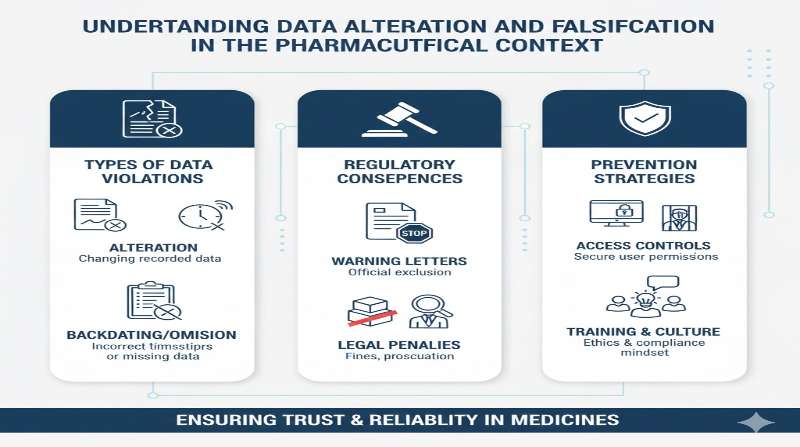
Data alteration refers to any change made to documents or records—in whole or in part—at an inappropriate time, or in an inappropriate format or content, deviating from what should have been recorded. This definition includes both intentional and unintentional modifications, regardless of whether malicious intent exists.
The concept of “alteration” is fundamentally neutral regarding intent. In fields where appropriate procedures and formats are strictly defined, such as pharmaceutical manufacturing and quality control, improper changes can occur through:
- Misunderstanding of procedures or requirements
- Insufficient knowledge or training
- Errors in judgment based on incorrect assumptions
- Accidental modifications due to computer operation errors
- Transcription mistakes during data transfer
- Typographical errors during data entry
All of these scenarios constitute “data alteration” even when no malicious intent is present.
Data Integrity and the Prevention of Alteration
The Purpose of Data Integrity
One of the primary objectives of data integrity is to ensure that data has not been altered inappropriately throughout its lifecycle. From the perspective of patient safety—the paramount concern in pharmaceutical regulation—both intentional data falsification and accidental alterations through input errors or transcription mistakes pose equal risks to product quality and patient welfare.
ALCOA+ Principles
Modern data integrity requirements are built upon the ALCOA+ principles, which originated with FDA guidance and have been adopted internationally:
- Attributable: Data must be traceable to the individual who generated it
- Legible: Data must be readable and permanent
- Contemporaneous: Data must be recorded at the time the activity is performed
- Original: Data must be the original record or a true copy
- Accurate: Data must be free from errors and reflect actual observations
The “+” extension includes:
- Complete: All data must be captured, including repeat testing and failures
- Consistent: Data must be internally consistent with timestamps in chronological order
- Enduring: Data must be preserved throughout the required retention period
- Available: Data must be readily available for review throughout the retention period
Current Regulatory Landscape
Several key guidance documents shape current data integrity expectations:
The PIC/S Good Practices for Data Management and Integrity in Regulated GMP/GDP Environments (PI 041-1, September 2021) provides comprehensive guidance on establishing data governance systems. The FDA’s Data Integrity and Compliance with Drug CGMP guidance (December 2018) emphasizes risk-based approaches to data integrity. The MHRA‘s GMP Data Integrity Definitions and Guidance for Industry (March 2018, revised) offers detailed definitions and practical expectations.
These documents collectively emphasize that data integrity must be embedded in the pharmaceutical quality system, requiring appropriate controls throughout the data lifecycle from creation to retention and destruction.
Classification of Data Alterations
Common Misconceptions in Training and Literature
Many data integrity seminars and publications tend to focus excessively on malicious, fraudulent data manipulation. While such fraud certainly occurs and demands serious consequences, it represents only one category of data integrity failures—and arguably not the most prevalent one.
For pharmaceutical companies, establishing robust systems to prevent unintentional alterations is often more critical than focusing primarily on detecting fraud.
Categories of Data Alteration
Data alterations without malicious intent can be classified into two primary categories:
Intentional but Non-Malicious Alterations: These occur when personnel deliberately modify data but without understanding that such modifications are inappropriate. Common scenarios include:
- Misunderstanding of procedural requirements leading to incorrect data recording practices
- Assumptions about “acceptable” modifications based on past practices or informal training
- Deliberate corrections made without following proper deviation or change control procedures
- “Tidying up” raw data before official recording without recognizing this as alteration
- Replacing “outlier” results without proper investigation and documentation
The concerning aspect of this category is that individuals may repeatedly commit such violations in their daily work without realizing they are engaging in improper data practices. This represents a failure in training, procedure design, or quality culture rather than intentional misconduct.
Unintentional Alterations: These occur through inadvertent errors and mistakes, including:
- Data entry errors when transcribing information between systems
- Typographical mistakes during manual data recording
- Accidental deletions or overwrites in electronic systems
- Calculation errors in manual computations
- Mislabeling of samples or data files
- Selection of incorrect options in electronic forms
The Prevalence Question
While specific statistics vary depending on the source and the industry sector examined, empirical evidence from regulatory inspections and internal audit programs generally suggests that unintentional data integrity failures significantly outnumber intentional fraud.
Some industry analyses have indicated that intentional alterations (both malicious and non-malicious but deliberate) may account for approximately 20% of data integrity issues, while unintentional alterations comprise roughly 80%. However, it is important to note that these figures can vary considerably depending on the organization, the specific processes examined, and the maturity of the quality system.
Regardless of the exact proportions, the key insight remains consistent: pharmaceutical companies must establish systems that effectively prevent both categories of alteration, with particular attention to the more common unintentional errors.
Establishing Effective Data Integrity Controls
Risk-Based Approach
To ensure pharmaceutical product efficacy and safety, companies must implement controls that address the full spectrum of potential data integrity failures. A risk-based approach, consistent with ICH Q9 Quality Risk Management principles, should be applied to identify critical data and implement appropriate controls.
Preventive Strategies for Unintentional Alterations
Given that unintentional alterations represent a significant portion of data integrity issues, the following strategies are essential:
System Design: Implementing computerized systems with appropriate controls such as:
- Audit trails that automatically capture all data modifications with timestamps and user identification
- Electronic signatures requiring authentication for critical data entries
- System validations ensuring data cannot be easily overwritten or deleted
- User access controls limiting who can modify different types of data
- Automated data transfer reducing manual transcription
Procedure Design: Creating clear, unambiguous procedures that:
- Minimize opportunities for transcription errors through streamlined workflows
- Provide clear instructions on data recording expectations
- Include worked examples and illustrations for complex operations
- Define acceptable versus unacceptable data modification practices
Training and Culture: Establishing a quality culture through:
- Comprehensive initial and ongoing training on data integrity expectations
- Clear communication about what constitutes acceptable and unacceptable data practices
- Emphasis on the importance of data integrity for patient safety
- Encouragement of error reporting without punitive responses to honest mistakes
- Regular refresher training on data integrity principles
Quality Control and Monitoring: Implementing oversight through:
- Regular review of audit trails and data modifications
- Statistical monitoring of error rates and patterns
- Periodic data integrity audits of critical processes
- Management review of data integrity metrics
Conclusion
As the pharmaceutical industry continues to enhance its data integrity practices in response to regulatory expectations and technological advances, understanding the true nature of data alteration becomes increasingly critical.
The recognition that data alteration extends beyond malicious fraud to include unintentional errors and non-malicious mistakes represents an important maturity in the industry’s approach to data integrity. By establishing robust, risk-based systems that prevent unintentional alterations—which evidence suggests comprise the majority of data integrity issues—pharmaceutical companies can better ensure the quality of their products and the safety of patients.
The urgent priority for pharmaceutical companies is not primarily the detection of fraud, but rather the establishment of systems, procedures, training programs, and quality cultures that prevent well-intentioned personnel from unknowingly committing data integrity violations in their daily work. This preventive approach, grounded in the ALCOA+ principles and aligned with current international regulatory guidance, represents the most effective path toward sustainable data integrity compliance.
Related Articles
- The Birth of 21 CFR Part 11: A Historical Perspective
- Why Printouts Cannot Be Trusted: Understanding the Vulnerability of Paper-Based Document Management
- The Evolution of Electronic Records Regulations: From FDA Part 11’s Tumultuous Past to Today’s Global Harmonization
- Understanding Authenticity: A Core Requirement of Japanese ER/ES Guidelines
- Understanding Legibility: A Fundamental Requirement for Electronic Records
📌 関連テンプレート: データインテグリティ手順書テンプレート
Related FDA QMSR Templates
Streamline your FDA QMSR compliance with our professionally crafted templates: