
Validation in Pharmaceutical Manufacturing
Definition and Historical Background of Validation
The FDA‘s 1987 “Guidelines on General Principles of Process Validation” defines validation in pharmaceutical manufacturing as follows:
💡 医薬品製造におけるバリデーションは、製品品質の一貫性を科学的に実証する不可欠なプロセスです。
“Establishing documented evidence which provides a high degree of assurance that a specific process will consistently produce a product meeting its predetermined specifications and quality characteristics.”
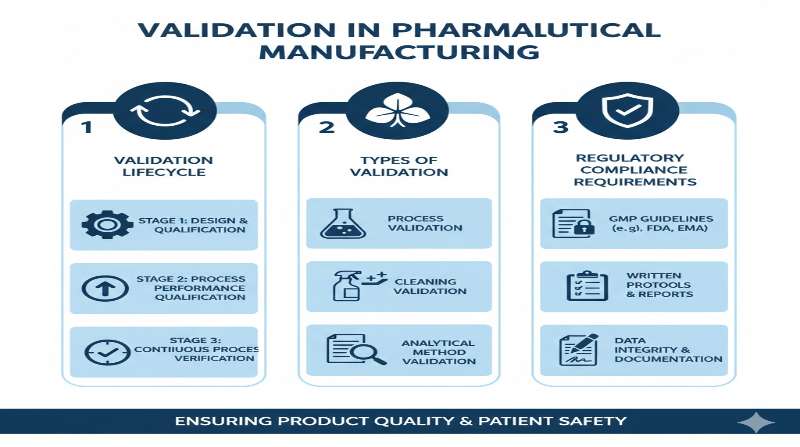
This definition remains valid today as a fundamental principle of pharmaceutical manufacturing. Subsequently, the FDA issued “Process Validation: General Principles and Practices” in 2011, introducing a three-stage lifecycle approach (Process Design, Process Qualification, and Continued Process Verification). In Europe, “EU GMP Annex 15: Qualification and Validation” establishes similar requirements.
Internationally, the International Council for Harmonisation (ICH) has established the concept of Quality by Design (QbD) through ICH Q8 (Pharmaceutical Development), ICH Q9 (Quality Risk Management), and ICH Q10 (Pharmaceutical Quality System), emphasizing science-based process understanding.
In essence, pharmaceutical products must be manufactured according to predetermined specifications and quality standards regardless of any variability factors (temperature and humidity changes, raw material quality, operational processes, etc.). This is an absolute requirement to ensure patient safety.
Product Quality Distribution and Process Capability
Product and process data should be analyzed to determine the normal range of variation within which the process output remains within specification. It is recommended to use Statistical Process Control (SPC) methods to calculate process capability indices (Cp, Cpk) and quantitatively evaluate whether the process can stably manufacture products within specifications.
Problems with Unstable Processes
In the following example (each peak represents one lot), quality is constantly fluctuating. The mean value shifts up and down. The variation also increases and decreases. Ultimately, the total variation also increases over time.
[Figure: Image of unstable process – multiple normal distributions varying in both position and shape]
If this were the manufacture of sweet buns (anpan), it might not be a serious problem. Whether there is more or less filling, whether they are burnt or undercooked, it would be a matter of consumer preference and would not be life-threatening. Of course, customer complaints would arise, and brand value would be damaged. However, safety concerns would be minimal.
But what if pharmaceutical products were manufactured with such variation in an unstable process? For vitamin supplements or nutritional aids, the acceptable range might be wider. However, for pharmaceuticals with a narrow therapeutic index such as anticancer drugs, antiviral drugs, psychotropic drugs, anticoagulants, and insulin preparations, if the content of active ingredients falls outside specifications, overdosing can cause toxicity or underdosing can result in lack of therapeutic effect, potentially causing significant harm to patients.
Furthermore, for biopharmaceuticals and peptide drugs, even slight process variations can affect product quality attributes (glycosylation patterns, aggregates, impurity profiles), which may have significant impacts on immunogenicity and safety.
Establishing a Stable Process
Therefore, it is necessary to stabilize the process. Regardless of which variability factors overlap, the process must be able to manufacture products with the same specifications and quality in every lot. To achieve this, the performance of facilities and equipment (formulation equipment) is required. Here, performance refers to process robustness and reproducibility.
For example, a high-performance automobile travels straight even when the steering wheel is held lightly. In other words, it has excellent straight-line stability. Similarly, a high-performance process has the ability to maintain target quality even when minor variability factors are present.
Historically, many pharmaceutical companies have conducted process validation with three lots. The reason is that with only two lots, straight-line stability (trend) cannot be determined. Only by plotting at least three points can straight-line stability be statistically evaluated.
The FDA‘s 1987 guideline stated “at least” three lots. However, the 2011 revised guidance shifted from the traditional “three-lot approach” to a science-based lifecycle approach. Currently, based on sufficient knowledge accumulation during the process design stage, risk assessment, and statistical methods, the number of lots required for validation should be scientifically determined by each company.
Furthermore, with the introduction of Process Analytical Technology (PAT) and Real-Time Release Testing (RTRT), continuous process monitoring and control have become possible, and forms of quality assurance that transcend the traditional “lot-based” concept have emerged.
[Figure: Image of stable process – multiple normal distributions overlapping at the same position and shape]
Processes that Consistently Produce Good Products
What is further necessary is that all products must fall within the specification limits. However, simply staying within specifications is not sufficient.
By understanding the normal range of variation, it becomes clear whether the process is in a controlled state and within an acceptable range for producing specific outputs. By reducing and managing the variation range, advanced quality assurance is achieved. This aligns with the modern quality management philosophy of “Quality by Design” – designing quality into products rather than inspecting for it.
Ideally, the process capability index Cpk should be 1.33 or higher (2.0 or higher for Six Sigma quality). This means that process variation is sufficiently small relative to the specification width, and the risk of out-of-specification results is extremely low.
Variability Factors to be Managed
Depending on the characteristics and sensitivity of the process, the variability factors to be managed are as follows. These factors should be identified and managed as “Critical Process Parameters (CPP)” according to ICH Q8 guidelines.
Environmental Factors
Temperature and humidity variations affect many formulation processes (particularly granulation, drying, and coating processes for solid dosage forms). Equipment surface temperature and condensation formation can potentially affect the physicochemical properties and microbiological quality of products. Cleanliness control is also important, requiring maintenance of cleanliness classes based on ISO 14644 standards.
Equipment and Utility Factors
Power supply variations affect processes that require precise temperature control or agitation speed control. Mechanical vibration affects the accuracy of filling and weighing processes. Light (especially ultraviolet light) can cause degradation of photosensitive active pharmaceutical ingredients and formulations.
Water Quality and Environmental Contamination
The quality of pharmaceutical water (purified water, water for injection) is specified in the Japanese Pharmacopoeia, United States Pharmacopeia, European Pharmacopoeia, etc., and parameters such as conductivity, total organic carbon (TOC), viable microorganism count, and endotoxin concentration must be continuously monitored. Particulate and microbial contamination from the environment must be strictly controlled, especially in sterile pharmaceutical manufacturing.
Human Factors
The training status of operators, understanding of procedures, and fatigue levels can also affect quality. To prevent human error, appropriate training and education, clarification of procedures, and introduction of automation are important.
Raw Material Variation
Changes in raw material brands (supplier changes) or variations in raw material viscosity due to lot changes can affect product dissolution performance, removal rate performance, and content uniformity. Management through not only incoming inspection of raw materials but also supplier audits and Change Control procedures is necessary. Differences in crystalline form or particle size distribution of excipients can also affect formulation properties.
Importance of Continued Process Verification (CPV)
Validation is not complete once it is performed. As emphasized in the 2011 FDA guidance, even after commercial production begins, it must be continuously verified through Continued Process Verification (CPV) that the process remains in a state of control. CPV includes trend analysis, Statistical Process Control (SPC), periodic reviews, and Change Control.
Additionally, Root Cause Analysis when deviations occur and implementation of Corrective Actions and Preventive Actions (CAPA) are essential for continuous process improvement.
Conclusion
Validation in pharmaceutical manufacturing is not merely compliance with regulatory requirements, but a scientific and systematic approach to ensure patient safety. Modern validation should be viewed as a lifecycle-wide activity that integrates deep process understanding, risk-based approaches, and continuous improvement based on Quality by Design principles.
Document revised and updated to reflect current regulatory requirements including FDA 2011 Process Validation Guidance, EU GMP Annex 15, ICH Q8/Q9/Q10 guidelines, and Quality by Design principles.
Related Articles
- Why Software Category Classification is Necessary
- The Purpose and Importance of Installation Qualification (IQ) in the Pharmaceutical Industry
- Understanding the True Purpose of Performance Qualification (PQ) in Computerized System Validation
- Purpose and Proper Development of Validation Reports
- Understanding Quality Control (QC) in Pharmaceutical Manufacturing: Beyond Inspection to Process Excellence
📌 関連テンプレート: バリデーションマスタープランテンプレート
Related FDA QMSR Templates
Streamline your FDA QMSR compliance with our professionally crafted templates: