
Why Usability Engineering Is Necessary for Non-Software Medical Devices
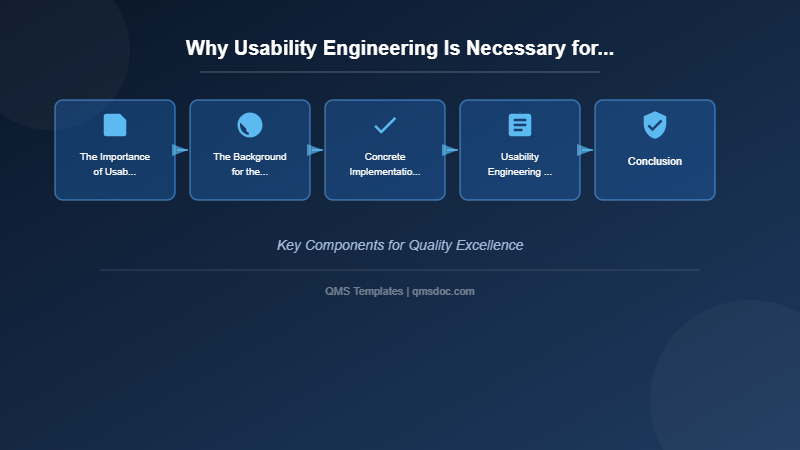
The Importance of Usability Engineering in Non-Software Medical Devices
The concept of “usability engineering” exists as a discipline primarily associated with the design of software and digital devices—one that produces results enabling users to operate such systems efficiently, safely, and with satisfaction. However, this concept has become increasingly critical not only in the digital realm but also for physical products that do not contain embedded software. In particular, within the medical device and diagnostic device sectors, usability engineering is positioned not merely as an optimization of design but as a legal and regulatory requirement.
The concept of “usability engineering” exists as a discipline primarily associated with the design of software and digital devices—one that produces r…
The Background for the Necessity of Usability Engineering
In the medical device industry, the importance of usability engineering is being recognized more than ever before. ISO 13485 (Quality Management Systems for Medical Devices) defines the product design process with precision, requiring that the optimization of interaction between users and products be considered systematically. Similarly, IEC 62366-1 (Usability Engineering of Medical Devices) stands as an international standard for ensuring the safety and effectiveness of medical devices. It is positioned as a requirement in the FDA (U.S. Food and Drug Administration) approval process, EU Medical Device Regulation (MDR), and MDSAP (Multi-Region Submission Program).
Concretely, for example, medical devices equipped with injection needles or control panels for diagnostic equipment—even those without embedded software—depend critically on whether users (healthcare professionals or patients) can employ them correctly and safely. The clarity of instructions for use, the intuitiveness of operational interfaces, and the appropriateness of warning labels are all at the core of usability engineering. When these elements are neglected, misuse can result in adverse events, leading not only to regulatory violations but potentially to the most serious consequence: harm to patients. In the regulatory context of FDA, EMA (European Medicines Agency), and PMDA (Pharmaceuticals and Medical Devices Agency of Japan), such outcomes represent fundamental failures in meeting the legal standards for marketing approval.
Concrete Implementation of Usability Engineering
A more concrete example illustrates this principle. Suppose a medical device manufacturer develops a new blood testing instrument. If the design of the sample insertion port is ambiguous, the risk of operator error by laboratory technicians increases significantly.
Incorporating usability engineering principles into this design would involve the following measures. First, user research is conducted to understand the knowledge level and operational environment of the intended users (laboratory technicians). Next, the shape and color of the sample insertion port are refined, employing fail-safe design to physically prevent incorrect insertion. Furthermore, procedural diagrams are prepared with high quality and clarity, preventing misinterpretation, and relevant warnings and precautions are appropriately displayed. Finally, formative evaluation through actual users—specifically usability testing—is conducted, and the design is iteratively refined based on findings.
Through such a process, even novice users can operate the device safely and efficiently, resulting in improved healthcare quality and reduced risk of adverse events. The investment in usability engineering directly translates to better patient outcomes.
Usability Engineering as a Regulatory Requirement
In recent years, regulatory authorities have increasingly emphasized the importance of usability. Since 2023, the FDA has strengthened requirements for usability data submission in medical device applications, demanding not merely the provision of instructions but clear documentation of design rationale underlying the usability approach. The EU Medical Device Regulation (MDR) similarly emphasizes that usability risk analysis constitutes an essential component of the risk management file. The PMDA in Japan has similarly intensified requirements for detailed usability information in medical device approval applications.
These trends demonstrate that medical devices are no longer viewed purely as “technical products” but increasingly as “user-centered services” involving human interaction. Whether the product contains embedded software is not fundamentally relevant from this perspective. What matters is how users actually interact with the product and whether expected outcomes are achieved.
The regulatory emphasis on usability extends beyond the device itself to encompassing the entire user experience ecosystem. Instructions for use, labeling, training materials, and packaging all fall within the scope of usability engineering requirements. Furthermore, the rise of emerging regulatory frameworks addressing artificial intelligence and machine learning in medical devices underscores the necessity of comprehensive usability consideration, as even algorithmic outputs must be presented to users in clinically meaningful and operationally manageable ways.
Conclusion
The scope of usability engineering application is expected to expand further from 2025 onward. Improved access in emerging markets, adaptation to aging societies, and growing recognition of the importance of multilingual support mean that medical devices are increasingly used across diverse user segments. To respond to these changing circumstances, it is necessary to design comprehensively—from the product itself through the control panel design, instructions for use, training materials, and labeling on packaging—applying usability engineering principles throughout.
Even for non-software medical devices, the application of usability engineering principles results in products that are safer, more effective, and easier to use, ultimately delivering greater value to patients and users. Developing and improving products from this perspective has become an essential requirement in the modern medical device industry. This integrated, user-centered approach to design represents not merely best practice but a fundamental obligation to ensure that medical devices fulfill their promise of safe and effective patient care.
Related Articles
- Why Class I Medical Devices Are Subject to Usability Engineering
- Why Medical Devices Need Usability Engineering
- Applying Human Factors and Usability Engineering to Medical Devices(邦訳版)
- The Importance of Use Environment and User Characteristics in Medical Device Usability Engineering
- Aircraft Pilot Type Ratings and Medical Device Usability Engineering
- Misuse and Use Error: Usability Engineering in Medical Device Design
