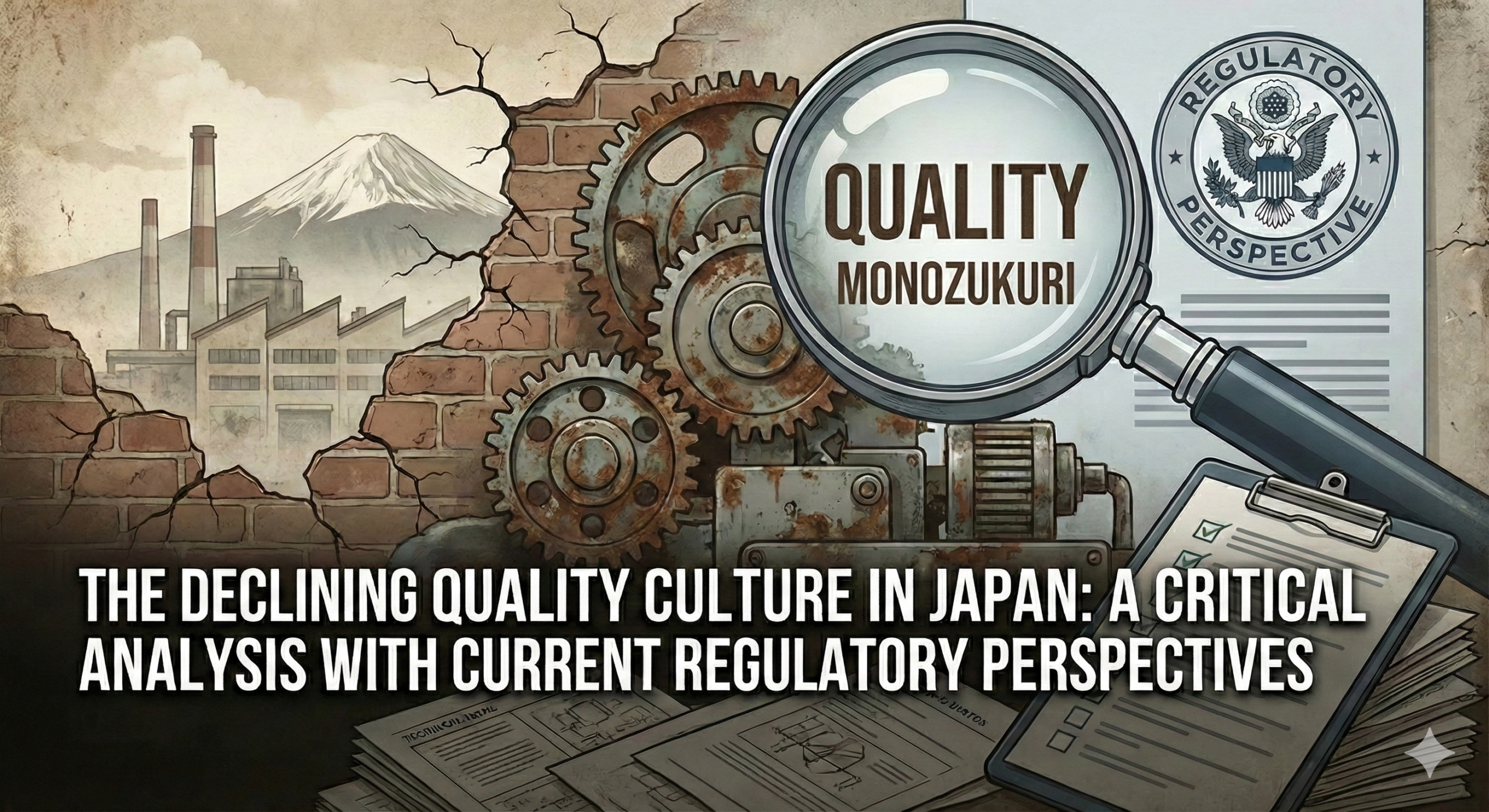
The Declining Quality Culture in Japan: A Critical Analysis with Current Regulatory Perspectives
Introduction
An intriguing article published in Nikkei Business Digital Edition caught my attention. As a consultant to medical device companies, I have been concerned about the widespread lack of quality consciousness across the industry. This column examines the decline in Japan’s once-renowned quality culture by drawing upon data from Nikkei Business Digital Edition and incorporating current regulatory frameworks and industry standards.
💡 日本における品質文化の低下は、製造業の競争力と信頼性に深刻な影響を及ぼしており、規制当局も警鐘を鳴らしています。
The Dramatic Decline in Kaizen (Improvement) Proposals
Manufacturing floors across Japan have witnessed a striking decline in employee-driven improvement initiatives. According to the Japan HR Association’s continuous improvement activity survey, the number of improvement proposals has plummeted to less than one-fifth of previous levels:
Table 1: Decline in Improvement Proposals
| Fiscal Year | Number of Participants | Number of Proposals | Proposals per Person |
| 1997 | Approximately 1.14 million | 26.86 million | 23.6 |
| 2016 | Approximately 370,000 | 5.28 million | 14.3 |
This represents a decline of approximately 67% in participation and 80% in total proposals over a 19-year period. While some reduction may be attributed to improved design quality that leaves fewer defects to address on the manufacturing floor, the magnitude of this decline cannot be explained by quality improvements alone.
It is worth noting that modern manufacturing has evolved significantly. Design-phase quality improvements through methodologies such as Design for Manufacturing and Assembly (DFMA) and advanced computer-aided engineering have indeed reduced manufacturing defects. However, continuous improvement should extend beyond defect correction to include process optimization, efficiency enhancement, and innovation, areas where Japanese manufacturers traditionally excelled.
The Erosion of Improvement Culture
The decline goes beyond mere statistics. Field reports indicate a troubling trend: some improvement activity teams have devolved into platforms for entertainment rather than genuine process enhancement. As one construction machinery manufacturer’s plant manager noted, “Improvement activities have become routine and stale. Some teams focus more on practicing comedy routines for presentation events than on substantive improvements.”
This observation raises a fundamental question: What is the true purpose of kaizen? The original intent of continuous improvement was to engage every employee in identifying and solving problems, fostering a culture of operational excellence and innovation. When improvement activities become performative rather than purposeful, organizations lose a critical mechanism for maintaining competitive advantage.
From a quality management systems (QMS) perspective, this represents a failure to maintain effective continual improvement processes as required by ISO 9001:2015, Clause 10.3. The standard explicitly requires organizations to “continually improve the suitability, adequacy and effectiveness of the quality management system.” The decline in employee-driven improvement suggestions indicates a systemic weakness in organizations’ ability to meet this fundamental requirement.
The Manifestation in Product Quality: Evidence from J.D. Power Studies
The cultural shift toward quality neglect has manifested tangibly in product quality metrics. The automotive sector, where Japanese manufacturers historically dominated quality rankings, provides compelling evidence.
U.S. Market Initial Quality Study (2017)
The J.D. Power U.S. Initial Quality Study (IQS) measures problems experienced during the first 90 days of vehicle ownership, expressed as Problems Per 100 Vehicles (PP100). Lower scores indicate higher quality. The June 2017 results were particularly striking:
Table 2: 2017 U.S. Initial Quality Study Rankings
| Rank | Brand | Country | PP100 Score |
| 1 | Kia | South Korea | 72 |
| 2 | Genesis | South Korea | 77 |
| 3 | Porsche | Germany | 78 |
| 4 | Ford | USA | 86 |
| 4 | Ram | USA | 86 |
| 6 | BMW | Germany | 88 |
| 6 | Chevrolet | USA | 88 |
| 6 | Hyundai | South Korea | 88 |
| 9 | Lincoln | USA | 92 |
| 10 | Nissan | Japan | 93 |
| 10 | Volkswagen | Germany | 93 |
| Industry Average | 97 | ||
| 13 (tie) | Toyota | Japan | (Below avg) |
| 13 (tie) | Buick | USA | (Below avg) |
For the first time in decades, Korean manufacturers Kia and Genesis captured the top two positions. Notably, Genesis, Hyundai’s luxury brand, achieved second place in its inaugural year in the rankings. Meanwhile, Japanese brands showed concerning declines:
- Nissan ranked 10th (tied), which was the highest placement among Japanese brands
- Toyota dropped to 13th place (tied), barely above the industry average
- Lexus, Toyota’s luxury brand, performed below the industry average
This represented a dramatic reversal from just six years earlier, when Lexus had claimed the top position in the study. The 2011 study had seen Honda and Mazda ranked 2nd and 5th respectively, highlighting the magnitude of the decline in Japanese automotive quality perception.
Contemporary Quality Trends: The Japanese Market (2024-2025)
More recent data from J.D. Power’s Japan Initial Quality Studies provide additional context:
2024 Japan IQS Results:
- Overall winner: Suzuki (132 PP100) – first time achieving top ranking since the study began in 2011
- Luxury brand winner: Lexus (149 PP100)
- Industry average: 152 PP100 (highest level of problems since 2021)
2025 Japan IQS Results:
- Overall winner: Daihatsu (114 PP100)
- Second place: Suzuki (120 PP100)
- Third place: Honda (134 PP100)
- Industry average: 140 PP100 (first decrease in four years, down 12 PP100 from 2024)
Importantly, the 2024-2025 studies revealed that the majority of reported problems (approximately 77-78% of total issues) related to design aspects such as “difficult to understand/use” rather than manufacturing defects such as “broken/not working” (approximately 22-23% of issues). This shift indicates that while manufacturing quality has improved, user experience design has become a critical challenge, particularly regarding infotainment systems, driver assistance features, and vehicle interfaces.
The Root Causes: Design Complexity vs. User Experience
Modern vehicles incorporate significantly more technology than their predecessors. Advanced driver-assistance systems (ADAS), complex infotainment platforms, and connectivity features have created new opportunities for user frustration. The 2024 Japan study found that vehicles equipped with Android Auto or Apple CarPlay experienced twice the number of infotainment-related problems (44.7 PP100) compared to vehicles without these features (21.7 PP100).
This presents a quality paradox: technological advancement intended to enhance user experience has become a significant source of customer dissatisfaction. From a QMS perspective, this indicates inadequate user-centered design processes and insufficient validation of human-machine interfaces prior to production.
Current Regulatory and Standards Framework
Understanding the quality decline requires examining it within the context of contemporary quality management standards and regulatory requirements.
ISO 9001:2015 – Quality Management Systems
The current version of ISO 9001 was published in 2015 and emphasizes:
- Risk-based thinking: Organizations must identify and address risks and opportunities that could affect QMS outcomes
- Leadership engagement: Top management must demonstrate leadership and commitment to the QMS
- Process approach: Focus on understanding and managing interrelated processes
- Continual improvement: Systematic enhancement of QMS effectiveness (Clause 10.3)
- Context of the organization: Understanding internal and external factors affecting strategic direction (Clause 4.1)
Upcoming ISO 9001:2026 Revision: The next version of ISO 9001 is scheduled for publication in September 2026. Expected changes include greater emphasis on sustainability, climate change adaptation, and digital transformation. Organizations should begin preparing for transition approximately 12 months before the publication date, as certification bodies typically provide a 2-3 year transition period.
Climate Change Amendment (2024): In 2023, ISO announced the integration of climate change considerations into all management system standards. ISO 9001 now includes Amendment 1:2024, requiring organizations to determine whether climate change is a relevant issue for their QMS and, if so, to address it within their quality management processes.
ISO 13485:2016 – Medical Device Quality Management
For medical device manufacturers, ISO 13485:2016 provides a more stringent framework. This standard:
- Prioritizes regulatory compliance over continual improvement
- Requires comprehensive medical device files documenting design, manufacturing, and labeling for each product type
- Mandates detailed risk management throughout the product lifecycle
- Enforces strict traceability requirements for materials, components, and processes
- Requires validation of special processes that cannot be fully verified through subsequent inspection
Relationship to Japanese Regulations: Japan’s QMS Ministerial Ordinance (QMS省令) is based on ISO 13485:2016 with additional country-specific requirements. Medical device manufacturers must comply with QMS requirements under the Pharmaceutical and Medical Device Act (薬機法). Organizations holding ISO 13485 certification may receive exemptions or reductions in on-site inspections during QMS conformity assessments.
Global Harmonization – MDSAP: The Medical Device Single Audit Program (MDSAP) allows a single regulatory audit to satisfy requirements for five participating countries: United States, Canada, Australia, Brazil, and Japan. MDSAP is based on ISO 13485, facilitating international medical device trade while maintaining rigorous quality standards.
The Concerning Gap in Medical Device Quality Awareness
As a consultant working extensively with medical device companies, I have observed a pervasive lack of quality consciousness that is particularly troubling given the regulatory environment and patient safety implications. Many organizations demonstrate:
- Inadequate understanding of risk management: Failure to implement ISO 14971 (risk management for medical devices) effectively
- Insufficient design control processes: Weak verification and validation procedures as required by ISO 13485 Clause 7.3
- Poor post-market surveillance: Inadequate mechanisms for capturing and analyzing adverse events and customer complaints
- Compliance-focused rather than quality-focused mindset: Treating regulatory requirements as checkboxes rather than quality fundamentals
- Lack of integration between QMS and R&D: Disconnection between quality system requirements and product development processes
This gap is particularly concerning because medical devices directly affect patient safety and clinical outcomes. Unlike consumer electronics or automobiles where quality issues cause inconvenience, medical device failures can result in serious injury or death.
Analysis: The Systemic Nature of Quality Decline
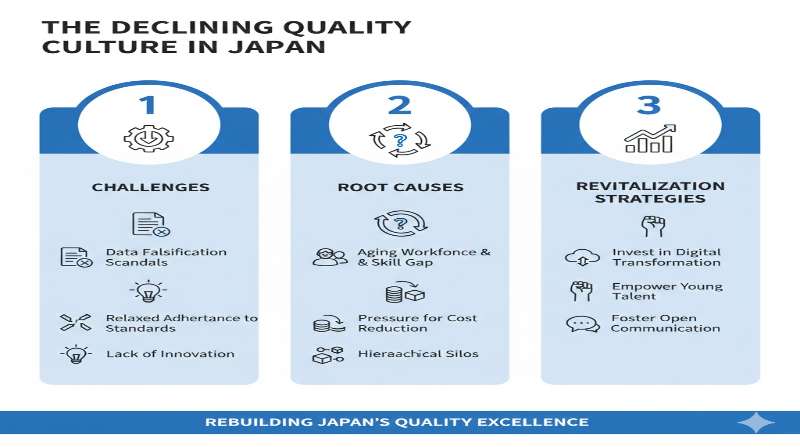
The evidence presented reveals not merely isolated quality problems but a systemic erosion of quality culture across Japanese manufacturing. Several interconnected factors contribute to this decline:
1. Loss of Front-Line Engagement
The 80% reduction in improvement proposals signals a fundamental disconnect between management and front-line workers. When employees stop actively seeking improvements, organizations lose their most valuable source of process knowledge and innovative ideas. This represents a failure of the “respect for people” pillar that underpinned Japan’s post-war quality revolution.
From an ISO 9001:2015 perspective, this violates Clause 5.1.1, which requires top management to demonstrate leadership by “ensuring the integration of the quality management system requirements into the organization’s business processes” and “promoting the use of the process approach and risk-based thinking.”
2. Overemphasis on Automation at the Expense of Human Insight
While automation and advanced manufacturing technologies have reduced defect rates, they may have inadvertently diminished the importance placed on human observation and problem-solving. The Toyota Production System (TPS) succeeded precisely because it combined technological efficiency with profound respect for human intelligence and creativity.
3. Short-Term Financial Pressures
Global competitive pressures and shareholder expectations for quarterly results may have shifted management focus from long-term quality excellence to short-term financial performance. Quality investments, particularly in culture and capability building, often have delayed returns that may not align with financial reporting cycles.
4. Erosion of Mentorship and Knowledge Transfer
Japan’s apprenticeship tradition ensured deep knowledge transfer from experienced craftspeople to the next generation. As experienced workers retire and younger employees face different career expectations, this knowledge transfer mechanism has weakened. Many organizations lack formal systems to capture and preserve critical quality knowledge.
5. Design Complexity Outpacing User Experience Capability
As noted in the J.D. Power studies, modern products incorporate significantly more features and technology than previous generations. However, many organizations have not developed corresponding expertise in human-centered design, user experience research, and interface validation. Engineering capability has advanced faster than design capability, creating products that are technically sophisticated but difficult to use.
Recommendations for Quality Renaissance
Reversing Japan’s quality decline requires comprehensive, sustained effort across multiple dimensions:
Strategic Level
- Reestablish Quality as a Core Value: Leadership must articulate and model the primacy of quality, not as a cost center but as a source of competitive advantage and customer loyalty.
- Invest in Quality Culture Development: Allocate resources to rebuild improvement culture through training, recognition systems, and protected time for improvement activities.
- Balance Short-Term and Long-Term Objectives: Establish metrics and incentive systems that reward both immediate financial performance and long-term quality excellence.
Operational Level
- Revitalize Kaizen Programs: Transform improvement activities from performative exercises into genuine problem-solving initiatives. Ensure that suggestions receive timely evaluation, implementation, and feedback.
- Enhance Design for Usability: Develop organizational capability in human-centered design. Conduct user research, usability testing, and iterative design refinement before finalizing product specifications.
- Strengthen QMS Integration: Ensure quality management systems actively support operations rather than existing as parallel compliance exercises. Particular attention should be given to:
- Risk-based thinking in daily operations (ISO 9001:2015 Clause 6.1)
- Management review effectiveness (ISO 9001:2015 Clause 9.3)
- Nonconformity and corrective action processes (ISO 9001:2015 Clause 10.2)
For Medical Device Manufacturers
- Elevate Regulatory Compliance to Quality Excellence: Move beyond checkbox compliance to embrace regulatory requirements as minimum standards for patient safety and product effectiveness.
- Implement Comprehensive Risk Management: Establish systematic risk management throughout the product lifecycle, from concept through post-market surveillance, as required by ISO 14971:2019.
- Strengthen Design Controls: Implement robust design verification and validation processes that ensure products meet user needs and intended use requirements (ISO 13485:2016 Clause 7.3).
- Enhance Post-Market Surveillance: Develop proactive systems for monitoring product performance, capturing adverse events, and implementing timely corrective and preventive actions.
Knowledge Management
- Formalize Knowledge Transfer: Implement systematic approaches to capture and transfer critical quality knowledge from experienced to newer employees. This might include mentorship programs, documented lessons learned, and communities of practice.
- Prepare for ISO 9001:2026 Transition: Begin assessment of current QMS against expected 2026 requirements, particularly regarding sustainability, climate change considerations, and digital transformation.
Conclusion
The evidence of Japan’s quality decline is substantial and concerning. From the dramatic reduction in employee-driven improvement initiatives to the measurable degradation in product quality rankings, Japanese manufacturers face a critical inflection point. This is not merely a matter of competitive positioning but touches upon national economic vitality and global safety in sectors like medical devices and transportation.
However, decline is not destiny. Japan has demonstrated remarkable capacity for transformation in the past. The post-World War II quality revolution, led by practitioners who learned from Deming and Juran and adapted their teachings to Japanese context, proved that cultural and operational excellence could be built through sustained commitment and systematic effort.
A quality renaissance is possible, but it requires acknowledging the current reality, understanding its root causes, and committing to comprehensive change. This means:
- Leadership must reestablish quality as a strategic priority, not a tactical concern
- Organizations must invest in rebuilding quality culture and capability
- Regulatory frameworks must be embraced as foundations for excellence, not bureaucratic burdens
- Technology must be balanced with human insight and user-centered design
- Knowledge must be systematically captured and transferred across generations
The regulatory frameworks exist—ISO 9001, ISO 13485, and related standards provide proven methodologies for quality excellence. What is required now is the will to implement them not merely for certification but for genuine operational transformation.
For medical device manufacturers specifically, the stakes are particularly high. These organizations bear responsibility not just to shareholders and customers but to patients whose health and lives depend on product quality. The path forward requires elevating quality consciousness from compliance obligation to ethical imperative.
Japan’s quality reputation was not built in a day, nor will it be rebuilt quickly. But with sustained effort, strategic investment, and genuine commitment to the principles that once made “Made in Japan” synonymous with excellence, a quality renaissance remains achievable.
The question is not whether Japan can reclaim its quality leadership, but whether it will choose to do so.
Sources and References:
- J.D. Power U.S. Initial Quality Study (2017)
- J.D. Power Japan Initial Quality Study (2024, 2025)
- Japan HR Association Continuous Improvement Activity Survey data
- ISO 9001:2015 Quality Management Systems – Requirements
- ISO 9001:2015/Amendment 1:2024 (Climate Change)
- ISO 13485:2016 Medical Devices – Quality Management Systems – Requirements for Regulatory Purposes
- ISO 14971:2019 Medical Devices – Application of Risk Management to Medical Devices
- Nikkei Business Digital Edition articles on quality trends
Note on Data Sources: The improvement proposal statistics (1997: 1.14 million participants, 26.86 million proposals; 2016: 370,000 participants, 5.28 million proposals) are cited from the Japan HR Association survey as reported in Nikkei Business. While the specific survey reports could not be independently verified, the Japan HR Association has conducted these surveys continuously since 1960, and the trend data aligns with broader observations of declining employee engagement in quality improvement activities across Japanese manufacturing.
Related Articles
- Understanding Quality Systems in Pharmaceutical and Medical Device Industries
- Why ISO-9001 Certification Alone Does Not Guarantee Quality Improvement
- The Critical Importance of Root Cause Analysis
- The Importance of Root Cause Analysis in CAPA
- On Continuous Improvement
📌 関連テンプレート: 品質文化評価テンプレート
Related FDA QMSR Templates
Streamline your FDA QMSR compliance with our professionally crafted templates: