
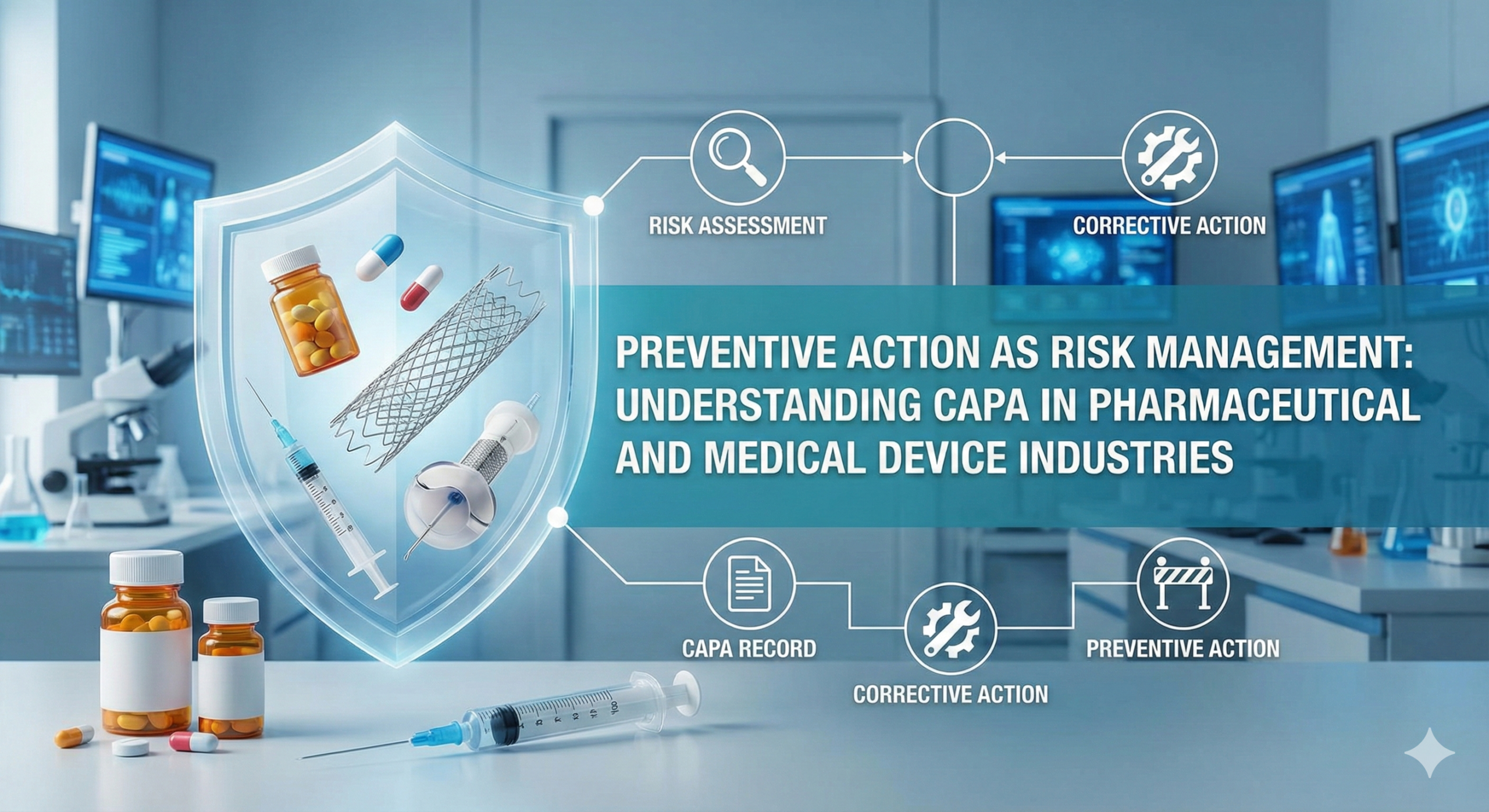
Preventive Action as Risk Management: Understanding CAPA in Pharmaceutical and Medical Device Industries
The Critical Importance of CAPA Implementation
For both pharmaceutical and medical device companies, implementing CAPA (Corrective Action and Preventive Action) systems is not merely a regulatory requirement but a fundamental imperative for ensuring product quality and patient safety. However, the adoption and understanding of CAPA vary significantly between these two industries, reflecting differences in their regulatory frameworks and historical development.
CAPA Requirements in the Medical Device Industry
The medical device industry has a more mature and standardized approach to CAPA implementation, driven by clear regulatory requirements.
Regulatory Framework
In the medical device sector, CAPA is explicitly mandated by multiple regulatory instruments. ISO 13485:2016, the international standard for medical device quality management systems, specifies requirements for corrective action (clause 8.5.2) and preventive action (clause 8.5.3). This standard emphasizes that medical device manufacturers must establish documented procedures for identifying potential nonconformities and their causes, evaluating the need for actions to prevent occurrence of nonconformities, and implementing appropriate actions while verifying their effectiveness.
In Japan, the QMS Ministerial Ordinance (Quality Management System Requirements for Medical Devices and In Vitro Diagnostic Reagents, Ministry of Health, Labour and Welfare Ordinance No. 169) incorporates these CAPA requirements in Articles 63 (Corrective Action) and 64 (Preventive Action). This ordinance is harmonized with ISO 13485, ensuring consistency between international standards and Japanese regulatory requirements. Consequently, virtually all medical device companies have implemented CAPA systems to some degree, as it is a prerequisite for market authorization and continued compliance.
Similarly, the U.S. Food and Drug Administration (FDA) explicitly requires CAPA in 21 CFR Part 820, Subpart J (Corrective and Preventive Action), for medical device manufacturers. The European Union’s Medical Device Regulation (EU MDR 2017/745) also mandates CAPA as part of the quality management system requirements under Article 10.
CAPA Implementation Challenges in the Pharmaceutical Industry
In contrast to the medical device industry, CAPA implementation in the pharmaceutical sector has been slower and more fragmented, particularly in Japan.
Japanese Regulatory Landscape
A significant reason for this disparity is that the Japanese GMP Ministerial Ordinance (Good Manufacturing Practice Standards for Drugs and Quasi-drugs, Ministry of Health, Labour and Welfare Ordinance No. 179) does not explicitly require CAPA in its main text. As a result, many pharmaceutical companies in Japan remain unaware of CAPA concepts or have not yet established formal CAPA systems. Some companies may not even be familiar with the terminology itself.
It should be noted, however, that while the GMP Ministerial Ordinance’s main text does not explicitly mention CAPA, the concept appears in related guidance documents such as the GMP Case Studies Collection. Furthermore, Article 15 of the GMP Ministerial Ordinance, which addresses deviation management, incorporates elements that align with CAPA principles, even if not explicitly labeled as such.
International Regulatory Requirements
The regulatory landscape differs significantly in other major markets:
United States: While the current Good Manufacturing Practice (cGMP) regulations (21 CFR Parts 210 and 211) do not explicitly mention CAPA, the FDA issued guidance in September 2006 titled “Quality Systems Approach to Pharmaceutical Current Good Manufacturing Practice Regulations.” This comprehensive guidance document describes a quality systems model that incorporates CAPA as a fundamental element, effectively making it a regulatory expectation even without explicit codification in the regulations themselves. The FDA’s six-system inspection approach, which evolved from medical device quality system concepts, emphasizes CAPA as a critical component of pharmaceutical quality systems.
Europe and PIC/S: The Pharmaceutical Inspection Co-operation Scheme (PIC/S) GMP Guidelines, which are harmonized with EU GMP requirements, explicitly require CAPA. Chapter 1 of the PIC/S GMP Guide (Pharmaceutical Quality System) clearly states that appropriate corrective actions and/or preventive actions (CAPA) should be identified and taken in response to investigations, with the effectiveness of such actions monitored and assessed in accordance with quality risk management principles. The PIC/S guidelines provide detailed requirements for root cause analysis, implementation of CAPA, and verification of effectiveness.
ICH Q10: The Bridge Between Regions
The only Japanese regulatory document that explicitly addresses CAPA for pharmaceuticals is ICH Q10 (Pharmaceutical Quality System), which was adopted through a Director’s Notice issued on February 19, 2010 (Notification No. PSEHB/PMED Notification 0219 No. 1 and No. 2 from the Pharmaceutical and Food Safety Bureau, Ministry of Health, Labour and Welfare).
ICH Q10 provides a comprehensive framework for pharmaceutical quality systems throughout the product lifecycle. Regarding CAPA, ICH Q10 states:
“Pharmaceutical companies should have a system for implementing corrective actions and preventive actions resulting from the investigation of complaints, product quality defects, non-conformances, recalls, deviations, audits, regulatory inspections and findings, and trends from the monitoring of process performance and product quality. A structured approach should be used in the investigation process to determine root cause. The level and effort of investigation should be commensurate with the level of risk. The CAPA methodology should result in product and process improvements and enhanced product and process understanding.”
This requirement establishes CAPA as an integral component of pharmaceutical quality systems, emphasizing the importance of structured root cause analysis, risk-proportionate investigations, and continuous improvement.
Understanding Preventive Action: The Conceptual Challenge
Based on my consulting experience, I frequently encounter the comment: “I understand corrective action, but I find preventive action difficult to grasp.” This confusion is understandable given the evolution of quality management standards.
Preventive Action as Risk Management
In ISO 9001:2008, preventive action was defined as “action to eliminate the cause of a potential nonconformity or other undesirable potential situation.” The key phrase “potential nonconformity” refers to a problem that has not yet occurred—in other words, a “risk.” Therefore, preventive action is fundamentally equivalent to risk management.
This conceptual clarity led to a significant change in ISO 9001:2015, where the separate clause for preventive action was eliminated. However, this does not mean that preventive action is no longer required. Rather, it has been integrated throughout the standard as “risk-based thinking” and appears in multiple clauses related to addressing risks and opportunities (particularly in clause 6.1, “Actions to address risks and opportunities”).
The 2015 Paradigm Shift
The 2015 revision of ISO 9001 reflects a fundamental reconceptualization: preventive action should not be isolated in a specific organizational unit or addressed by a single procedure. Instead, every organization and every procedure should incorporate risk management as an inherent element of their operations. This approach recognizes that prevention is not a separate activity but an integral aspect of how organizations plan, execute, and improve their processes.
This change was driven by practical experience showing that when preventive action was treated as a separate requirement (as in ISO 9001:2008), organizations often struggled to differentiate it from corrective action, leading to ineffective implementation or mere compliance exercises without substantive risk reduction.
Risk-Based Thinking: A Comprehensive Approach
The risk-based approach embedded throughout ISO 9001:2015 requires organizations to:
- Understand their organizational context and determine risks and opportunities (clause 4.1, 4.2)
- Address risks and opportunities in QMS planning (clause 6.1)
- Apply risk-based thinking in determining resource requirements (clause 7)
- Consider risks in operational planning and control (clause 8.1)
- Evaluate whether nonconformities indicate the need to update risk assessments (clause 10.2.1 e)
This distributed approach ensures that risk management permeates all aspects of the quality management system rather than being confined to a reactive “preventive action” procedure.
The Distinction Between ISO 13485 and ISO 9001
It is important to note that ISO 13485:2016, which governs medical device quality management systems, retains explicit requirements for both corrective action (8.5.2) and preventive action (8.5.3) as separate clauses. This difference from ISO 9001:2015 reflects the specific needs of the medical device industry, where:
- Regulatory authorities require demonstrable evidence of preventive action systems
- The potential consequences of product failures can be severe, requiring explicit preventive measures
- International harmonization of regulatory requirements necessitates clear, auditable preventive action procedures
Medical device manufacturers must therefore maintain documented procedures specifically for preventive action, including methods for identifying potential nonconformities, evaluating the need for preventive actions, implementing and recording such actions, and verifying their effectiveness.
The Growing Importance of Risk Management
For industries manufacturing products with significant safety implications—such as pharmaceuticals and medical devices—the importance of risk management continues to escalate. Several factors drive this trend:
Regulatory Expectations
Regulatory authorities worldwide increasingly emphasize risk-based approaches to quality assurance. The FDA’s quality metrics program, EMA’s risk-based inspection model, and PMDA’s implementation of ICH Q9 (Quality Risk Management) all reflect this evolution. Companies that proactively implement robust risk management systems, including comprehensive CAPA processes, are better positioned to meet these evolving expectations.
Patient Safety Imperatives
The fundamental responsibility to protect patients demands that pharmaceutical and medical device companies identify and mitigate risks before they result in product defects or adverse events. Preventive action, understood as systematic risk management, serves as a critical safeguard.
Business Sustainability
Beyond regulatory compliance, effective CAPA systems deliver substantial business value. They reduce the likelihood of costly recalls, prevent manufacturing deviations, enhance process understanding, and contribute to continuous improvement. Organizations with mature CAPA systems typically experience fewer quality incidents and more efficient operations.
Supply Chain Complexity
Modern pharmaceutical and medical device supply chains span multiple countries and involve numerous suppliers. This complexity multiplies potential failure modes and necessitates systematic risk assessment and preventive action throughout the supply network. CAPA systems must extend beyond the manufacturer’s own facilities to encompass suppliers and contract organizations.
Practical Implementation Considerations
For pharmaceutical companies seeking to establish or enhance CAPA systems, several practical considerations merit attention:
Integration with Existing Systems
CAPA should be integrated with existing quality systems such as deviation management, change control, complaint handling, and quality review processes. Standalone CAPA systems risk becoming disconnected from actual operational issues.
Root Cause Analysis Capabilities
Effective CAPA depends on rigorous root cause analysis. Organizations should develop competency in structured investigation methodologies such as fishbone diagrams, 5-Why analysis, and failure mode and effects analysis (FMEA). Importantly, root causes should focus on system and process issues rather than attributing problems to individual human error without examining underlying systemic factors.
Risk-Proportionate Approach
Not every deviation or nonconformity requires elaborate preventive action. Organizations should use risk assessment to determine the appropriate level of investigation and preventive measures, focusing intensive efforts on issues with the greatest potential impact on product quality and patient safety.
Effectiveness Verification
Preventive actions must be verified for effectiveness. This requires establishing measurable success criteria and monitoring relevant metrics over an appropriate time period to confirm that implemented actions successfully prevent recurrence or occurrence of issues.
Cross-Functional Collaboration
Effective preventive action requires input from multiple perspectives, including quality assurance, manufacturing, engineering, regulatory affairs, and senior management. Organizational silos can impede the identification and implementation of effective preventive measures.
Continuous Learning
CAPA systems should facilitate organizational learning. Trends analysis, review of patterns across multiple CAPA cases, and systematic capture of lessons learned enable continuous improvement beyond individual corrective or preventive actions.
Conclusion
Preventive action, properly understood as risk management, represents a fundamental shift from reactive problem-solving to proactive quality assurance. While the terminology and explicit requirements differ between ISO 9001:2015 (which integrates preventive action into risk-based thinking) and ISO 13485:2016 (which maintains separate preventive action requirements), the underlying principle remains constant: organizations must systematically identify and address potential problems before they occur.
For pharmaceutical and medical device companies operating in highly regulated industries with significant public health responsibilities, robust implementation of CAPA systems—encompassing both corrective action and preventive action (risk management)—is essential. As regulatory expectations evolve toward greater emphasis on risk-based approaches and quality culture, the importance of effective preventive action will only continue to grow.
The path forward requires not merely compliance with regulatory requirements but a genuine commitment to embedding risk management throughout organizational processes and decision-making. Companies that embrace this comprehensive approach to preventive action position themselves not only for regulatory success but for enhanced product quality, improved operational efficiency, and ultimately, better protection of patient health and safety.
Comparison of CAPA Requirements Across Regulatory Frameworks
| Regulatory Framework | Explicit CAPA Requirement | Key Characteristics |
| ISO 13485:2016 (Medical Devices) | Yes – Clauses 8.5.2 (Corrective Action) and 8.5.3 (Preventive Action) | Separate clauses for corrective and preventive action; requires documented procedures; emphasis on verification of effectiveness |
| QMS Ministerial Ordinance (Japan – Medical Devices) | Yes – Articles 63 and 64 | Harmonized with ISO 13485; mandatory for market authorization; requires records of investigations and actions |
| 21 CFR Part 820 (FDA – Medical Devices) | Yes – Subpart J | Explicit CAPA requirements; emphasizes statistical techniques; requires trending analysis |
| EU MDR 2017/745 (Europe – Medical Devices) | Yes – Article 10 | CAPA required as part of QMS; integration with post-market surveillance |
| 21 CFR Parts 210/211 (FDA – Pharmaceuticals) | Implicit | Not explicitly mentioned in regulations; required through 2006 Quality Systems Guidance |
| PIC/S GMP Guidelines (International – Pharmaceuticals) | Yes – Chapter 1 | Explicit CAPA requirements; emphasis on root cause analysis and risk management |
| GMP Ministerial Ordinance (Japan – Pharmaceuticals) | No – Not in main text | Appears in GMP Case Studies; Article 15 on deviation management contains related concepts |
| ICH Q10 (International – Pharmaceuticals) | Yes – Section 3.2 | Comprehensive CAPA requirements; applicable throughout product lifecycle; adopted in Japan as 2010 Director’s Notice |
| ISO 9001:2015 (General Quality Management) | Integrated | No separate preventive action clause; incorporated as risk-based thinking throughout standard |
Evolution of Preventive Action Concepts
| Aspect | ISO 9001:2008 | ISO 9001:2015 | ISO 13485:2016 |
| Preventive Action Clause | Yes – Clause 8.5.3 | No – Removed | Yes – Clause 8.5.3 |
| Conceptualization | Separate activity | Integrated risk-based thinking | Separate, documented procedure |
| Risk Management | Implicit | Explicit throughout standard | Explicit (via ISO 14971 reference) |
| Documentation | Required for procedures and records | Not specifically required | Required for procedures and records |
| Regulatory Relevance | Applicable to general industries | Applicable to general industries | Mandatory for medical device regulation |
| Primary Focus | Preventing potential nonconformities | Addressing risks and opportunities | Preventing nonconformities in medical devices |
These tables provide a clear comparison of how different regulatory frameworks and standards approach CAPA and preventive action, highlighting the evolution of thinking and the specific requirements applicable to pharmaceutical and medical device industries.

Comment