Understanding Self-Inspection in Pharmaceutical Quality Management: A Comparative Analysis of Global Regulatory Approaches
Introduction: The Critical Role of Self-Inspection in Pharmaceutical Quality
Self-inspection (or internal audit) represents one of the fundamental pillars of pharmaceutical quality assurance. This systematic, independent assessment process enables pharmaceutical manufacturers to proactively identify deficiencies and implement corrective and preventive actions (CAPA) before regulatory authorities conduct their inspections. However, the philosophy, terminology, and implementation of self-inspection vary significantly across different regulatory jurisdictions, reflecting distinct cultural approaches to quality management and regulatory oversight.
Regulatory Requirements Across Different Jurisdictions
Japanese Regulatory Framework
In Japan, the pharmaceutical regulatory framework—including the GMP Ministerial Ordinance (MHLW Ordinance No. 179 of 2004, as amended in 2021), GVP (Good Vigilance Practice), and other ministerial ordinances—explicitly requires manufacturers to conduct self-inspection (自己点検). The most recent GMP ordinance amendments, which came into effect in April 2021, maintain these self-inspection requirements while aligning more closely with international standards, particularly PIC/S GMP guidelines.
A forthcoming revision to Japan’s GMP ordinance is expected to introduce a new requirement: self-inspection results must be formally reported to the Quality Assurance (QA) department. This regulatory development reflects Japan’s evolving approach to quality management oversight and represents a significant shift in how self-inspection findings are managed within pharmaceutical organizations.
PIC/S GMP and International Standards
In the international pharmaceutical regulatory landscape, particularly within the Pharmaceutical Inspection Co-operation Scheme (PIC/S) framework, self-inspection is termed “Self Inspection.” The PIC/S GMP Guide (PE 009, currently at version 17 as of September 2025) establishes comprehensive requirements for self-inspection programs. PIC/S, which now includes over 50 regulatory authorities worldwide, promotes harmonized GMP standards and mutual recognition of inspection outcomes.
The term “Self Inspection” in this context emphasizes that these activities should mirror regulatory inspections in their rigor and methodology. Rather than waiting for periodic authority inspections that may occur only every few years, manufacturers are expected to conduct regular, systematic self-inspections—essentially internal “inspections”—to identify deficiencies and implement CAPA to prevent recurrence.
European Union GMP Requirements
The EU GMP Guide, Chapter 9 (Self-Inspection), provides detailed requirements for self-inspection programs. According to EU regulations, all self-inspections must be documented, and reports must contain all observations made during inspections, proposals for corrective measures, and statements on actions subsequently taken. Critically, EU regulations explicitly require that self-inspection reports be retained and made available to regulatory inspectors when requested. Refusal to provide self-inspection reports during an EU inspection can be considered a critical observation and may result in inspection termination.
United States FDA Approach
The U.S. FDA takes a notably different approach to internal audit reports. According to FDA Compliance Program Guidance (CPG) Sec. 130.300, the FDA’s policy is generally not to review or copy internal audit reports during routine inspections. This policy is codified in 21 CFR 820.180(c) for medical device manufacturers. The FDA’s rationale is to encourage companies to conduct candid and meaningful internal audits without concern that findings will be directly reviewed by regulators during routine inspections.
However, there are important exceptions to this policy. FDA may access internal audit reports in specific circumstances including: directed or “for-cause” investigations, litigation proceedings, inspections conducted with warrants where statute authorizes record access, and when executing judicial search warrants. The FDA continues to have full access to required quality control records relating to product failures and manufacturing errors, regardless of their audit status.
The Fundamental Purpose of Self-Inspection: Internal Audit vs. Regulatory Inspection
Self-inspection should be understood as an internal audit function within the pharmaceutical quality management system. The term “Self Inspection” accurately conveys that these activities should possess the same rigor, independence, and systematic approach as regulatory authority inspections. The key distinction lies not in methodology but in timing and purpose: self-inspection occurs continuously throughout the year, enabling organizations to identify and correct deficiencies proactively, rather than reactively responding to findings from infrequent regulatory inspections.
According to internationally recognized auditing standards such as ISO 19011:2018 (Guidelines for auditing management systems), effective internal audits are characterized by seven fundamental principles:
- Integrity: Auditors must act ethically and maintain professional conduct
- Fair presentation: Auditors must report findings truthfully, accurately, and objectively
- Due professional care: Auditors must apply diligence and judgment
- Confidentiality: Auditors must protect information appropriately
- Independence: Auditors must be impartial and free from bias—the foundation of objective audit conclusions
- Evidence-based approach: Audit conclusions must be based on verifiable evidence
- Risk-based approach: Audit programs should prioritize areas based on risk assessment
The independence principle is particularly critical. Auditors must be free from conflicts of interest and organizational pressures that could compromise their objectivity. This independence enables auditors to provide unbiased assessments and make findings that genuinely support continuous improvement.
Divergent Regulatory Philosophies on Audit Report Review
The approach to reviewing internal audit reports during regulatory inspections reveals fundamentally different regulatory philosophies between the United States and Europe.
The U.S. FDA Approach: Protecting Audit Independence
The FDA’s policy of generally not reviewing internal audit reports is designed to preserve audit independence and candor. The underlying principle is that if companies know their internal audit reports will be reviewed by regulators, they may be less forthcoming in documenting deficiencies. This could result in:
- Auditors softening their findings or using vague language
- Companies limiting the scope or depth of internal audits
- Self-censorship in audit reports to avoid regulatory scrutiny
- Focus shifting from genuine quality improvement to regulatory compliance appearances
By not routinely reviewing audit reports, the FDA encourages companies to conduct robust, honest internal assessments that identify the full scope of quality issues. The FDA verifies the existence and effectiveness of the quality assurance program through other means, including reviewing CAPA documentation, deviation records, and other required quality control records.
The European Approach: Demonstrating Proactive Quality Management
European regulatory authorities take the opposite approach, actively reviewing self-inspection reports during inspections. This philosophy is based on several principles:
- Verification of Proactive Quality Management: Regulators want to confirm that companies are identifying and addressing issues independently, not merely responding to regulatory findings.
- Assessment of Self-Inspection Quality: By reviewing self-inspection reports, inspectors can evaluate whether the company’s internal audit program is sufficiently rigorous, comprehensive, and effective.
- “No-Repeat” Principle: An important aspect of the European approach is that inspectors should not cite deficiencies that a company has already identified through self-inspection and for which effective CAPA has been implemented. This principle creates a positive incentive: companies that identify and correct issues through self-inspection receive credit for their proactive quality management.
- Promoting Continuous Improvement: The European approach encourages companies to develop robust self-inspection programs because findings and corrections documented through self-inspection demonstrate regulatory compliance and quality consciousness.
This system creates a regulatory dynamic where thorough self-inspection with proper documentation and CAPA implementation becomes a competitive advantage rather than a potential liability. Companies are incentivized to find and fix problems themselves rather than waiting for regulatory inspections.
The Question of Quality Assurance Department Oversight
The forthcoming Japanese GMP revision introducing requirements for reporting self-inspection results to the QA department raises an important question: What should be the role of the QA department in relation to self-inspection activities?
The Independence Dilemma
If self-inspection is fundamentally an audit function, it requires independence from the areas being audited. However, several organizational models exist:
Model 1: QA Department Conducts Self-Inspection
- The QA department performs self-inspections of manufacturing, quality control, and other operational areas
- Challenge: Who audits the QA department itself? Who ensures objectivity in QA’s own processes?
- This model may lack complete independence
Model 2: Independent Audit Function
- A separate audit department, independent from both operations and QA, conducts self-inspections
- QA receives self-inspection reports and verifies CAPA implementation
- This model better preserves independence but requires additional organizational structure
Model 3: Cross-Functional Audit Teams
- Audit teams include qualified personnel from various departments who audit areas outside their normal responsibilities
- QA coordinates and oversees the program but does not audit areas directly
- This model balances independence with resource efficiency
International Best Practices
According to ISO 19011 and ICH Q10 (Pharmaceutical Quality System), an effective self-inspection program should include:
- Defined organizational structure with clear roles and responsibilities for audit program management
- Independence requirements ensuring auditors do not audit their own work or areas under their direct control
- Risk-based planning that prioritizes audit frequency and scope based on factors such as process criticality, compliance history, recent changes, and previous findings
- Competence requirements for auditors, including appropriate training and qualifications
- Management review where senior management reviews aggregated audit findings, CAPA trends, and program effectiveness
The QA department typically plays a coordination role, ensuring that self-inspections are planned, conducted according to established procedures, findings are properly documented, and CAPA is completed effectively. However, to maintain true independence, additional oversight mechanisms are necessary, such as periodic audits of the QA function itself by external auditors or corporate audit teams.
Cultural and Philosophical Contexts
Regulatory Philosophy and Cultural Background
The column’s original reference to cultural differences between Japan (influenced by Confucian philosophy, characterized as “性善説” or “theory of innate human goodness”) and Western countries (influenced by Christian traditions, characterized as “性悪説” or “theory of innate human selfishness”) represents an oversimplification of complex regulatory philosophies.
More Accurate Characterization:
Rather than attributing regulatory differences to broad cultural philosophies, it is more accurate to understand them as different approaches to achieving the same goal: ensuring pharmaceutical quality and patient safety.
- U.S. Approach: Trust-but-verify model that protects audit independence to promote candid self-assessment
- European Approach: Transparency model that reviews audit reports to verify proactive quality management
- Both approaches aim to encourage robust quality systems and continuous improvement
Neither approach is inherently superior. Each has advantages and potential limitations:
| Aspect | U.S. FDA Approach | European Approach |
| Audit Independence | Strong protection through non-review policy | Potential influence on audit candor |
| Verification of Self-Inspection Quality | Indirect verification through CAPA and QC records | Direct verification through report review |
| Incentive Structure | Encourages candid internal documentation | Encourages thorough inspection with documented CAPA |
| Regulatory Efficiency | Potential for hidden quality issues | Credit for proactive problem identification |
| Company Burden | Focus on genuine quality improvement | Need for inspection-ready documentation |
The Japanese Approach: Evolving Hybrid Model
Japan’s regulatory approach has historically been closer to the U.S. model in not requiring routine regulatory review of self-inspection reports. However, the forthcoming requirement for reporting self-inspection results to the QA department suggests Japan may be developing a hybrid model that:
- Maintains internal transparency by requiring QA department oversight of self-inspection findings
- Ensures systematic tracking and resolution of identified issues
- Creates internal accountability structures within the company
- May eventually align more closely with European transparency expectations as Japan continues PIC/S harmonization efforts
Contemporary Regulatory Trends and Developments
PIC/S Harmonization and Global Convergence
The global pharmaceutical regulatory landscape is increasingly characterized by harmonization efforts. Key developments include:
- PIC/S Expansion: With 56 countries involved as members or through pre-accession processes, PIC/S continues to drive global GMP convergence
- ICH Guidelines Integration: Recent updates to PIC/S GMP Guide incorporate ICH Q9(R1) on Quality Risk Management and ICH Q10 on Pharmaceutical Quality System
- Digital Transformation: New guidance on remote inspections (December 2024) and upcoming annexes on computerized systems and artificial intelligence (expected 2025-2026)
- Data Integrity Focus: Increased emphasis on data governance and audit trails across all major regulatory authorities
The Future of Self-Inspection
Looking forward, self-inspection programs are evolving to incorporate:
- Risk-based approaches as mandated by ICH Q9(R1), focusing resources on highest-risk areas
- Data analytics and trending to identify systemic issues and prevent recurrence
- Continuous monitoring rather than periodic assessments, enabled by digital systems
- Integration with knowledge management to capture and apply lessons learned
- Enhanced auditor competency requirements including specialized training for complex technologies
Practical Recommendations for Pharmaceutical Manufacturers
Designing an Effective Self-Inspection Program
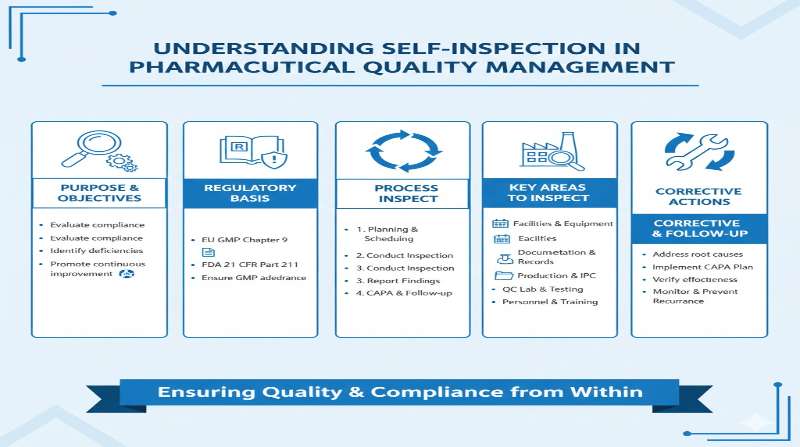
Regardless of regulatory jurisdiction, an effective self-inspection program should include:
- Clear Objectives and Scope
- Define what will be audited (all GMP areas: personnel, premises, equipment, documentation, production, quality control, distribution, complaints, recalls)
- Establish risk-based audit frequency (e.g., critical areas every 6 months, other areas annually)
- Specify audit criteria (relevant regulations, internal procedures, industry standards)
- Independence Mechanisms
- Establish organizational independence of auditors from audited areas
- Define reporting lines that preserve objectivity
- Consider external audits or corporate audits for QA department oversight
- Implement rotation of audit team members to maintain fresh perspectives
- Auditor Competence and Training
- Define qualification requirements (education, experience, training)
- Provide specialized training in GMP requirements, auditing techniques, and root cause analysis
- Maintain records of auditor qualifications and ongoing training
- Consider certifications such as ISO 19011 lead auditor training
- Systematic Audit Process
- Develop detailed audit plans and checklists
- Use evidence-based assessment methodologies
- Document findings with objective evidence and photographs where appropriate
- Classify findings by criticality (critical, major, minor) based on risk to product quality
- Robust CAPA Management
- Conduct thorough root cause analysis using appropriate tools (5 Whys, fishbone diagrams, fault tree analysis)
- Implement corrective actions to address immediate issues
- Implement preventive actions to prevent recurrence in similar situations
- Define clear timelines and responsibilities for CAPA completion
- Verify CAPA effectiveness through follow-up audits
- Management Review and Continuous Improvement
- Present aggregated audit findings to senior management
- Analyze trends across multiple audits to identify systemic issues
- Use audit program metrics to assess and improve program effectiveness
- Integrate self-inspection results into the Pharmaceutical Quality System (PQS) per ICH Q10
- Adjust audit program based on lessons learned and changing risks
Preparing for Regulatory Inspections
To ensure inspection readiness across different regulatory jurisdictions:
For FDA Inspections:
- Maintain evidence of a functioning quality assurance program
- Be prepared to demonstrate the audit program’s structure and implementation
- Ensure CAPA records are complete and accessible
- Keep quality control investigation records comprehensive and current
- Do not volunteer audit reports but maintain them for exceptional circumstances
For European Inspections:
- Maintain complete, professional self-inspection reports
- Ensure reports demonstrate thoroughness and objectivity
- Document robust CAPA with evidence of implementation and effectiveness
- Be prepared to discuss how identified issues were addressed before the inspection
- Maintain self-inspection reports according to documentation retention requirements
For Japanese Inspections:
- Comply with self-inspection requirements in applicable ministerial ordinances
- Prepare for evolving requirements regarding QA department reporting
- Align practices with PIC/S standards as Japan continues harmonization efforts
- Maintain comprehensive documentation of self-inspection activities and outcomes
Conclusion: The Strategic Value of Proactive Quality Management
Self-inspection, properly implemented as a rigorous internal audit function, represents far more than a regulatory compliance requirement. It embodies a commitment to proactive quality management and continuous improvement. While regulatory approaches differ—with the United States generally protecting audit report confidentiality to encourage candor, and Europe actively reviewing reports to verify proactive quality management—the fundamental goal remains consistent: ensuring that pharmaceutical manufacturers maintain robust quality systems that reliably produce safe, effective medicines.
The forthcoming changes in Japanese GMP regulations, requiring reporting of self-inspection results to QA departments, illustrate the ongoing evolution of regulatory thinking about how best to structure quality oversight. This development raises important questions about maintaining audit independence while ensuring appropriate organizational accountability.
Ultimately, the question posed by the original column—”Should the QA department itself not be subject to audit?”—highlights a critical principle: no area of a pharmaceutical organization should be exempt from independent, objective assessment. Whether through external audits, corporate auditing functions, or carefully structured cross-functional audit programs, organizations must ensure that all functions, including Quality Assurance itself, undergo periodic independent evaluation.
As regulatory requirements continue to evolve and converge globally through initiatives like PIC/S, ICH, and digital transformation efforts, pharmaceutical manufacturers should view self-inspection not as a compliance burden but as a strategic quality tool. Companies that embrace rigorous, independent self-inspection programs, implement effective CAPA, and continuously improve their quality systems will be best positioned to meet regulatory expectations, maintain product quality, and ultimately serve patient safety—regardless of which regulatory jurisdiction inspects their facilities.
The most successful approach is to adopt the highest standards from all regulatory frameworks: conduct self-inspections with the rigor of PIC/S requirements, maintain the transparency expected by European authorities, implement the robust CAPA systems valued by the FDA, and ensure the systematic oversight increasingly expected by Japanese regulators. This comprehensive approach transforms self-inspection from a regulatory obligation into a genuine driver of pharmaceutical quality excellence.
References and Additional Resources
Primary Regulatory Documents
- MHLW Ordinance No. 179 (2004, as amended 2021): Ministerial Order on Standards for Manufacturing Control and Quality Control for Pharmaceuticals and Quasi-Pharmaceuticals
- PIC/S GMP Guide (PE 009-17, 2025): Guide to Good Manufacturing Practice for Medicinal Products
- EU GMP Guide, Chapter 9: Self-Inspection
- FDA CPG Sec. 130.300: FDA Access to Results of Quality Assurance Program Audits and Inspections
International Standards
- ISO 19011:2018: Guidelines for auditing management systems
- ICH Q10: Pharmaceutical Quality System
- ICH Q9(R1): Quality Risk Management
Additional Reading
- PMDA GMP Annual Report (published annually)
- EMA Compilation of Union Procedures on Inspections and Exchange of Information (CoUP)
- PIC/S Guidance on Remote Inspections (December 2024)
- Draft revisions to EU GMP Chapter 1 (Pharmaceutical Quality System) and Chapter 4 (Documentation) – consultation period Q3-Q4 2025
This document represents an educational resource and should not be construed as legal or regulatory advice. Organizations should consult with qualified regulatory professionals regarding specific compliance requirements applicable to their operations.
Related Articles
- Is Senior Management Responsible for GMP Compliance?
- The Importance of Supplier Management (Revised Edition)
- The Future of Japan’s GDP (Good Distribution Practice)
- Revision of Japan’s GMP Ministerial Ordinance
- Quality Manuals in Pharmaceutical Manufacturing: A Comprehensive Guide
Related FDA QMSR Templates
Streamline your FDA QMSR compliance with our professionally crafted templates: